Review
. 2021 Jan;99(1):93-106.
doi: 10.1007/s00109-020-02012-8. Epub 2020 Dec 2.

The human coronaviruses (HCoVs) and the molecular mechanisms of SARS-CoV-2 infection

Affiliations
Review

The human coronaviruses (HCoVs) and the molecular mechanisms of SARS-CoV-2 infection

Luigi Santacroce et al. J Mol Med (Berl). 2021 Jan.

Abstract

In humans, coronaviruses can cause infections of the respiratory system, with damage of varying severity depending on the virus examined: ranging from mild-to-moderate upper respiratory tract diseases, such as the common cold, pneumonia, severe acute respiratory syndrome, kidney failure, and even death. Human coronaviruses known to date, common throughout the world, are seven. The most common-and least harmful-ones were discovered in the 1960s and cause a common cold. Others, more dangerous, identified in the early 2000s and cause more severe respiratory tract infections. Among these the SARS-CoV, isolated in 2003 and responsible for the severe acute respiratory syndrome (the so-called SARS), which appeared in China in November 2002, the coronavirus 2012 (2012-nCoV) cause of the Middle Eastern respiratory syndrome (MERS) from coronavirus, which exploded in June 2012 in Saudi Arabia, and actually SARS-CoV-2. On December 31, 2019, a new coronavirus strain was reported in Wuhan, China, identified as a new coronavirus beta strain ß-CoV from group 2B, with a genetic similarity of approximately 70% to SARS-CoV, the virus responsible of SARS. In the first half of February, the International Committee on Taxonomy of Viruses (ICTV), in charge of the designation and naming of the viruses (i.e., species, genus, family, etc.), thus definitively named the new coronavirus as SARS-CoV-2. This article highlights the main knowledge we have about the biomolecular and pathophysiologic mechanisms of SARS-CoV-2.

Keywords: Coronavirus; Human microbiota; Immunity; Molecular biology; Pandemics; Pathology; SARS-CoV-2.


Conflict of interest statement

The authors declare that they have no conflict of interest.

Figures
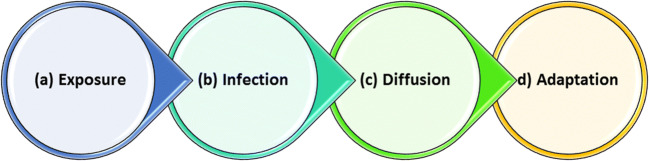
Fig. 1
Fig. 1
The emergence of a non-pre-adapted virus in a new host follows four consecutive phases: a Exposure (contact between the donor host and the recipient, which can be influenced by geographical, ecological, and behavioral factors). b Infection (the passage of the virus from the donor host to the recipient, which can be influenced by the ability of the virus to overcome the species barriers and by the compatibility with the new host: binding to the cell receptor, ability to complete the replication cycle, evasion the immune response, etc.). c Diffusion (transmission of the virus between subjects belonging to the new population, which can be influenced by the ability of the virus to complete its replication cycle in the new host and by the contact between the subjects that make up the new population). d Adaptation (evolution of the virus in the new host so as to remain in equilibrium within the population, which can be influenced by the genetic variability of the virus) [24]
Fig. 2
Fig. 2
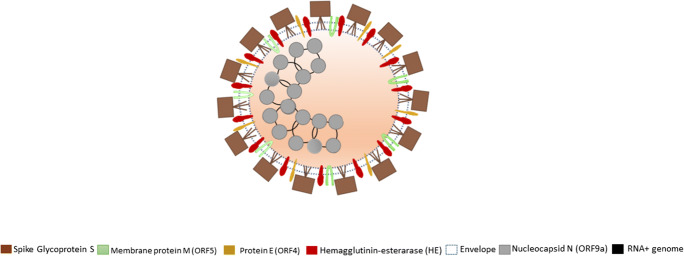
Coronavirus SARS-CoV-2 structure: glycoprotein S (spike) is cleaved into two glycosylated subunits, S1 (binds to the host’s receptor, ACE2) and S2 (aid viral and host membrane fusion). Membrane protein M aids to the assembly and budding of viral particles to ER-Golgi-intermediate compartment and interacts with ORF9a for RNA packaging into virion. Protein membrane E type III (single pass and forms a homopentameric ion channel, and is a viroporin) interacts with ORF5 and ORF9a, which aids in viral assembly, budding, and pathogenesis. Dimer hemagglutinin-esterase (HE) plays an important role during the release phase of the virus into the host cell. Genome consists of a single strand of large size positive sense RNA (26 to 32 kb in different viruses). Nucleocapsid N (ORF9a) plays its role in genome protection, viral RNA replication, virion assembly, and immune evasion (including IFN-I suppression). It binds to viral genomic RNA, forming a helical ribonucleocapsid and interacts with M and NSP3 proteins. Envelope is the coating of the virus, consisting of a membrane that the virus “inherits” from the host cell after infecting it
Fig. 3
Fig. 3
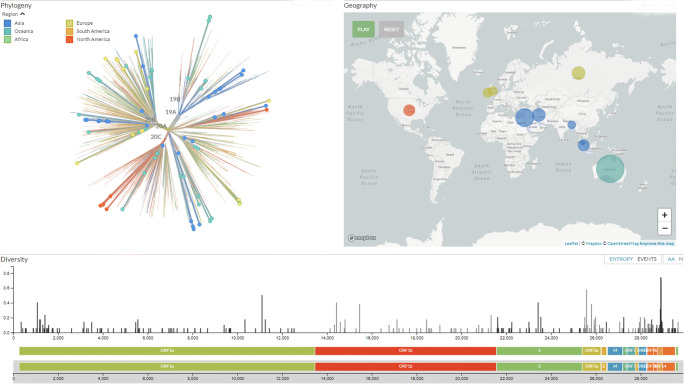
The genomic epidemiology of novel coronavirus (Global subsampling, 93 of 3587 genomes sampled between Mar 2020 and Oct 2020, source https://nextstrain.org/ncov/global?f_recency=1-2%20days%20ago&l=unrooted)
Fig. 4
Fig. 4
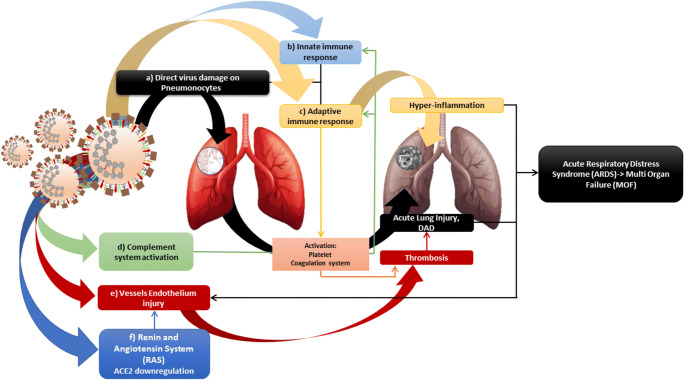
The virus causes direct and indirect effects that lead to severe lung damage. Direct actions: a induces damage directly to pneumonocytes I and II with cytopathic consequences through pro-inflammatory status (cytokines/chemokines), b recruitment activation of the innate immune response (macrophages/PMN, proinflammatory status (cytokines/chemokines tempest), c recruitment activation or the adaptive immune response (antiviral CD8, antiviral B cell, antibodies), d complement system (generation of C3a, C5a, membrane complex), e endothelial activation and injury leading to endothelial dysfunction and vascular leakage), and f RAS: downregulation of ACE2 which increases ACE/AT1 with pro-inflammatory, pro-oxidative effects, vasoconstriction, and pulmonary endothelial damage. Activation of the adaptive immune system causes lung tissue hyper-inflammation, activation of coagulation system (which in turn reactivates complement), activation of platelets (which in turn activates coagulation system), down regulation of inactivity and apoptosis. The activation of the coagulation system and the dysregulation of the ACE2 also lead to endothelial damage thus causing an increase in the possibility of formation of clots and microthrombi/thrombi (such as pulmonary embolism, deep vein thrombosis, large vessel stroke, arterial and venous thromboembolism); increase the risk of lung damage with edema, diffused alveolar destruction (DAD), severe hypoxemia; and can evolve into acute respiratory distress syndrome (ARDS) and afterwards multi organ failure (MOF)

References

    1. World Health Organization. Coronavirus. (2019) https://www.who.int/health-topics/coronavirus. Accessed 28 Oct 2020
    1. Santacroce L, Charitos IA, Del Prete R. COVID-19 in Italy: an overview from the first case to date. Electron J Gen Med. 2020;17(6):em235.
    1. Wang C, Horby PW, Hayden FG, Gao GF. A novel coronavirus outbreak of global health concern. Lancet. 2020;395(10223):470–473. - PMC - PubMed
    1. Morgello S. Coronaviruses and the central nervous system. J Neuro-Oncol. 2020;26(4):459–473. - PMC - PubMed
    1. Santacroce L, Bottalico L, Charitos IA (2020) The impact of COVID-19 on Italy: a lesson for the future. Int J Occup Environ Med. 10.34172/ijoem.2020.1984 - PMC - PubMed

Publication types

MeSH terms