


The Allele Frequency of EGFR Mutations Predicts Survival in Advanced EGFR T790M-Positive Non-small Cell Lung Cancer Patients Treated with Osimertinib
- PMID: 33270169
- PMCID: PMC7810636
- DOI: 10.1007/s11523-020-00781-3
The Allele Frequency of EGFR Mutations Predicts Survival in Advanced EGFR T790M-Positive Non-small Cell Lung Cancer Patients Treated with Osimertinib
Abstract
Background: The allele frequency of epidermal growth factor receptor (EGFR) mutations could be a potential molecular biomarker for the outcome of osimertinib therapy.
Objective: The purpose of our study was to assess the clinical relevance of the allele frequency of EGFR mutations in plasma-based circulating tumor DNA (ctDNA) before starting osimertinib therapy in patients with advanced EGFR-mutated non-small cell lung cancer (NSCLC) who had progressed under treatment with EGFR tyrosine kinase inhibitors (TKIs).
Patients and methods: We enrolled 141 patients with advanced EGFR T790M-positive NSCLC who underwent second-line osimertinib treatment. Plasma ctDNA was tested for EGFR-activating mutations (EGFR deletions in exon 19, L858R, L861Q, S768I) and T790M by means of droplet digital polymerase chain reaction (ddPCR).
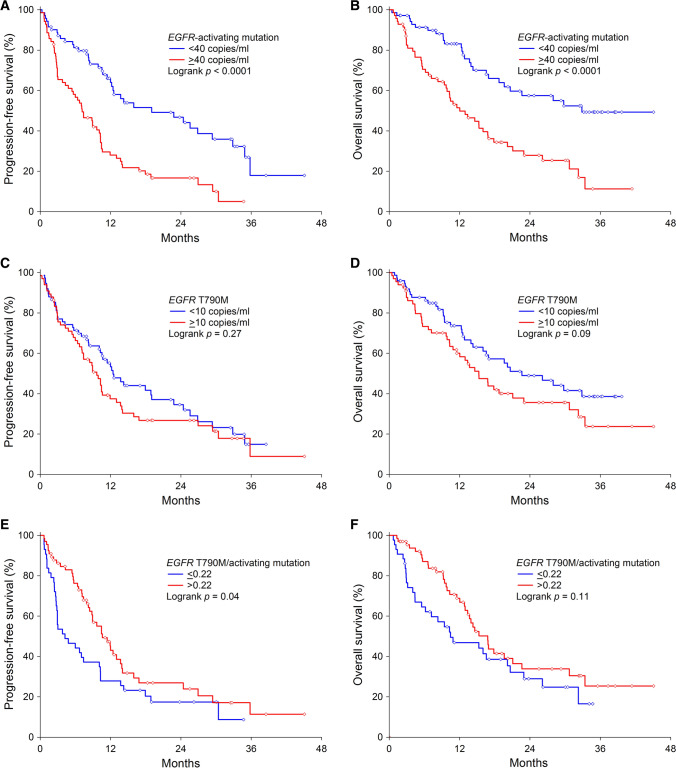
Results: The allele frequency of EGFR-activating mutations in plasma ctDNA before osimertinib initiation ranged from 0 to 81,543 copies/ml and was independently associated with progression-free survival (PFS) and overall survival (OS) after adjusting for known clinicopathological risk factors (PFS: adjusted hazard ratio [HR] 1.26, 95% confidence interval [CI] 1.15-1.39, P < 0.0001; OS: adjusted HR 1.32, 95% CI 1.18-1.47, P < 0.0001). The allele frequency of T790M in plasma ctDNA before starting osimertinib therapy ranged from 0 to 38,092 copies/ml. Multivariate analyses showed that a higher T790M allele frequency was associated with a trend towards a shorter PFS (adjusted HR 1.19, 95% CI 0.99-1.42, P = 0.05) and a significantly shorter OS (adjusted HR 1.25, 95% CI 1.02-1.53, P = 0.03) of the patients.
Conclusion: A higher allele frequency of EGFR mutations, particularly EGFR-activating mutations, in plasma ctDNA is a poor prognostic marker. Further studies on the clinical utility of liquid biopsy are needed.
Conflict of interest statement
Anna Buder has received honoraria from AstraZeneca. Maximilian J. Hochmair has received honoraria from AstraZeneca, Bristol-Myers Squibb, Boehringer Ingelheim, Merck Sharp & Dohme, Pfizer, and Roche and had consulting or advisory roles with Boehringer Ingelheim, Merck Sharp & Dohme, Novartis, and Roche. Martin Filipits has received honoraria for advisory boards from Astra Zeneca, Bayer, Biomedica, Biorad, Boehringer Ingelheim, Myriad Genetics Inc., Pfizer, and Roche.
Figures
References
-
- Planchard D, Popat S, Kerr K, Novello S, Smit EF, Faivre-Finn C et al. Metastatic non-small cell lung cancer: ESMO Clinical Practice Guidelines for diagnosis, treatment and follow-up. Ann Oncol 2018; 29: iv192–iv237. - PubMed
-
- Piotrowska Z, Niederst MJ, Karlovich CA, Wakelee HA, Neal JW, Mino-Kenudson M, et al. Heterogeneity underlies the emergence of EGFRT790 wild-type clones following treatment of T790M-positive cancers with a third-generation EGFR inhibitor. Cancer Discov. 2015;5:713–722. doi: 10.1158/2159-8290.CD-15-0399. - DOI - PMC - PubMed
Publication types
MeSH terms
Substances
LinkOut - more resources
Full Text Sources
Medical
Research Materials
Miscellaneous
