Review
. 2020 Dec 1;9(4):67.
doi: 10.3390/antib9040067.

The Role of Complement in Angiogenesis

Affiliations
Review

The Role of Complement in Angiogenesis

Maciej M Markiewski et al. Antibodies (Basel). .

Abstract

The link of the complement system to angiogenesis has remained circumstantial and speculative for several years. Perhaps the most clinically relevant example of possible involvement of complement in pathological neovascularization is age-related macular degeneration. Recent studies, however, provide more direct and experimental evidence that indeed the complement system regulates physiological and pathological angiogenesis in models of wound healing, retinal regeneration, age-related macular degeneration, and cancer. Interestingly, complement-dependent mechanisms involved in angiogenesis are very much context dependent, including anti- and proangiogenic functions. Here, we discuss these new developments that place complement among other important regulators of homeostatic and pathological angiogenesis, and we provide the perspective on how these newly discovered complement functions can be targeted for therapy.

Keywords: angiogenesis; cancer; complement; ocular pathology.


Conflict of interest statement

The authors declare no conflict of interest.

Figures
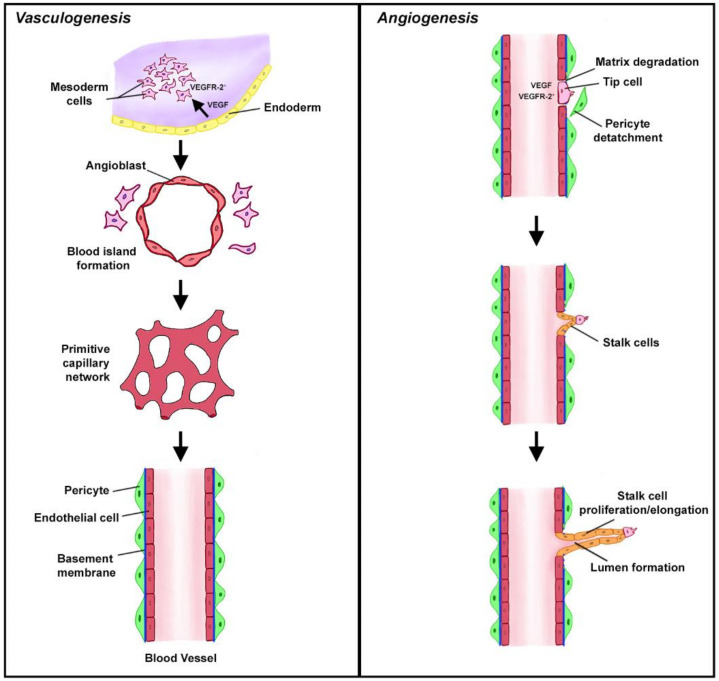
Figure 1
Figure 1
Vasculogenesis vs. angiogenesis. Vasculogenesis in embryos (left) is the de novo creation of new vasculature from primitive mesodermal cells that express VEGFR2. VEGF released from neighboring endodermal cells converts these VEGFR2+ cells into angioblasts surrounding the blood islands. These islands fuse to form the primitive vascular network that eventually converts into the arteriovenous system. In contrast, angiogenesis (right) is a formation of new vessels from the existing vasculature. The initial steps involve degradation of the extracellular matrix (ECM), detachment of pericytes, and tip formation. The non-proliferating tip endothelial cells move toward proangiogenic factors and are followed by dividing stalk cells. These drawings are based on the figures included in [12,14].
Figure 2
Figure 2
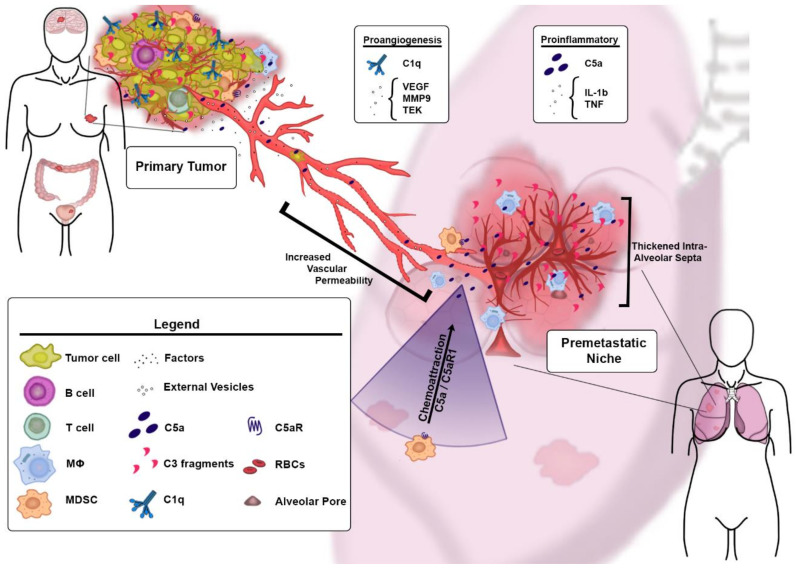
Overview of the role of complement in cancer-associated angiogenesis. C1q, C3 and C5aR1 were implicated in angiogenesis in primary tumors in cancer models and patients. In the premetastatic niches, angiogenesis seems to be regulated by MDSC activated and recruited to these niches through C5aR1-mediated signaling. MDSC secrete proangiogenic and proinflammatory factors contributing to this process.
Figure 3
Figure 3
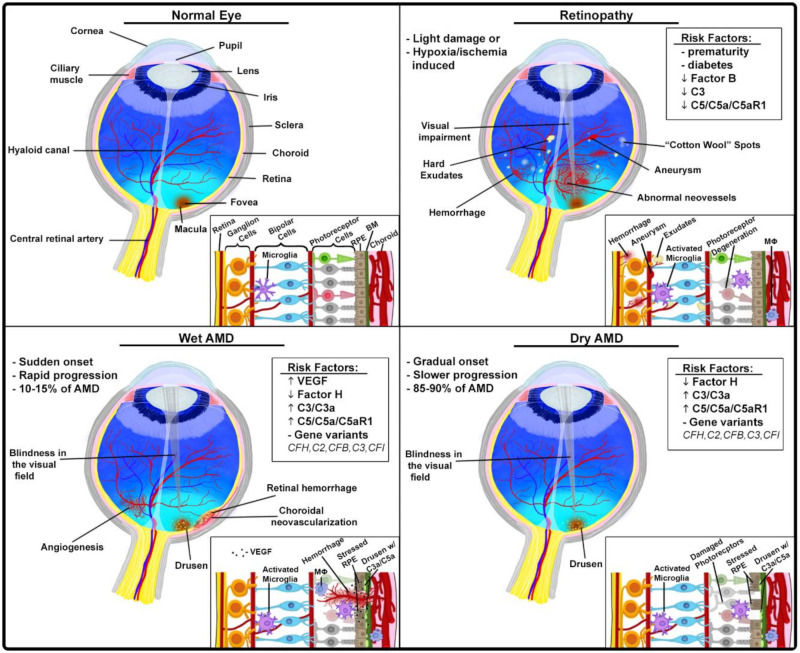
Ocular pathologies with complement involvement. Anatomy and histology of normal eye (upper left); proliferative retinopathies (upper right): the process of neovascularization leads to formation of blood vessels that are fragile and leaky, increased permeability or rupture of newly formed blood vessels and subsequent hemorrhage cause impairment or loss of vision, in mouse models of these retinopathies, complement seems to have a protective role; wet AMD (lower left) and dry AMD (lower right): in both forms, excessive complement activation and subsequent generation of complement effectors (C3a and C5a) has been implicated; frequently AMD is linked to FH polymorphism; in wet AMD, VEGF-driven neovascularization, possibly also regulated by complement, leads to severe impairment or loss of vision.

References

    1. Ricklin D., Reis E.S., Lambris J.D. Complement in disease: A defence system turning offensive. Nat. Rev. Nephrol. 2016;12:383–401. doi: 10.1038/nrneph.2016.70. - DOI - PMC - PubMed
    1. Ricklin D., Lambris J.D. Complement in Immune and Inflammatory Disorders: Pathophysiological Mechanisms. J. Immunol. 2013;190:3831–3838. doi: 10.4049/jimmunol.1203487. - DOI - PMC - PubMed
    1. Markiewski M.M., Lambris J.D. The Role of Complement in Inflammatory Diseases From Behind the Scenes into the Spotlight. Am. J. Pathol. 2007;171:715–727. doi: 10.2353/ajpath.2007.070166. - DOI - PMC - PubMed
    1. Walport M.J. Complement. First of two parts. N. Engl. J. Med. 2001;344:1058–1066. doi: 10.1056/NEJM200104053441406. - DOI - PubMed
    1. Kolev M., Markiewski M.M. Targeting complement-mediated immunoregulation for cancer immunotherapy. Semin. Immunol. 2018;37:85–97. doi: 10.1016/j.smim.2018.02.003. - DOI - PMC - PubMed

LinkOut - more resources