Review
. 2020 Dec 4;5(1):280.
doi: 10.1038/s41392-020-00349-7.

Methionine metabolism in chronic liver diseases: an update on molecular mechanism and therapeutic implication

Affiliations
Review

Methionine metabolism in chronic liver diseases: an update on molecular mechanism and therapeutic implication

Zhanghao Li et al. Signal Transduct Target Ther. .

Abstract

As one of the bicyclic metabolic pathways of one-carbon metabolism, methionine metabolism is the pivot linking the folate cycle to the transsulfuration pathway. In addition to being a precursor for glutathione synthesis, and the principal methyl donor for nucleic acid, phospholipid, histone, biogenic amine, and protein methylation, methionine metabolites can participate in polyamine synthesis. Methionine metabolism disorder can aggravate the damage in the pathological state of a disease. In the occurrence and development of chronic liver diseases (CLDs), changes in various components involved in methionine metabolism can affect the pathological state through various mechanisms. A methionine-deficient diet is commonly used for building CLD models. The conversion of key enzymes of methionine metabolism methionine adenosyltransferase (MAT) 1 A and MAT2A/MAT2B is closely related to fibrosis and hepatocellular carcinoma. In vivo and in vitro experiments have shown that by intervening related enzymes or downstream metabolites to interfere with methionine metabolism, the liver injuries could be reduced. Recently, methionine supplementation has gradually attracted the attention of many clinical researchers. Most researchers agree that adequate methionine supplementation can help reduce liver damage. Retrospective analysis of recently conducted relevant studies is of profound significance. This paper reviews the latest achievements related to methionine metabolism and CLD, from molecular mechanisms to clinical research, and provides some insights into the future direction of basic and clinical research.


Conflict of interest statement

The authors declare no competing interests.

Figures
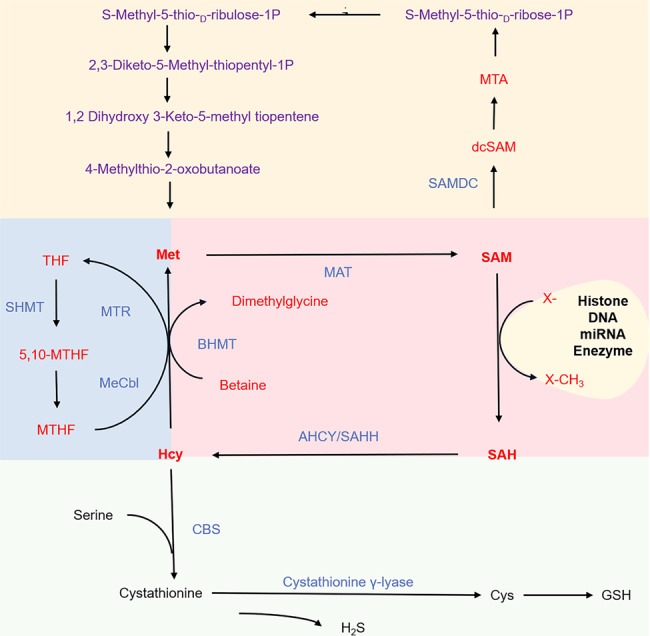
Fig. 1
Fig. 1
Response of methionine metabolism in the liver. There are four main participants in this pathway, namely methionine, S-adenosylmethionine (SAM), S-adenosyl homocysteine (SAH), and homocysteine (Hcy). Methionine adenosyltransferase (MAT) converts methionine to SAM and then uses a methyl donor catalyzed methyl donor. Another product of these reactions is SAH, which is reduced by S-adenosine homocysteine protease (AHCY/SAHH) to adenosine and Hcy. Methionine metabolism involves the folate cycle, the transsulfuration pathway, and the salvage pathway. AHCY adenosylhomocysteinase, BHMT betaine homocysteine methyltransferase; GSH glutathione; Hcy homocysteine, SAM S-adenosylmethionine, SAH S-adenosyl homocysteine, Met methionine, MTs methyltransferase, CBS cystathionine-β-synthase, Cbl cobalamin, vitamin B12, MeCbl methylcobalamin, MTA 5′‐methylthioadenosine, dcSAM decarboxylated SAM, MTHFR methylenetetrahydrofolate reductase, SHMT serine hydroxymethyltransferase
Fig. 2
Fig. 2
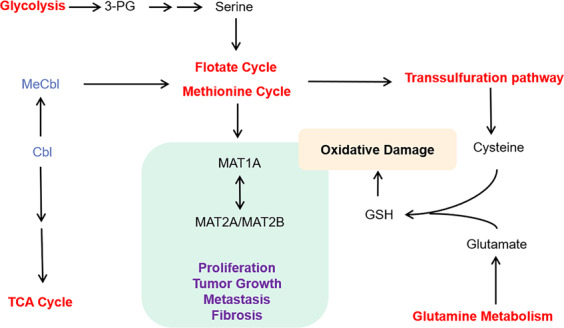
Cross talk between methionine metabolism and the other metabolism. Glycolysis produces ATP and 3-phosphoglycerate (3-PG), which are used in serine synthesis and folate cycle. ATP can be used to transform methionine into SAM. Cobalamin (Cbl) is closely related to TCA, while the methylcobalamin (MeCbl) is related to the folate cycle and methionine cycle. Glutamic acid produced by glutamine metabolism can be used in the synthesis of GSH. 3-PG 3-phosphoglycerate, Cbl cobalamin, vitamin B12, MeCbl methylcobalamin, TCA cycle tricarboxylic acid cycle
Fig. 3
Fig. 3
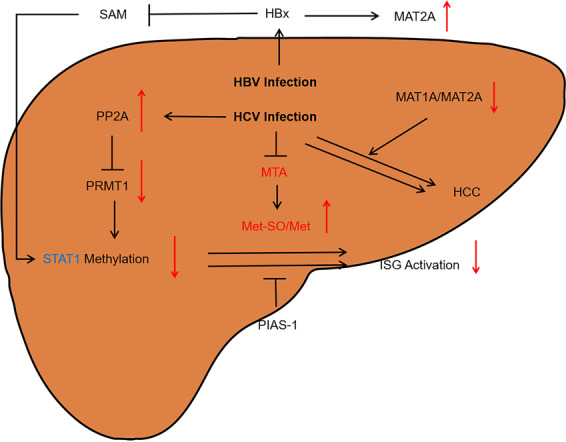
The metabolism of methionine in viral infections of hepatitis B and C. The hepatic polyamine synthesis and transsulfuration pathway activities are impaired in virus infection. Methylthioadenosine (MTA) is a sulfur-containing adenine nucleoside produced from SAM during the synthesis of polyamines, including spermine and spermidine. The level of MTA significantly decreases during the late stage of HCV infection in cells. Moreover, Met is particularly susceptible to elevated ROS levels. Upon reacting to ROS, protein-bound Met is readily oxidized to form methionine sulfoxide (Met-SO). The increased Met-SO level and Met-SO/Met ratio indicate increased oxidative stress subsequent to decrease liver function. Furthermore, the STAT-1 genes showed significant difference between HBV and HCV. Met methionine, Met-SO methionine sulfoxide, HBx the X protein of HBV, ISG interferon-stimulated gene, PP2A protein phosphatase 2A, PRMT1 protein arginine methyltransferase 1, PIAS protein inhibitor of activated STATs

References

    1. Lemoinne S, Friedman SL. New and emerging anti-fibrotic therapeutics entering or already in clinical trials in chronic liver diseases. Curr. Opin. Pharm. 2019;49:60–70. doi: 10.1016/j.coph.2019.09.006. - DOI - PubMed
    1. Salarian M, et al. Early detection and staging of chronic liver diseases with a protein MRI contrast agent. Nat. Commun. 2019;10:4777. doi: 10.1038/s41467-019-11984-2. - DOI - PMC - PubMed
    1. Younossi ZM, Marchesini G, Pinto-Cortez H, Petta S. Epidemiology of nonalcoholic fatty liver disease and nonalcoholic steatohepatitis: implications for liver transplantation. Transplantation. 2019;103:22–27. doi: 10.1097/TP.0000000000002484. - DOI - PubMed
    1. Patten DA, Shetty S. Chronic liver disease: scavenger hunt for novel therapies. Lancet. 2018;391:104–105. doi: 10.1016/S0140-6736(17)32671-5. - DOI - PubMed
    1. Vanni E, et al. Sites and mechanisms of insulin resistance in nonobese, nondiabetic patients with chronic hepatitis C. Hepatology. 2009;50:697–706. doi: 10.1002/hep.23031. - DOI - PubMed

Publication types