. 2020 Dec 3;10(1):21017.
doi: 10.1038/s41598-020-77646-2.

Social cues can impact complex behavior unconsciously

Affiliations

Social cues can impact complex behavior unconsciously

Christoph Schütz et al. Sci Rep. .

Abstract

In three experiments, we investigated the effect of unconscious social priming on human behavior in a choice reaction time task. Photographs of a basketball player passing a ball to the left/right were used as target stimuli. Participants had to respond to the pass direction either by a whole-body (complex) response or a button-press (simple) response. Visually masked stimuli, showing both a task-relevant cue (pass direction) and a task-irrelevant, social cue (gaze direction), were used as primes. Subliminal social priming was found for kinematic (center of pressure) and chronometric measures (response times): gaze direction in the primes affected responses to the pass direction in the targets. The social priming effect diminished when gaze information was unhelpful or even detrimental to the task. Social priming of a complex behavior does not require awareness or intentionality, indicating automatic processing. Nevertheless, it can be controlled by top-down, strategic processes.


Conflict of interest statement

The authors declare no competing interests.

Figures
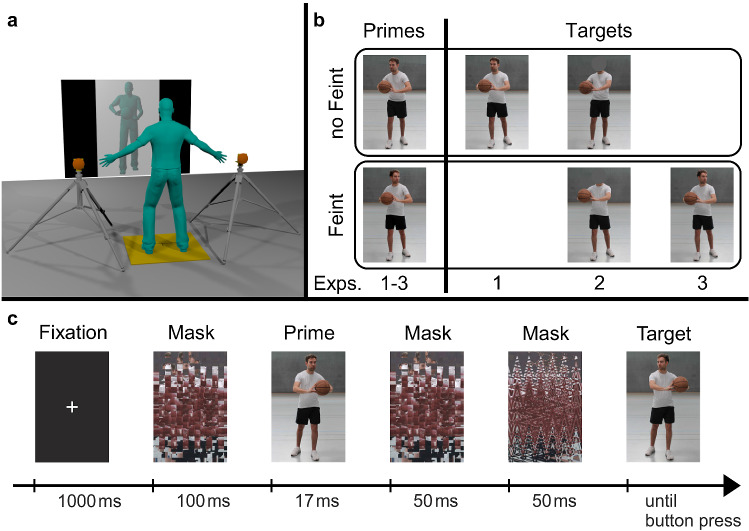
Figure 1
Figure 1
Setup, stimulus examples and procedure of the study. Panel (a) shows the setup. Participants were positioned on a force plate facing the projection screen. Response buttons were positioned left and right of the participants in their horizontal plane. Panel (b) shows prime-target combinations for all experiments (for a response to the left). Mirrored stimuli were used for a response to the right. In all experiments, half of the trials required a left, the other half a right response. ’No feint’ (top row) /’feint’ (bottom row) indicates whether the stimulus displayed a head fake or not. As primes, feint and no-feint stimuli were used in all experiments (first column). As targets, only no-feint (second column), neutral (third column), or feint (fourth column) stimuli were used for the respective experiments. Panel (c) gives the temporal sequence of the stimulus presentation in a single trial (here: for a response to the right). Notes. Stimulus pictures for the figure were recreated. Informed consent for publication of identifying images was given. The original stimulus pictures used in the experiment are available on request.
Figure 2
Figure 2
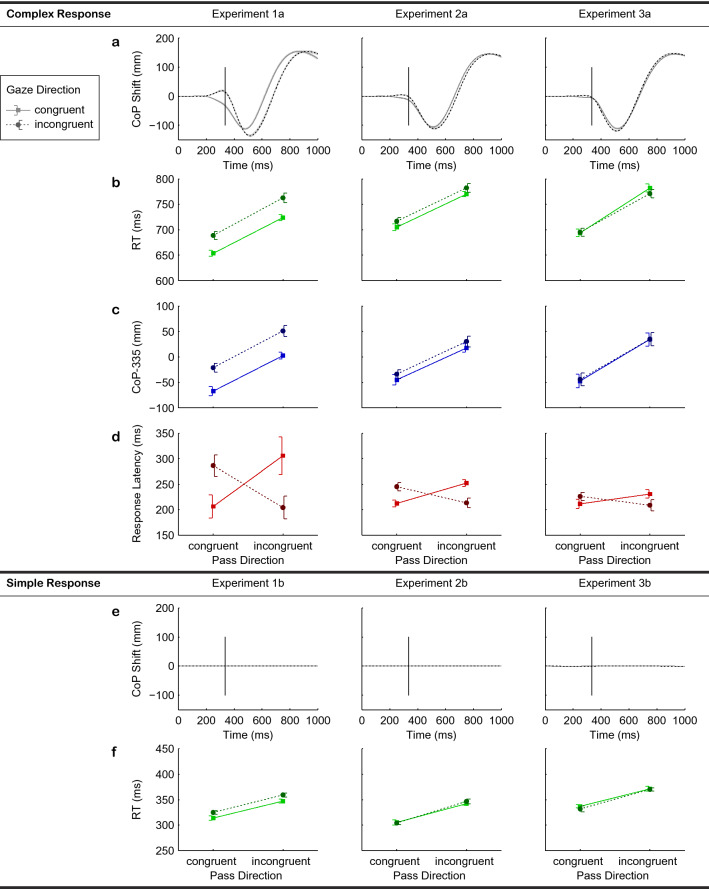
Results of the chronometric and kinematic analyses. All plots depict congruent (solid lines) vs. incongruent gaze direction (dashed lines). Panels (a,e) show lateral movements [shifts of the center of pressure (CoP shifts)], plotted against time. At 0 ms, the prime picture was presented. CoP shifts were rectified; positive values indicate shifts towards the correct response side. For simple responses (e), no spatial displacements were detected (yielding flat lines). Panels (b,f) show response times (RTs) for whole-body movements (complex response, b) and button-press responses (simple response, f), plotted against pass congruency. Panel (c) depicts the CoP shift 335 ms after prime onset (comparable across exps., see text). Panel (d) shows the response latencies (first CoP deviation from rest). Error bars represent 95 % (within subject) confidence intervals.

References

    1. Freud, S. Das Unbewußte (Fischer, 1915/1946).
    1. Leibniz GW. New Essays on Human Understanding. Cambridge: Cambridge University Press; 1981.
    1. Stein G. Cultivated motor automatism; a study of character in its relation to attention. Psychol. Rev. 1898;5:295–306. doi: 10.1037/h0073997. - DOI
    1. Cesario J. Priming, replication, and the hardest science. Perspect. Psychol. Sci. 2014;9:40–48. doi: 10.1177/1745691613513470. - DOI - PubMed
    1. Molden DC. Understanding priming effects in social psychology: what is “social priming” and how does it occur? Soc. Cogn. 2014;32:1–11. doi: 10.1521/soco.2014.32.supp.1. - DOI

Publication types