


The development and implementation of an oxygen treatment solution for health facilities in low and middle-income countries
- PMID: 33274064
- PMCID: PMC7698571
- DOI: 10.7189/jogh.10.020425
The development and implementation of an oxygen treatment solution for health facilities in low and middle-income countries
Abstract
Background: Oxygen reduces mortality from severe pneumonia and is a vital part of case management, but achieving reliable access to oxygen is challenging in low and middle-income country (LMIC) settings. We developed and field tested two oxygen supply solutions suitable for the realities of LMIC health facilities.
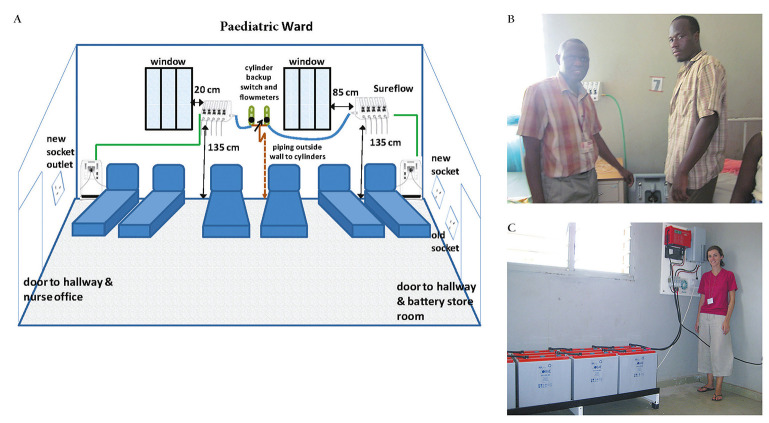
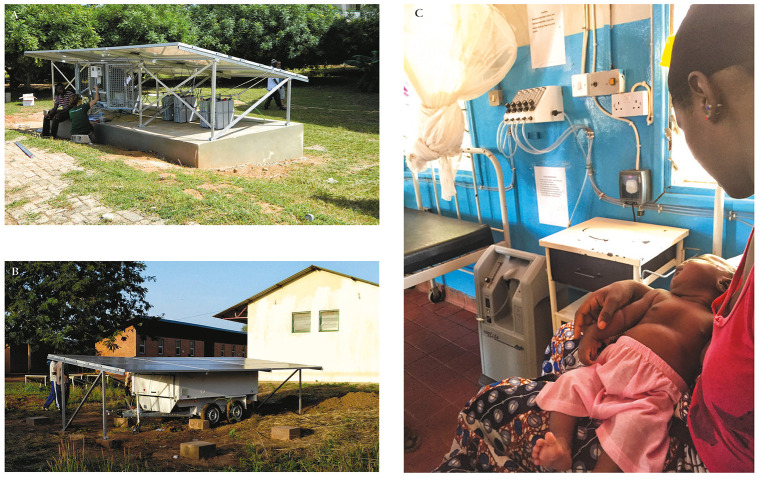
Methods: A Health Needs Assessment identified a technology gap preventing reliable oxygen supplies in Gambian hospitals. We used simultaneous engineering to develop two solutions: a Mains-Power Storage (Mains-PS) system consisting of an oxygen concentrator and batteries connected to mains power, and a Solar-Power Storage (Solar-PS) system (with batteries charged by photovoltaic panels) and evaluated them in health facilities in The Gambia and Fiji to assess reliability, usability and costs.
Results: The Mains-PS system delivered the specified ≥85% (±3%) oxygen concentration in 100% of 1-2 weekly measurements over 12 months, which was available to 100% of hypoxaemic patients, and 100% of users rated ease-of-use as at least 'good' (90% very good or excellent). The Solar-PS system delivered ≥85% ± 3%) oxygen concentration in 100% of 1-2 weekly measurements, was available to 100% of patients needing oxygen, and 100% of users rated ease-of-use at least very good.Costs for the systems (in US dollars) were: PS$9519, Solar-PS standard version $20 718. The of oxygen for a standardised 30-bed health facility using 1.7 million litres of oxygen per year was: for cylinders 3.2 cents (c)/L in The Gambia and 6.8 c/L in Fiji, for the PS system 1.2 c/L in both countries, and for the Solar-PS system 1.5 c/L in both countries.
Conclusions: The oxygen systems developed and tested delivered high-quality, reliable, cost-efficient oxygen in LMIC contexts, and were easy to operate. Reliable oxygen supplies are achievable in LMIC health facilities like those in The Gambia and Fiji.
Copyright © 2020 by the Journal of Global Health. All rights reserved.
Conflict of interest statement
Conflicts of interest: Stephen Howie and Eric Rafai have received funding from the Medical Research Council and CureKids New Zealand. The authors completed the ICMJE Unified Competing Interest form (available upon request from the corresponding author), and declare no further conflicts of interest.
Figures
References
-
- UNICEF. Under-five mortality. Available: https://data.unicef.org/resources/dataset/under-five-mortality-data/. Accessed: 10 September 2018.
-
- World Health Organization. Management of the child with serious infection or severe malnutrition. Guidelines for care at the first-referral level in developing countries. Geneva: WHO/FCH/CAH; 2000.
-
- United Nations. United Nations Sustainable Development Goals. 2016. Available: https://sdgs.un.org/goals. Accessed: 3 September 2020.
-
- Enarson PM, Enarson DA, Gie R.Management of pneumonia in the child 2 to 59 months of age. Int J Tuberc Lung Dis. 2005;9:959-63. - PubMed
Publication types
MeSH terms
Substances
LinkOut - more resources
Full Text Sources
Medical
Miscellaneous