. 2020 Dec;9(12):848-856.
doi: 10.1302/2046-3758.912.BJR-2020-0157.R1.

A novel antimicrobial coating to prevent periprosthetic joint infection

Affiliations

A novel antimicrobial coating to prevent periprosthetic joint infection

Rita Ramalhete et al. Bone Joint Res. 2020 Dec.

Abstract

Aims: Periprosthetic joint infection (PJI) is a debilitating condition with a substantial socioeconomic burden. A novel autologous blood glue (ABG) has been developed, which can be prepared during surgery and sprayed onto prostheses at the time of implantation. The ABG can potentially provide an antimicrobial coating which will be effective in preventing PJI, not only by providing a physical barrier but also by eluting a well-known antibiotic. Hence, this study aimed to assess the antimicrobial effectiveness of ABG when impregnated with gentamicin and stem cells.

Methods: Gentamicin elution from the ABG matrix was analyzed and quantified in a time-dependent manner. The combined efficiency of gentamicin and ABG as an anti-biofilm coating was investigated on titanium disks.

Results: ABG-gentamicin was bactericidal from 10 μg/ml and could release bactericidal concentrations over seven days, preventing biofilm formation. A concentration of 75 μg/ml of gentamicin in ABG showed the highest bactericidal effect up to day 7. On titanium disks, a significant bacterial reduction on ABG-gentamicin coated disks was observed when compared to both uncoated (mean 2-log reduction) and ABG-coated (mean 3-log reduction) disks, at days 3 and 7. ABG alone exhibited no antimicrobial or anti-biofilm properties. However, a concentration of 75 μg/ml gentamicin in ABG sustains release over seven days and significantly reduced biofilm formation. Its use as an implant coating in patients with a high risk of infection may prevent bacterial adhesion perioperatively and in the early postoperative period.

Conclusion: ABG's use as a carrier for stem cells was effective, as it supported cell growth. It has the potential to co-deliver compatible cells, drugs, and growth factors. However, ABG-gentamicin's potential needs to be further justified using in vivo studies. Cite this article: Bone Joint Res 2020;9(12):848-856.

Keywords: Implant; Periprosthetic joint infection; Stem cell.


Figures
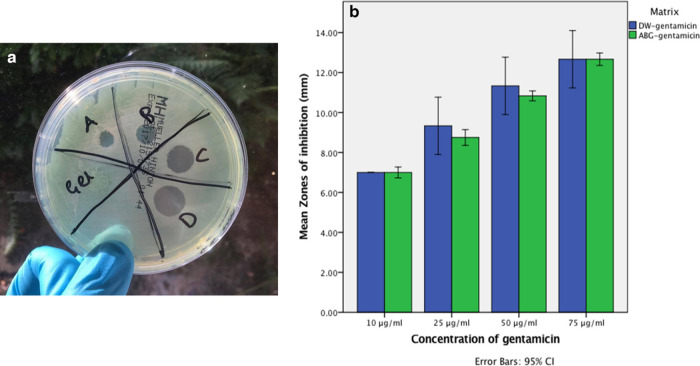
Fig. 1
Fig. 1
Modified disk susceptibility test to determine the gentamicin released from autologous blood glue (ABG). a) Zone of inhibition represented by the different concentrations of antimicrobial activity in the ABG matrix (A: 10 μg/ml, B: 25 μg/ml, C: 50 μg/ml, D: 75 μg/ml). b) Gentamicin release in Mueller-Hinton agar from controls and autologous blood glue (ABG), in concentrations of 10, 25, 50, and 75 μg/ml. CI, confidence interval; DW, deionized water.
Fig. 2
Fig. 2
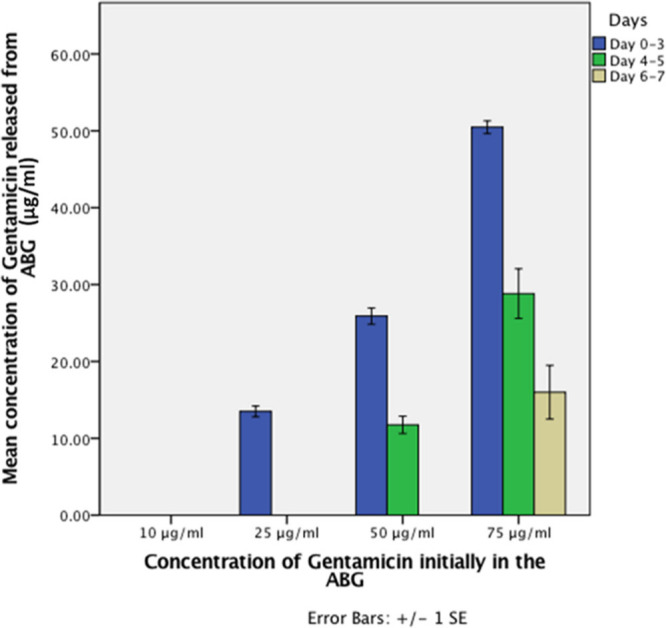
Release kinetics of autologous blood glue (ABG)-gentamicin using a disk diffusion method. The mean concentration of gentamicin within fetal calf serum (FCS), which had been extracted from wells of ABG-gentamicin on days 3, 5, and 7. A concentration of 75 μg/ml of ABG-gentamicin continuously released gentamicin into FCS up to seven days after ABG formation. There was a significant difference between all of the concentrations of gentamicin released from the ABG after three and five days (p < 0.05, Mann-Whitney U test), except between 10 μg/ml and 25 μg/ml at five days. However, after seven days, only the 75 μg/ml concentration showed any effective release of gentamicin. SE, standard error.
Fig. 3
Fig. 3
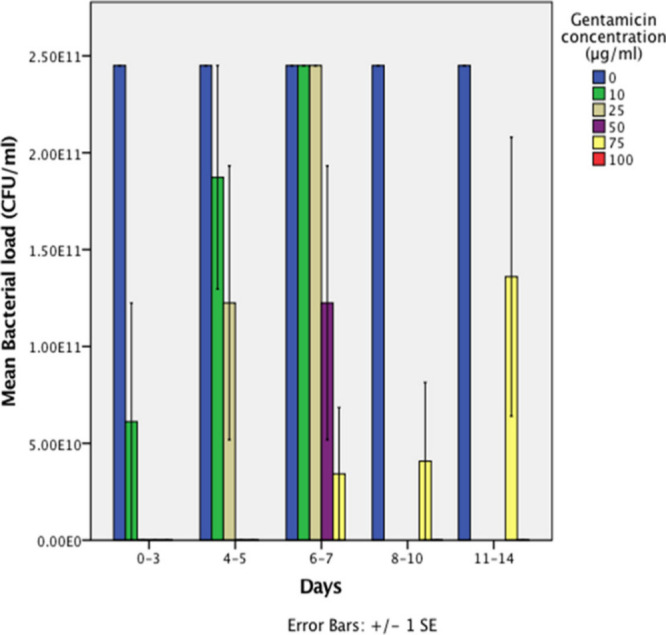
Release kinetics of autologous blood glue (ABG)-gentamicin using a reinfection model. The mean CFUs/ml were calculated after inoculating samples of fetal calf serum (FCS) extracted from wells containing increasing concentrations of ABG-gentamicin, with a 0.5 McFarland suspension of Pseudomonas aeruginosa at different time points. A bar corresponding to ABG-gentamicin concentration of 100 μg/ml for day 14 cannot be observed because the mean value is inferior to 5 x 10¹⁰ CFUs/ml and 100 μg/ml was effective at all timepoints while 75 μg/ml was only effective up to five days. Experiments for the reinfection method were only carried out with 75 μg/ml and 100 μg/ml from days 10 to 14 because these concentrations were deemed to be the most effective. SE, standard error.
Fig. 4
Fig. 4
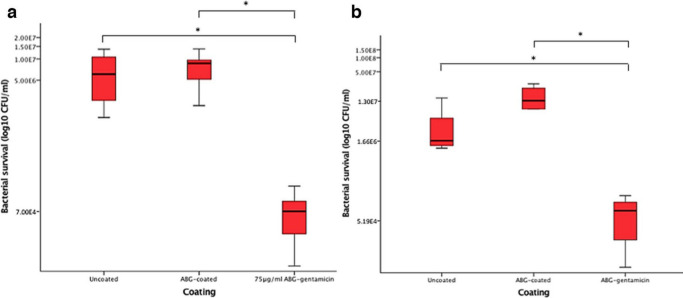
a) Bacterial recovery after biofilm formation following three days of bacterial inoculation on uncoated, autologous blood glue (ABG)-coated, and 75 μg/ml ABG-gentamicin coated disks. There was statistical significance between ABG-coated and 75 μg/ml (p < 0.001, all Mann-Whitney U test) and uncoated and 75 μg/ml (p = 0.006). b) Bacterial recovery after biofilm formation following seven days of bacterial inoculation on uncoated, ABG-coated, and 75 μg/ml ABG-gentamicin-coated disks. There was statistical significance between uncoated versus 75 μg/ml (p = 0.029) and ABG-coated versus 75 μg/ml (p = 0.016).
Fig. 5
Fig. 5
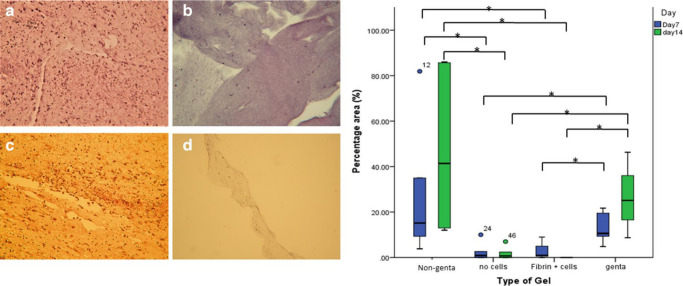
Histology images of the gels after day 14 stained with haematoxylin and eosin (H&E) (×5 magnification). Gels embedded: a) with bone marrow (BM) cells; b) without BM cells; c) with BM cells and gentamicin; and d) with gentamicin but without BM cells. The box plot demonstrates the percentage area occupied by the cells in the gel after seven and 14 days in culture. *p < 0.05, Mann-Whitney U test.
Fig. 6
Fig. 6
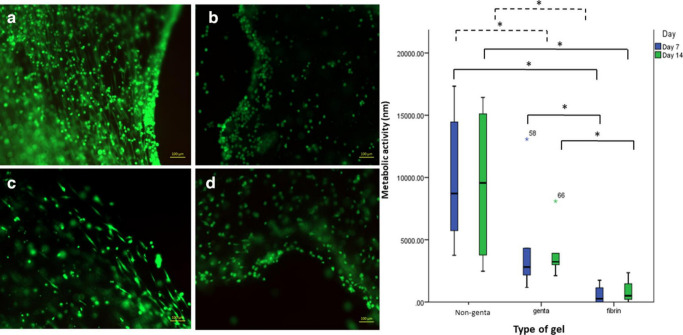
Live/dead (calcein Am and ethidium homodimer staining) images of the gels after day 14, at ×5 magnification. Gels embedded: a) with bone marrow (BM) cells; b) without BM cells; c) with BM cells and gentamicin; and d) with gentamicin but without BM cells. The box-plot demonstrates the metabolic activity of the cells in the gentamicin and non-gentamicin autologous blood glue (ABG) gels and fibrin glue after seven and 14 days in culture. There was a significant difference between all ABG gels with fibrin glue. *p < 0.05, Mann-Whitney U test.

References

    1. Cyteval C, Bourdon A. Imaging orthopedic implant infections. Diagn Interv Imaging. 2012;93(6):547–557. - PubMed
    1. Arciola CR, Campoccia D, Ehrlich GD, Montanaro L. Biofilm-Based Implant Infections in Orthopaedics In: Donelli G, ed. Biofilm-based Healthcare-associated Infections. Vol. 1. Cham: Springer International Publishing Switzerland, 2015:29–46. - PubMed
    1. Tande AJ, Patel R. Prosthetic joint infection. Clin Microbiol Rev. 2014;27(2):302–345. - PMC - PubMed
    1. Ahmed SS, Haddad FS. Prosthetic joint infection. Bone Joint Res. 2019;8(11):570–572. - PMC - PubMed
    1. Hsieh P-H, Lee MS, Hsu K-Y, et al. Gram-negative prosthetic joint infections: risk factors and outcome of treatment. Clin Infect Dis. 2009;49(7):1036–1043. - PubMed