. 2021 May;74(5):1087-1096.
doi: 10.1016/j.jhep.2020.11.038. Epub 2020 Dec 1.

Fetal cardiac dysfunction in intrahepatic cholestasis of pregnancy is associated with elevated serum bile acid concentrations

Affiliations

Fetal cardiac dysfunction in intrahepatic cholestasis of pregnancy is associated with elevated serum bile acid concentrations

Tharni Vasavan et al. J Hepatol. 2021 May.

Abstract

Background & aims: Intrahepatic cholestasis of pregnancy (ICP) is associated with an increased risk of stillbirth. This study aimed to assess the relationship between bile acid concentrations and fetal cardiac dysfunction in patients with ICP who were or were not treated with ursodeoxycholic acid (UDCA).

Methods: Bile acid profiles and NT-proBNP, a marker of ventricular dysfunction, were assayed in umbilical venous serum from 15 controls and 76 ICP cases (36 untreated, 40 UDCA-treated). Fetal electrocardiogram traces were obtained from 43 controls and 48 ICP cases (26 untreated, 22 UDCA-treated). PR interval length and heart rate variability (HRV) parameters were measured in 2 behavioral states (quiet and active sleep).

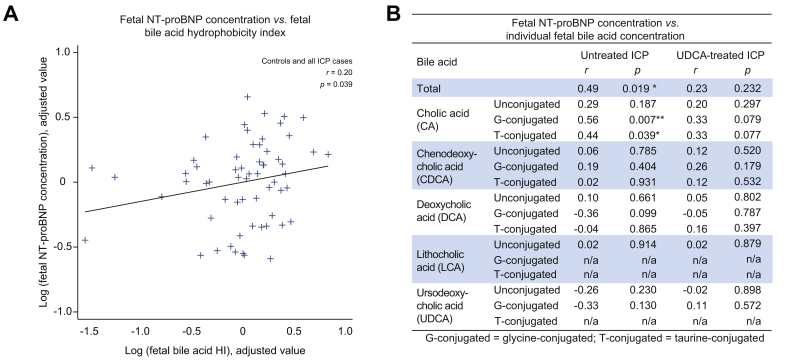
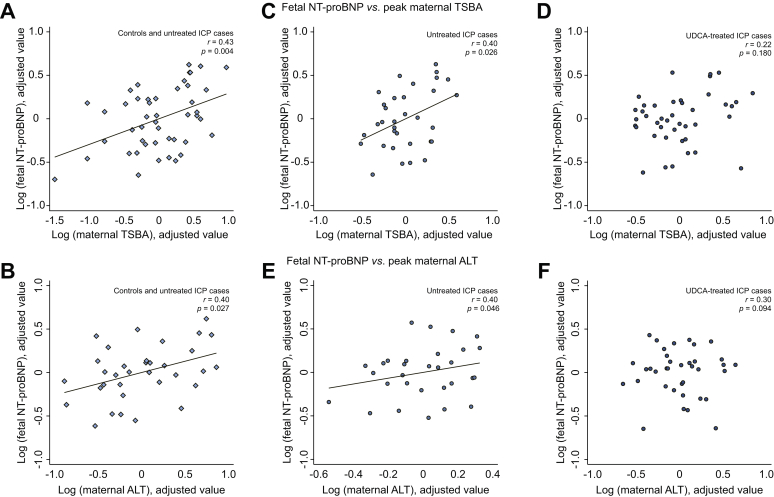
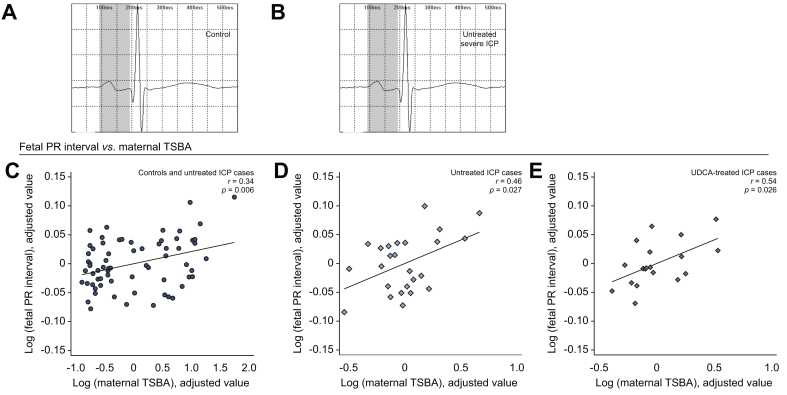
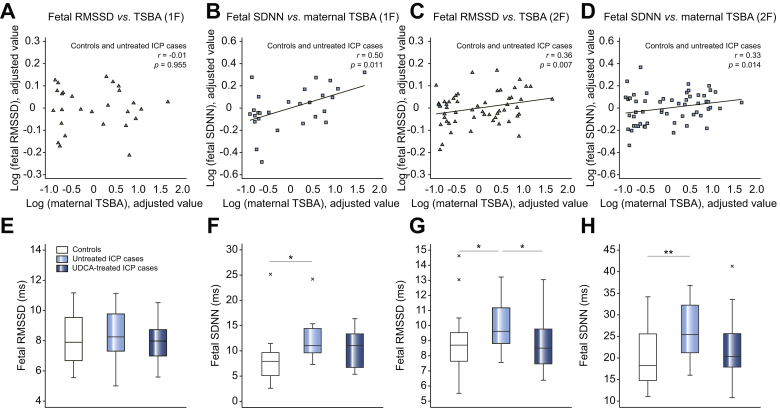
Results: In untreated ICP, fetal total serum bile acid (TSBA) concentrations (r = 0.49, p = 0.019), hydrophobicity index (r = 0.20, p = 0.039), glycocholate concentrations (r = 0.56, p = 0.007) and taurocholate concentrations (r = 0.44, p = 0.039) positively correlated with fetal NT-proBNP. Maternal TSBA (r = 0.40, p = 0.026) and alanine aminotransferase (r = 0.40, p = 0.046) also positively correlated with fetal NT-proBNP. There were no significant correlations between maternal or fetal serum bile acid concentrations and fetal HRV parameters or NT-proBNP concentrations in the UDCA-treated cohort. Fetal PR interval length positively correlated with maternal TSBA in untreated (r = 0.46, p = 0.027) and UDCA-treated ICP (r = 0.54, p = 0.026). Measures of HRV in active sleep and quiet sleep were significantly higher in untreated ICP cases than controls. HRV values in UDCA-treated cases did not differ from controls.

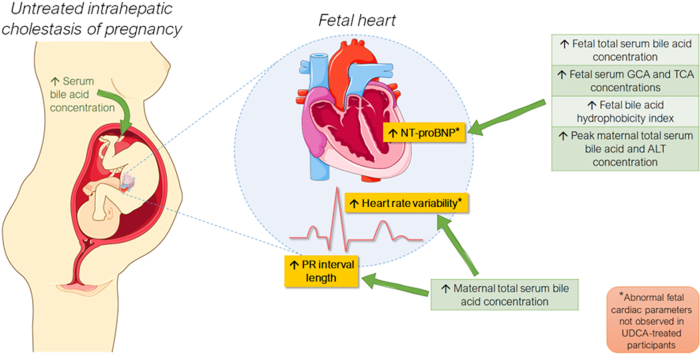
Conclusions: Elevated fetal and maternal serum bile acid concentrations in untreated ICP are associated with an abnormal fetal cardiac phenotype characterized by increased NT-proBNP concentration, PR interval length and HRV. UDCA treatment partially attenuates this phenotype.

Lay summary: The risk of stillbirth in intrahepatic cholestasis of pregnancy (ICP) is linked to the level of bile acids in the mother which are thought to disrupt the baby's heart rhythm. We found that babies of women with untreated ICP have abnormally functioning hearts compared to those without ICP, and the degree of abnormality is closely linked to the level of harmful bile acids in the mother and baby's blood. Babies of women with ICP who received treatment with the drug UDCA do not have the same level of abnormality in their hearts, suggesting that UDCA could be a beneficial treatment in some ICP cases, although further clinical trials are needed to confirm this.

Keywords: Bile; Cholic acid; Female; Heart rate; Intrahepatic cholestasis of pregnancy; Pregnancy; Stillbirth; Ursodeoxycholic acid; Ventricular dysfunction.


Conflict of interest statement

Conflict of interest BHG has previously served as a director for Monica Healthcare Limited and has no commercial or financial connections in the company. CW and HUM are consultants with Mirum Pharmaceuticals and CW is a consultant for GlaxoSmithKline. The remaining authors have no conflicts of interest to disclose. Please refer to the accompanying ICMJE disclosure forms for further details.

Figures
None
Graphical abstract
Fig. 1
Fig. 1
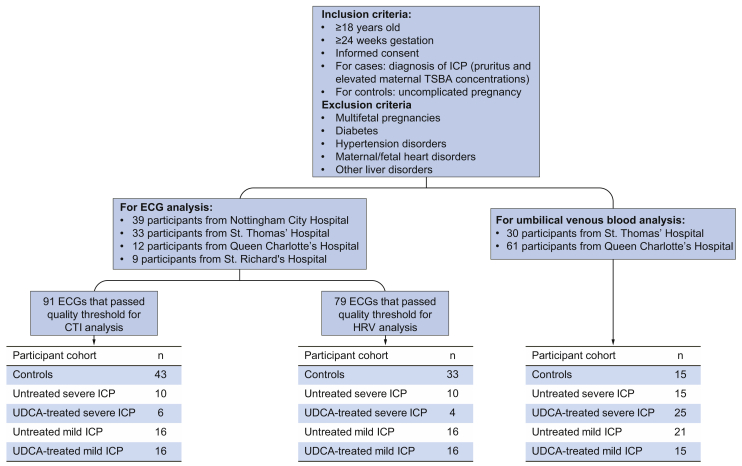
Flowchart depicting numbers of participants in each analyzed cohort and the sites they were recruited from.
Fig. 2
Fig. 2
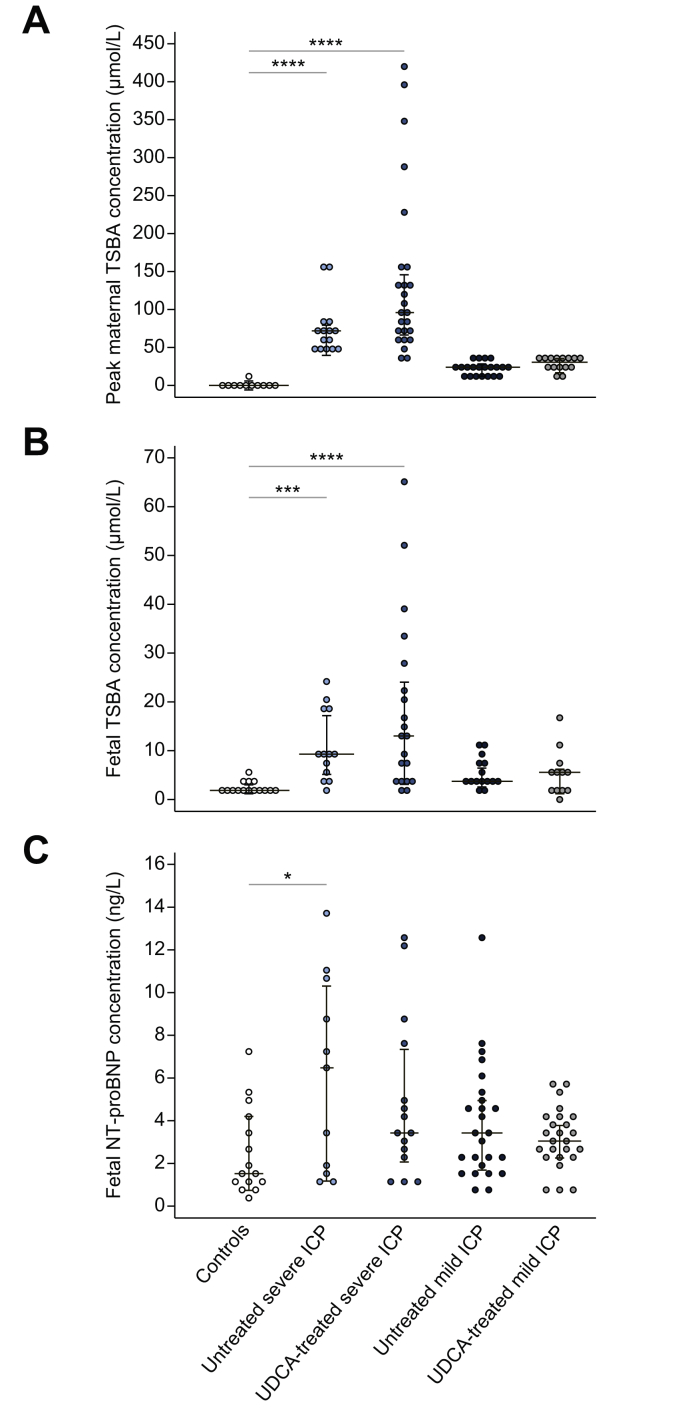
Dot plots depicting TSBA and NT-proBNP concentrations. Controls (n = 15), individuals with severe untreated ICP (n = 15), severe UDCA-treated ICP (n = 25), mild untreated ICP (n = 21) or UDCA-treated mild ICP (n = 15). (A) Peak maternal TSBA concentrations measured during pregnancy; (B) corresponding fetal TSBA concentrations measured using umbilical venous blood; (C) fetal NT-proBNP concentrations measured using umbilical venous blood. Analysis via Kruskal Wallis test with post-hoc Dunn's, ∗p <0.05, ∗∗∗p <0.001, ∗∗∗∗p <0.0001. ICP, intrahepatic cholestasis of pregnancy; NT-proBNP, N-terminal pro-B-type natriuretic peptide; TSBA, total serum bile acid; UDCA, ursodeoxycholic acid.
Fig. 3
Fig. 3
Association between fetal bile acids and NT-proBNP concentrations. (A) Added variable plot of partial correlation analysis between log-transformed fetal NT-proBNP concentration and fetal bile acid HI measured using umbilical venous blood samples taken from controls (n = 15), untreated ICP (n = 36) and UDCA-treated ICP (n = 40). (B) Table demonstrating partial correlation analysis of individual fetal serum bile acids and NT-proBNP concentrations from women with untreated (n = 36) or UDCA-treated (n = 40) ICP only. r = correlation coefficient. Significant p values are presented in bold. ∗p <0.05, ∗∗p <0.01. HI, hydrophobicity index; ICP, intrahepatic cholestasis of pregnancy; NT-proBNP, N-terminal pro-B-type natriuretic peptide; UDCA, ursodeoxycholic acid.
Fig. 4
Fig. 4
Added variable plots of partial correlation analyses between fetal NT-proBNP and maternal TSBA or ALT concentrations. (A & D) In both controls (n = 15) and women with untreated ICP (n = 36); (B & E) in women with untreated ICP only (n = 36); (C & F) in women with UDCA-treated ICP only (n = 40). Plots with both controls and cases on the same graph have diamond-shaped data points, plots with untreated ICP cases only have circle-shaped shaded data points and plots with UDCA-treated cases only have circle-shaped hollow data points. ALT, alanine aminotransferase; ICP, intrahepatic cholestasis of pregnancy; NT-proBNP, N-terminal pro-B-type natriuretic peptide; TSBA, total serum bile acid; UDCA, ursodeoxycholic acid.
Fig. 5
Fig. 5
Association between ICP and PR interval prolongation (A & B) Representative averaged fECG waveforms demonstrating PR interval prolongation (grey) in untreated severe ICP (C) added variable plot demonstrating the partial correlation between maternal TSBA concentration and fetal PR interval length in both controls (n = 43) and women with untreated ICP (n = 26), (D) in women with untreated ICP only (n = 26), (E) in women with UDCA-treated ICP only (n = 22). Plots with both controls and cases have circle-shaped data points, plots with untreated ICP cases only have diamond-shaped shaded data points and plots with UDCA-treated cases only have diamond-shaped hollow data points. fECG, fetal electrocardiogram; ICP, intrahepatic cholestasis of pregnancy; TSBA, total serum bile acid; UDCA, ursodeoxycholic acid.
Fig. 6
Fig. 6
Association between untreated ICP and fetal heart rate variability (A-D) Added variable plots demonstrating the partial correlation between maternal TSBA concentration and fetal heart rate variability measurements in controls (n = 16 in 1F and n = 33 in 2F) and untreated ICP (n = 13 in 1F and n = 36 in 2F). RMSSD data points are triangles whilst SDNN data points are squares. (E-H) Box and whisker plots demonstrating the medians and IQRs of fetal heart rate variability measurements of controls (n = 16 in 1F and n = 33 in 2F), untreated ICP (n = 13 in 1F and n = 36 in 2F) and UDCA-treated ICP (n = 15 in 1F and n = 20 in 2F). Analysis via Kruskal Wallis test with post-hoc Dunn's. ∗p <0.05, ∗∗p <0.01. ICP, intrahepatic cholestasis of pregnancy; RMSSD, root mean square of successive differences; SDNN, standard deviation of normal to normal intervals; TSBA, total serum bile acid; UDCA, ursodeoxycholic acid.

Similar articles

Cited by

References

    1. Geenes V., Lövgren-Sandblom A., Benthin L., Lawrance D., Chambers J., Gurung V. The reversed feto-maternal bile acid gradient in intrahepatic cholestasis of pregnancy is corrected by ursodeoxycholic acid. PLoS One. 2014;9 - PMC - PubMed
    1. Glantz A., Marschall H.U., Mattsson L.A. Intrahepatic cholestasis of pregnancy: relationships between bile acid levels and fetal complication rates. Hepatology. 2004;40:467–474. - PubMed
    1. Geenes V., Chappell L.C., Seed P.T., Steer P.J., Knight M., Williamson C. Association of severe intrahepatic cholestasis of pregnancy with adverse pregnancy outcomes: a prospective population-based case-control study. Hepatology. 2014;59:1482–1491. - PMC - PubMed
    1. Ovadia C., Seed P.T., Sklavounos A., Geenes V., Di Illio C., Chambers J. Association of adverse perinatal outcomes of intrahepatic cholestasis of pregnancy with biochemical markers: results of aggregate and individual patient data meta-analyses. Lancet. 2019;393:899–909. - PMC - PubMed
    1. Fisk N.M., Storey G.N. Fetal outcome in obstetric cholestasis. Br J Obstet Gynaecol. 1988;95:1137–1143. - PubMed

Publication types

MeSH terms

Supplementary concepts