Review
. 2021 Aug:50:101134.
doi: 10.1016/j.molmet.2020.101134. Epub 2020 Dec 1.

Mitochondrial oxidative function in NAFLD: Friend or foe?

Affiliations
Review

Mitochondrial oxidative function in NAFLD: Friend or foe?

Michael Shum et al. Mol Metab. 2021 Aug.

Abstract

Background: Mitochondrial oxidative function plays a key role in the development of non-alcoholic fatty liver disease (NAFLD) and insulin resistance (IR). Recent studies reported that fatty liver might not be a result of decreased mitochondrial fat oxidation caused by mitochondrial damage. Rather, NAFLD and IR induce an elevation in mitochondrial function that covers the increased demand for carbon intermediates and ATP caused by elevated lipogenesis and gluconeogenesis. Furthermore, mitochondria play a role in regulating hepatic insulin sensitivity and lipogenesis by modulating redox-sensitive signaling pathways.

Scope of review: We review the contradictory studies indicating that NAFLD and hyperglycemia can either increase or decrease mitochondrial oxidative capacity in the liver. We summarize mechanisms regulating mitochondrial heterogeneity inside the same cell and discuss how these mechanisms may determine the role of mitochondria in NAFLD. We further discuss the role of endogenous antioxidants in controlling mitochondrial H2O2 release and redox-mediated signaling. We describe the emerging concept that the subcellular location of cellular antioxidants is a key determinant of their effects on NAFLD.

Major conclusions: The balance of fat oxidation versus accumulation depends on mitochondrial fuel preference rather than ATP-synthesizing respiration. As such, therapies targeting fuel preference might be more suitable for treating NAFLD. Similarly, suppressing maladaptive antioxidants, rather than interfering with physiological mitochondrial H2O2-mediated signaling, may allow the maintenance of intact hepatic insulin signaling in NAFLD. Exploration of the subcellular compartmentalization of different antioxidant systems and the unique functions of specific mitochondrial subpopulations may offer new intervention points to treat NAFLD.

Keywords: H(2)O(2); Lipid metabolism; Mitochondria; Mitochondrial heterogeneity; Mitophagy; NAFLD; NASH.


Figures

Figure 1
Figure 1
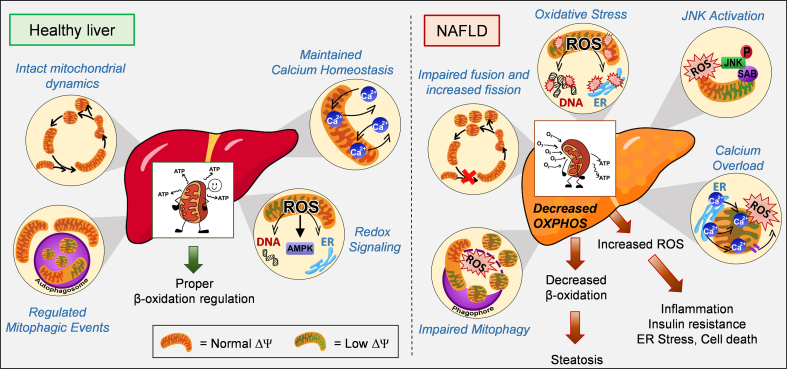
Mitochondria as a compromised friend in NAFLD. Mitochondria in hepatocytes oxidize fatty acids to produce ketone bodies, as well as ATP to cover glucose production during fasting. Mitochondria rely on diverse mechanisms to preserve their function including dynamics, redox signaling, mitophagy and calcium homeostasis. In contrast to a healthy liver, mitochondria in NAFLD were reported to be fragmented, overloaded with calcium, with decreased oxidative capacity and increased ROS production, which cause JNK activation. JNK activation itself can induce these same defects in mitochondrial function, constituting a feed-forward cycle of mitochondrial dysfunction. Mitochondrial dysfunction in NAFLD was also explained by defective mitophagy. The decrease in fatty acid oxidation caused by this compromise in mitochondrial function was deemed to induce fat accumulation in hepatocytes, while impairing insulin signaling. ER, endoplasmic reticulum; JNK, c-Jun NH2-terminal Kinase; SAB, SH3 homology associated BTK binding protein; Dy, mitochondrial membrane potential; ROS, reactive oxygen species.
Figure 2
Figure 2
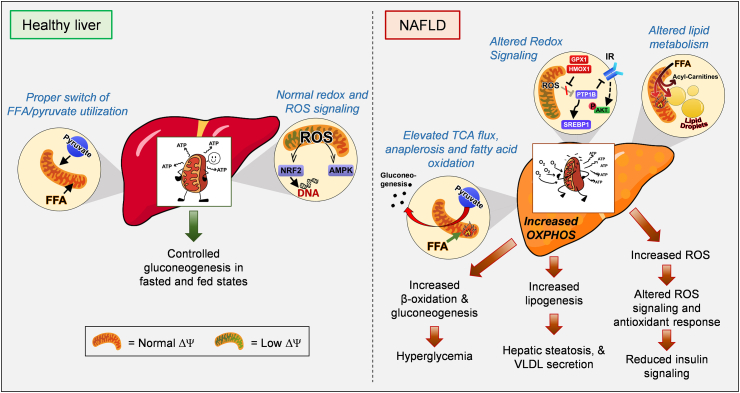
Mitochondria as a foe in NAFLD. As the liver supplies glucose, ketone bodies and lipids to other organs, proper control of hepatic gluconeogenesis and lipid metabolism in the fasted and fed state is essential. NAFLD is associated with increases in hepatic glucose production and lipid synthesis/storage in part due to higher glucose and lipid supply. The elevation in gluconeogenesis and lipid storage increase mitochondrial ATP demand, explaining the increase in mitochondrial oxidative capacity reported in simple steatosis and even in NASH. Interestingly, fatty liver is not only associated with increased mitochondrial fat oxidation, which normally fuels glucose production and ketogenesis, but it also increases TCA cycle flux. Further, it was proposed that increased oxidative function of mitochondria elevates ROS production, which can underpin inflammation, impaired insulin signaling and cell death. Evidence suggests that increased TCA cycle flux and impaired ketogenesis cause hepatic steatosis and hyperglycemia, supporting that restoration of mitochondrial fuel preference can be a therapeutic target for NAFLD. IR, insulin receptor; GPX1, glutathione peroxidase 1; HMOX1, heme oxygenase-1; PTP1B, protein-tyrosine phosphatase 1B; SREBP1-c, Sterol regulatory element-binding transcription factor 1-c; FFA, free fatty acids; VLDL, very low densitity lipoprotein.
Figure 3
Figure 3
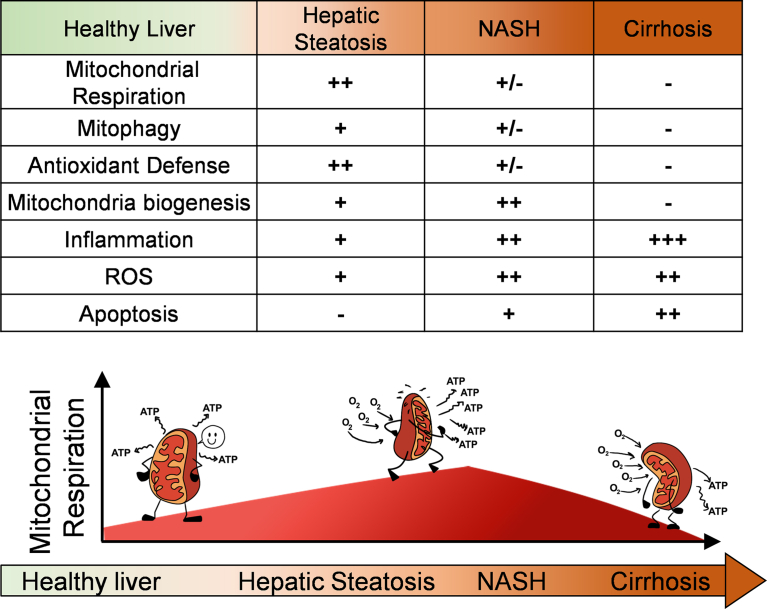
Mitochondrial states throughout the progression of NAFLD. In the early stages of NAFLD, namely simple steatosis, adaptative mechanisms occur to compensate for the increase in fuel availability and anabolism: mitochondrial respiration increases due to higher substrate availability and increased ATP demand, which will increase ROS prodcution, activate mitochondrial biogenesis and antioxidant responses. As hepatocytes store more lipids and reach full storage capacity, free-fatty acid mediated toxicity impairs mitophagy and damages mitochondria. In the transition to NASH, mitochondrial function is decreased and ROS is further increased, which were deemed to be responsible for higher inflammation and cell death characteristic of NASH. However, some mouse models with antioxidant enzymes selectively deleted in hepatocytes are protected from NASH, questioning whether the increase in ROS observed in simple steatosis and NASH contributes to the disease. In certain cases, NASH with fibrosis will progress to cirrhosis, meaning that hepatocytes will be replaced with cell types with fewer and dysfunctional mitochondria, contributing to the decline in liver oxidative function. FFA, free fatty acids; VLDL, very low densitity lipoprotein; TG, triglycerides
Figure 4
Figure 4
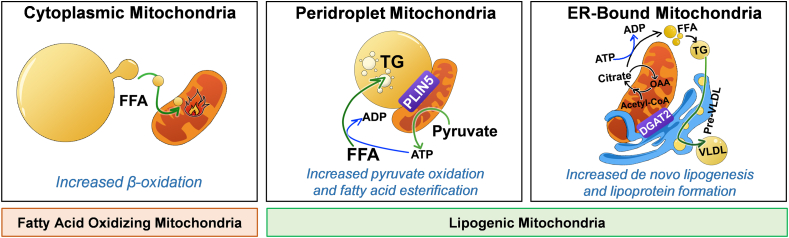
Proposed model of three distinct mitochondrial populations in hepatocytes. Mitochondria attached to different organelles were shown to have distinct functions, demonstrating that not all mitochondria in the same cell are homogeneous. This concept supports that: 1) Different mitochondria can be specialized in a specific task: some mitochondria in hepatocytes can be specialized in synthesizing lipids, while other mitochondria can oxidize lipids. 2) Localizing mitochondria close to their targeted organelles or compartments have the advantage to exchange metabolites or molecules more efficiently. The functional segregation of mitochondria can be determined by their anchorage to specific organelles, which prevents motility and thus fusion between the different subpopulations. Based partly on our previous work [61], we propose the existence of 3 mitochondrial populations in hepatocytes: 1) Cytosolic mitochondria, which are responsible for fatty acid oxidation, ketone bodies production and ureagenesis to support glucose production; 2) mitochondria attached to lipid droplets, namely peridroplet mitochondria (PDM), which promote the esterification of fatty acids into triglycerides and; 3) the ER-anchored mitochondria, which are responsible for fatty acid synthesis, lipoprotein assembly and excretion. VLDL, very low densitity lipoprotein; PLIN5, perlipin 5; DGAT2, Diacylglycerol O-Acyltransferase 2; ER, endoplasmic reticulum; OAA, oxaloacetate.
Figure 5
Figure 5
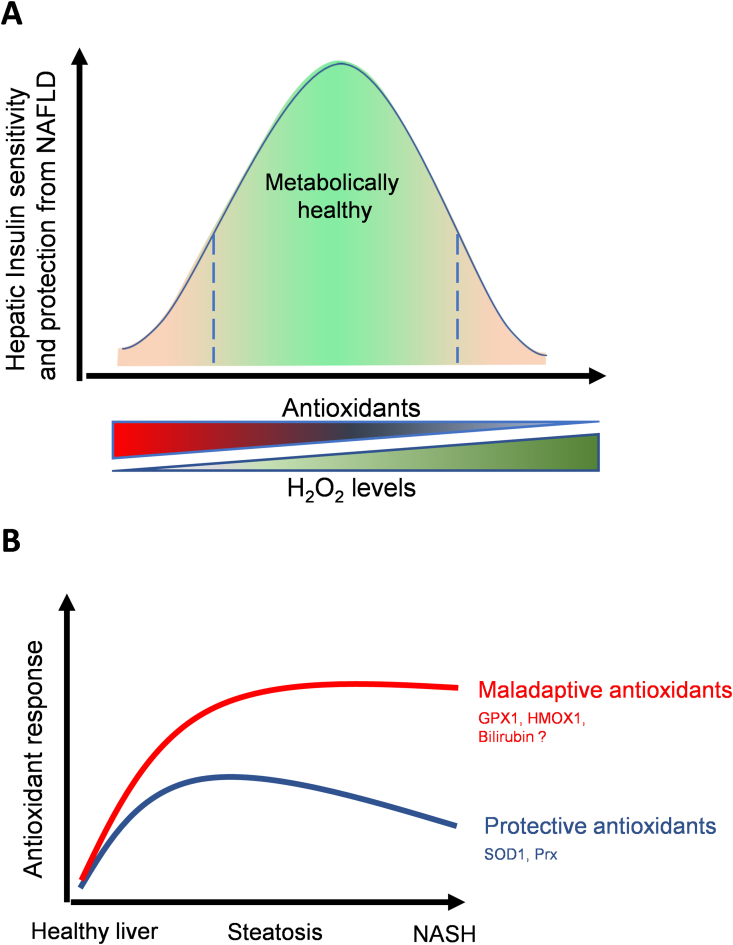
Heterogenous antioxidant systems reveal a spectrum of protective and maladaptive antioxidant responses in NAFLD. A) The essential role of reactive oxygen species (ROS) as a signaling molecule for physiological processes demonstrated that impairment of ROS signaling caused by excessive antioxidant activity can be as deleterious as uncontrolled ROS production. Indeed, insulin resistance and NAFLD have been reported to be caused by excessive ROS production or excessive antioxidant activity. As these are two opposite processes driving the same disease, two options exist to explain these findings: i) In some individuals, increased antioxidant function rather than excessive ROS drives pathogenesis. ii) The different subcellular localization of different antioxidant systems can explain the concurrency of increased ROS in one compartment and increased antioxidant function in another compartment, both contributing to pathogenesis. B) Identified maladaptive antioxidants that contribute to NAFLD by eliminating mitochondrial H2O2 are GPX1, HMOX1, and potentially bilirubin. On the other hand, superoxide dismutase 1, which transforms superoxide to H2O2, and Prx, which removes H2O2, were shown to protect from NAFLD. The divergent and opposite role of these different antioxidant systems in NAFLD development demonstrates that H2O2 can have opposite roles depending on where it is generated and removed. Bilirubin is a lipophilic antioxidant, whose production can be increased when HMOX1 activity is upregulated. Bilirubin has actions on the mitochondrial electron transport chain as well, but the role of these actions of bilirubin in the mitochondria to NAFLD development have not been characterized yet. GPX1, glutathione peroxidase 1; HMOX1, heme oxygenase 1; Prx, Peroxiredoxin, SOD1, Superoxide dismutase 1.

References

    1. Rolfe D.F., Brown G.C. Cellular energy utilization and molecular origin of standard metabolic rate in mammals. Physiological Reviews. 1997;77(3):731–758. - PubMed
    1. McGarry J.D., Foster D.W. Effects of exogenous fatty acid concentration on glucagon-induced changes in hepatic fatty acid metabolism. Diabetes. 1980;29(3):236–240. - PubMed
    1. Young S., Tariq R., Provenza J., Satapathy S.K., Faisal K., Choudhry A. Prevalence and profile of nonalcoholic fatty liver disease in lean adults: systematic review and meta-analysis. Hepatology Communications. 2020;4(7):953–972. - PMC - PubMed
    1. Bril F., Lomonaco R., Orsak B., Ortiz-Lopez C., Webb A., Tio F. Relationship between disease severity, hyperinsulinemia, and impaired insulin clearance in patients with nonalcoholic steatohepatitis. Hepatology. 2014;59(6):2178–2187. - PubMed
    1. Jais A., Einwallner E., Sharif O., Gossens K., Lu T.T., Soyal S.M. Heme oxygenase-1 drives metaflammation and insulin resistance in mouse and man. Cell. 2014;158(1):25–40. - PMC - PubMed

Publication types

MeSH terms