


Immune Escape Mechanisms in Non Small Cell Lung Cancer
- PMID: 33276569
- PMCID: PMC7761620
- DOI: 10.3390/cancers12123605
Immune Escape Mechanisms in Non Small Cell Lung Cancer
Abstract
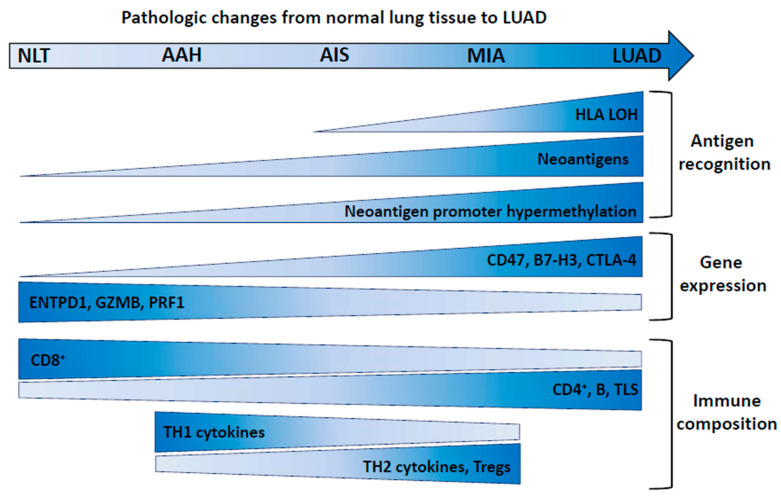
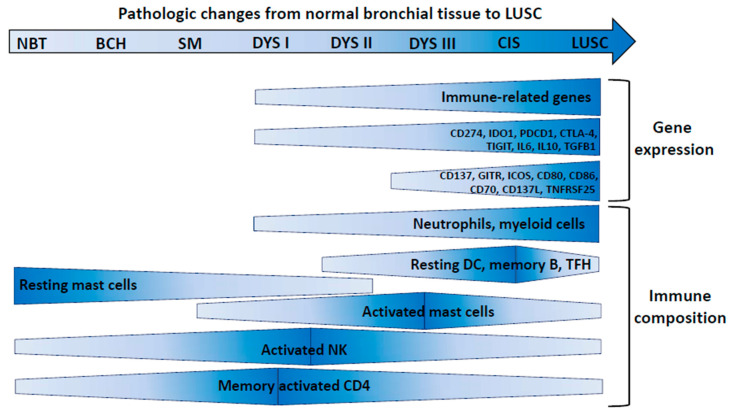
Development of strong immune evasion has been traditionally associated with the late stages of solid tumor progression, since advanced cancers are more likely to have reached the third phase of the immunoediting process. However, by integrating a variety of approaches, evidence for active immune escape mechanisms has been found even in the pre-invasive lesions that later progress to the main NSCLC histotypes. Pre-invasive lesions of adenocarcinoma (LUAD) and of squamous cell carcinoma (LUSC) can show impaired antigen presentation, loss of heterozygosity at the Human Leukocyte Antigen (HLA) region, neoantigen silencing, activation of immune checkpoints, altered TH1/TH2 cytokine ratios, and immune contexture evolution. Analysis of large panels of LUAD vs. LUSC, of early stage NSCLC vs. normal lung tissue, of specific molecular subsets of NSCLC, and of distinct regions within the same tumor, indicates that all these processes of immune escape continue to evolve in the invasive stage of NSCLC, are associated with inter- and intra-tumor heterogeneity, and contribute to resistance to therapy by immune checkpoint blockade (ICB). In this review, we will discuss the most recent evidence on immune escape mechanisms developing from the precursor to invasive stage in NSCLC, and the contribution of immune evasion to resistance to ICB in lung cancer.
Keywords: HLA loss of heterozygosity; carcinoma in situ; dysfunctional T cells; immune checkpoint blockade; immune contexture; immune escape; immunotherapy; lung adenocarcinoma; lung squamous cell carcinoma; neoantigens; pre-invasive lesions.
Conflict of interest statement
The authors declare no conflict of interest.
Figures
References
-
- Dong Z., Zhang J., Liu S., Su J., Zhang C., Xie Z., Zhou Q., Tu H., Xu C., Yan L. EGFR mutation correlates with uninflamed phenotype and weak immunogenicity, causing impaired response to PD-1 blockade in non-small cell lung cancer. Oncoimmunology. 2017;6:e1356145. doi: 10.1080/2162402X.2017.1356145. - DOI - PMC - PubMed
-
- Kitajima S., Ivanova E., Guo S., Yoshida R., Campisi M., Sundararaman S.K., Tange S., Mitsuishi Y., Thai T.C., Masuda S., et al. Suppression of STING associated with LKB1 loss in KRAS-driven lung cancer. Cancer Discov. 2019;9:34–45. doi: 10.1158/2159-8290.CD-18-0689. - DOI - PMC - PubMed
Publication types
Grants and funding
LinkOut - more resources
Full Text Sources
Research Materials
