. 2020 Dec 4;10(1):21284.
doi: 10.1038/s41598-020-78479-9.

Magnetoconductivity in quasiperiodic graphene superlattices

Affiliations

Magnetoconductivity in quasiperiodic graphene superlattices

M de Dios-Leyva et al. Sci Rep. .

Abstract

The magnetoconductivity in Fibonacci graphene superlattices is investigated in a perpendicular magnetic field B. It was shown that the B-dependence of the diffusive conductivity exhibits a complicated oscillatory behavior whose characteristics cannot be associated with Weiss oscillations, but rather with Shubnikov-de Haas ones. The absense of Weiss oscillations is attributed to the existence of two incommensurate periods in Fibonacci superlattices. It was also found that the quasiperiodicity of the structure leads to a renormalization of the Fermi velocity [Formula: see text] of graphene. Our calculations revealed that, for weak B, the dc Hall conductivity [Formula: see text] exhibits well defined and robust plateaux, where it takes the unexpected values [Formula: see text], indicating that the half-integer quantum Hall effect does not occur in the considered structure. It was finally shown that [Formula: see text] displays self-similarity for magnetic fields related by [Formula: see text] and [Formula: see text], where [Formula: see text] is the golden mean.


Conflict of interest statement

The authors declare no competing interests.

Figures
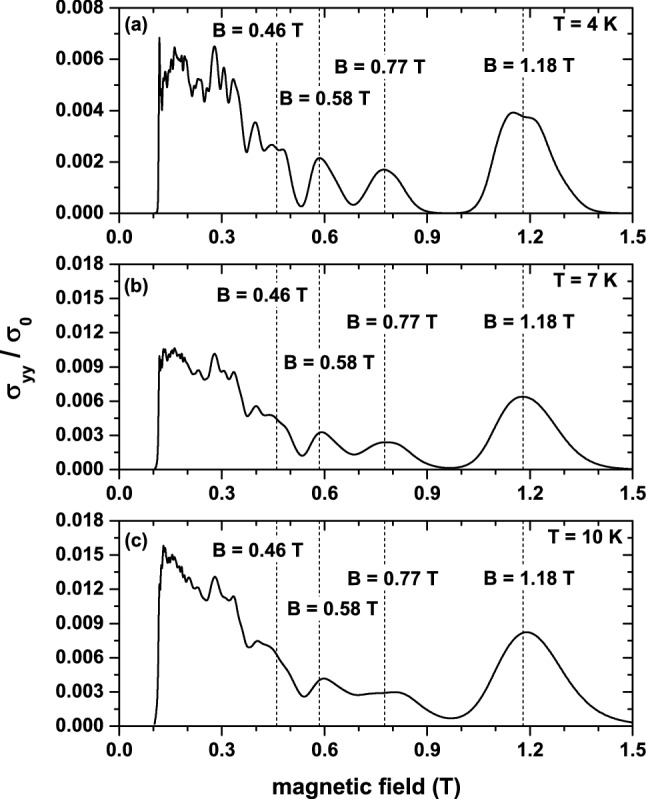
Figure 1
Figure 1
Diffusive conductivity (in units of σ0) as a function of the applied magnetic field for several temperature values: (a) T=4 K, (b) T=7 K, and (c) T=10 K, where σ0=(e2/h)(4βτEF2/ħ). Vertical dotted lines indicate the magnetic field intensities for which maxima have been obtained.
Figure 2
Figure 2
Center-position dependence and shifting β(B) of the magnetic subbands corresponding to those magnetic fields at which the diffuse conductivity in Fig. 1 takes its maximum values. Note that the center of the n=2,3,4, and 5 magnetic subbands for B=1.18 T, 0.77 T, 0.58 T, and 0.46T, respectively, coincides with the μ=0 chemical potential.
Figure 3
Figure 3
Magnetic field dependence of the band width for the n=0, n=+1, and n=+2 magnetic subbandas (a). In (b), the same results but for n=+3, n=+4, and n=+5.
Figure 4
Figure 4
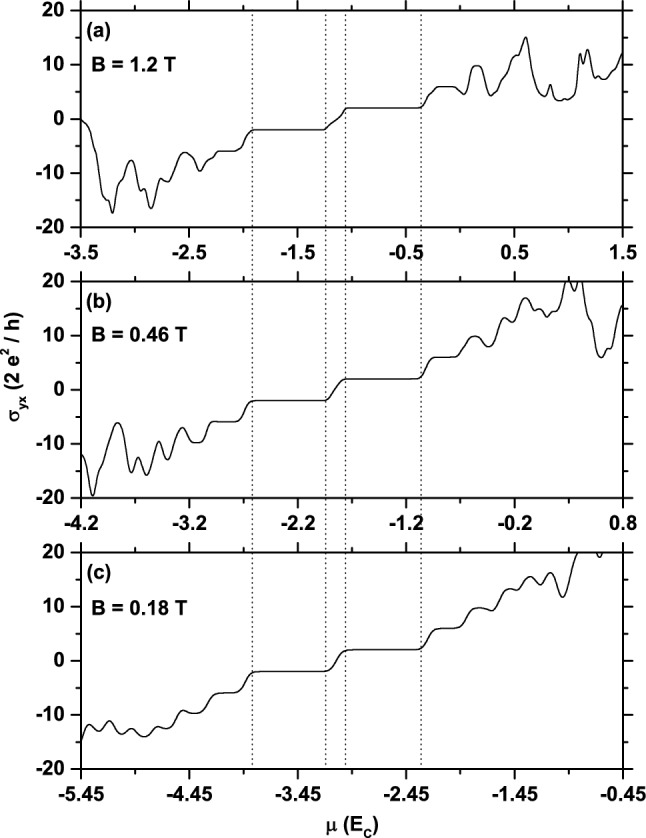
Hall dc-conductivity (in units of 2e2/h) as a function of the chemical potential (in units of EC=ħωC) for three values of the applied magnetic field, which are scaled by τ2 and τ4. The vertical lines determine the intervals for the plateaux that are around the n=0 shifted magnetic subbband.

References

    1. Novoselov KS, Geim AK, Morozov SV, Jiang D, Zhang Y, Dubonos SV, Grigorieva IV, Firsov AA. Electric field effect in atomically thin carbon films. Science. 2004;306:666–669. doi: 10.1126/science.1102896. - DOI - PubMed
    1. Novoselov KS, Geim AK, Morozov SV, Jiang D, Katsnelson MI, Grigorieva IV, Dubonos SV, Firsov AA. Two-dimensional gas of massless Dirac fermions in graphene. Nature. 2005;438:197–200. doi: 10.1038/nature04233. - DOI - PubMed
    1. Zhang Y, Tang Y-W, Stormer HL, Kim P. Experimental observation of the quantum Hall effect and Berrys phase in graphene. Nature. 2005;438:201–204. doi: 10.1038/nature04235. - DOI - PubMed
    1. Gusynin VP, Sharapov SG. Unconventional integer quantum Hall effect in graphene. Phys. Rev. Lett. 2005;95:146801. doi: 10.1103/PhysRevLett.95.146801. - DOI - PubMed
    1. Peres NMR, Guinea F, Castro Neto AH. Electronic properties of disordered two-dimensional carbon. Phys. Rev. B. 2006;73:125411. doi: 10.1103/PhysRevB.73.125411. - DOI