


Annual Research Review: A multilevel bioecological analysis of factors influencing the mental health and psychosocial well-being of refugee children
- PMID: 33277944
- PMCID: PMC8246898
- DOI: 10.1111/jcpp.13355
Annual Research Review: A multilevel bioecological analysis of factors influencing the mental health and psychosocial well-being of refugee children
Abstract
Background: This paper revisits the themes of an influential 1993 review regarding the factors shaping the mental health and psychosocial well-being of refugees to take stock of developments in the evidence base and conceptualisation of issues for refugee children over the last 25 years.
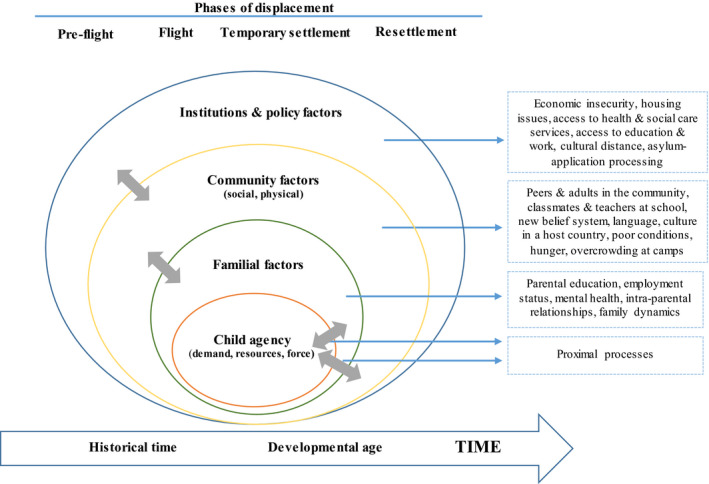
Methods: The study deployed a systematic search strategy. This initially identified 784 papers, which was reduced to 65 studies following application of inclusion and exclusion criteria. We used a later iteration of Bronfenbrenner's bioecological model of human development - the PPCT model - to consolidate evidence.
Results: We identify a range of risk and protective factors operating at individual, familial, community and institutional and policy levels that influence outcomes for refugee children. The dynamics shaping the interaction of these influences are linked to the life course principles of socio-historical time and developmental age, proximal processes and child agency.
Conclusions: Actions at individual, familial, community, school, institutional and policy levels all have potential traction on mental health and psychosocial well-being of refugee children. However, evidence suggests that greatest impact will be secured by multilevel interventions addressing synergies between ecological systems, approaches engaging proximal processes (including parenting programmes) and interventions facilitating the agency of the developing refugee child.
Keywords: Refugee; children; mental health; protective factors; psychosocial support; stressors.
© 2020 The Authors. Journal of Child Psychology and Psychiatry published by John Wiley & Sons Ltd on behalf of Association for Child and Adolescent Mental Health.
Figures
Comment in
-
Commentary: Deepening understanding of refugee children and adolescents using Bronfenbrenner's bioecological and PPCT models - A Commentary on Arakelyan and Ager (2020).J Child Psychol Psychiatry. 2021 May;62(5):510-513. doi: 10.1111/jcpp.13403. Epub 2021 Mar 6. J Child Psychol Psychiatry. 2021. PMID: 33675241
-
Editorial: 'In our time': Has the pandemic changed the way we write and read mental health and neurodevelopmental disorder research reviews?J Child Psychol Psychiatry. 2021 May;62(5):481-483. doi: 10.1111/jcpp.13424. J Child Psychol Psychiatry. 2021. PMID: 33905121
References
-
- Afifi, T.D. , Afifi, W.A. , Acevedo Callejas, M. , Shahnazi, A. , White, A. , & Nimah, N. (2019). The functionality of communal coping in chronic uncertainty environments: The context of Palestinian refugees in Lebanon. Health Communication, 34, 1585–1596. - PubMed
-
- Ager, A. (1993). Mental health issues in refugee populations: A review. Cambridge, MA: Harvard Medical School. https://www.academia.edu/32952651/Mental_health_issues_in_refugee_popula...
-
- Ager, A. , Annan, J. , & Panter‐Brick, C. (2013). Resilience: From conceptualisation to effective intervention. Available at: http://www.cpcnetwork.org/resource/resilience‐from‐conceptualization‐to‐...
-
- Aitcheson, R.J. , Abu‐Bader, S.H. , Howell, M.K. , Khalil, D. , & Elbedour, S. (2017). Resilience in Palestinian adolescents living in Gaza. Psychological Trauma: Theory, Research, Practice, and Policy, 9, 36–43. - PubMed
Publication types
MeSH terms
Grants and funding
LinkOut - more resources
Full Text Sources
