. 2021 Jan;113(1 Pt 1):111-119.
doi: 10.1016/j.ygeno.2020.11.032. Epub 2020 Dec 2.

Characterizing the effect of background selection on the polygenicity of brain-related traits

Affiliations

Characterizing the effect of background selection on the polygenicity of brain-related traits

Frank R Wendt et al. Genomics. 2021 Jan.

Abstract

Background: Genome-wide association studies (GWAS) have demonstrated that psychopathology phenotypes are affected by many risk alleles with small effect (polygenicity). It is unclear how ubiquitously evolutionary pressures influence the genetic architecture of these traits.

Methods: We partitioned SNP heritability to assess the contribution of background (BGS) and positive selection, Neanderthal local ancestry, functional significance, and genotype networks in 75 brain-related traits (8411 ≤ N ≤ 1,131,181, mean N = 205,289). We applied binary annotations by dichotomizing each measure based on top 2%, 1%, and 0.5% of all scores genome-wide. Effect size distribution features were calculated using GENESIS. We tested the relationship between effect size distribution descriptive statistics and natural selection. In a subset of traits, we explore the inclusion of diagnostic heterogeneity (e.g., number of diagnostic combinations and total symptoms) in the tested relationship.

Results: SNP-heritability was enriched (false discovery rate q < 0.05) for loci with elevated BGS (7 phenotypes) and in genic (34 phenotypes) and loss-of-function (LoF)-intolerant regions (67 phenotypes). These effects were strongest in GWAS of schizophrenia (1.90-fold BGS, 1.16-fold genic, and 1.92-fold LoF), educational attainment (1.86-fold BGS, 1.12-fold genic, and 1.79-fold LoF), and cognitive performance (2.29-fold BGS, 1.12-fold genic, and 1.79-fold LoF). BGS (top 2%) significantly predicted effect size variance for trait-associated loci (σ2 parameter) in 75 brain-related traits (β = 4.39 × 10⁻⁵, p = 1.43 × 10⁻⁵, model r2 = 0.548). Considering the number of DSM-5 diagnostic combinations per psychiatric disorder improved model fit (σ2 ~ BTop2% × Genic × diagnostic combinations; model r2 = 0.661).

Conclusions: Brain-related phenotypes with larger variance in risk locus effect sizes are associated with loci under BGS. We show exploratory results suggesting that diagnostic complexity may also contribute to the increased polygenicity of psychiatric disorders.

Keywords: Background selection; Complex traits; Diagnostic heterogeneity; Natural selection; Partitioned heritability; Psychiatry.


Conflict of interest statement

The authors declare no competing interests.

Figures
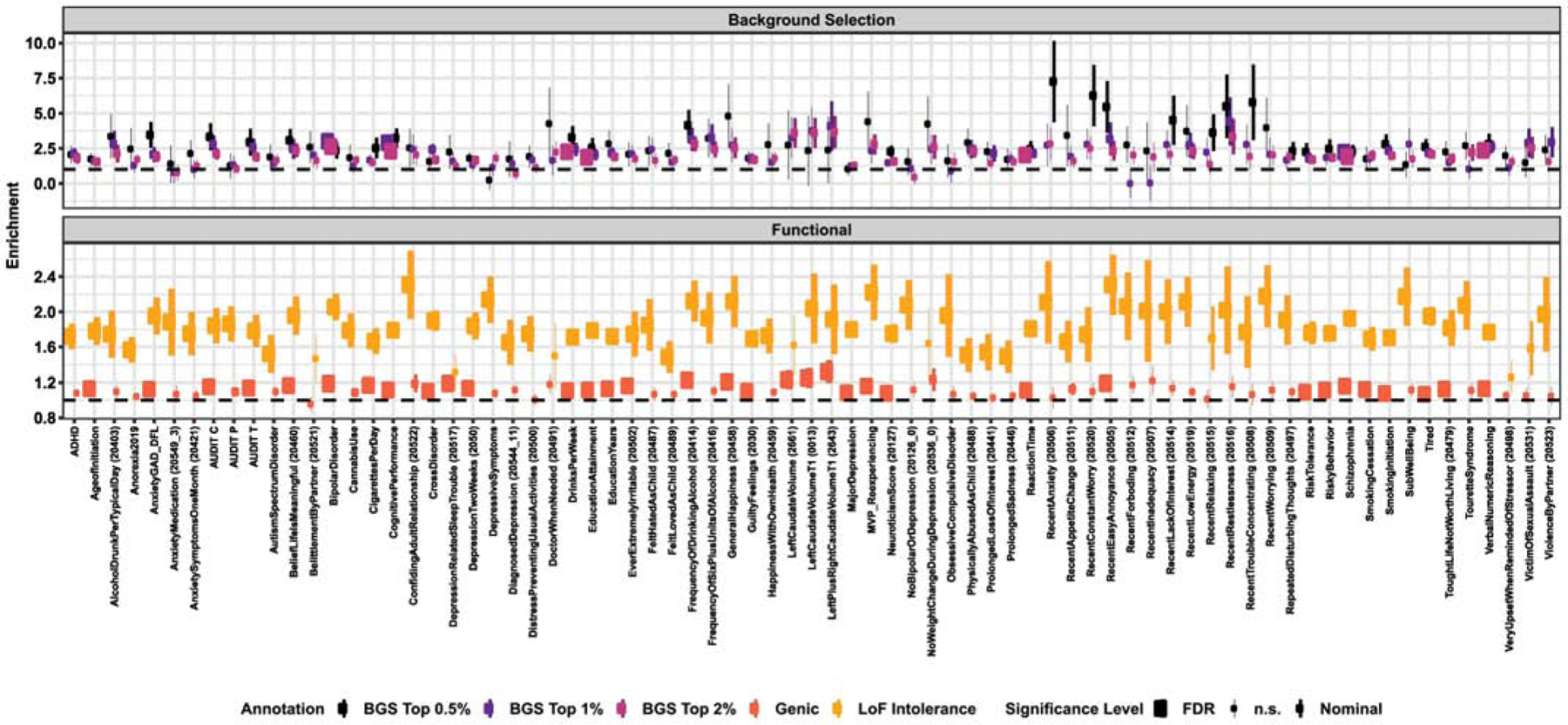
Figure 1.
Figure 1.. Enrichment of natural selection and functional annotation measures.
Significant enrichments of genic and loss-of-function (LoF) intolerant loci (A) and three genomic annotations of background selection (BGS). Both panels list phenotypes in descending order from highest to lowest magnitude enrichment for the most abundant annotation (i.e., LoF intolerance in panel A and top 2% of BGS scores in panel B). All phenotypes listed were at least nominally significant (p<0.05) and solid circles indicate that the enrichment survived multiple testing correction (q<0.05). Error bars represent the 95% confidence interval around each enrichment estimate.
Figure 2.
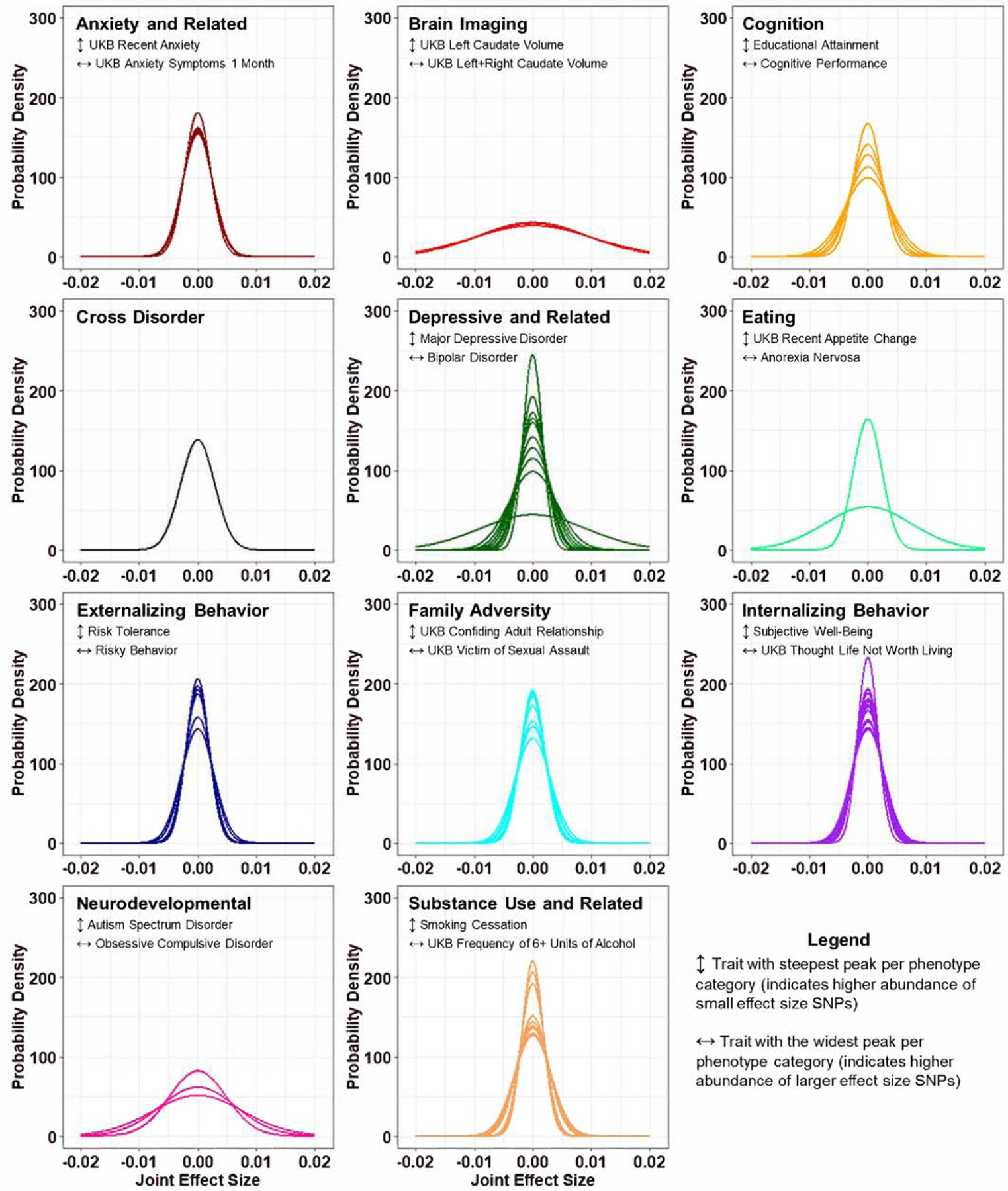
Figure 2.. Complex trait effect size distribution curves.
Effect size distribution curves derived from GWAS summary statistics for 75 mental health and disease phenotypes using the GENESIS R package. Phenotypes were grouped into eleven categories (Table S1). The phenotype corresponding to the steepest curve (↕) and the widest curve (↔) are identified in each subplot.
Figure 3.
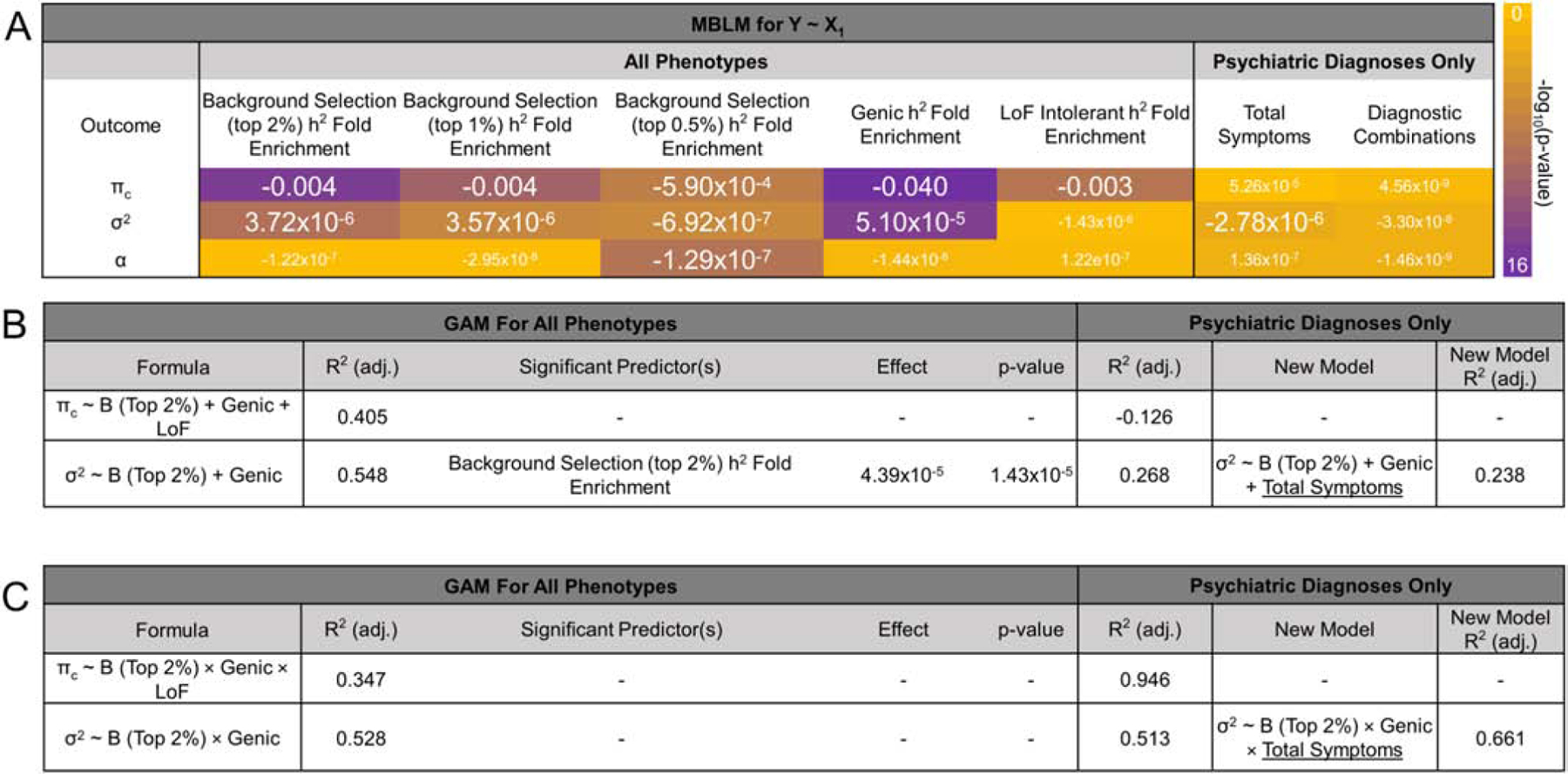
Figure 3.. Predicting effect size distribution with natural selection, functional annotation, and phenotype heterogeneity.
Summary of models predicting effect size distribution parameters. (A) Median-based linear models (MBLM) for predicting effect size distribution descriptive statistics with a single unstandardized independent variable. Larger font indicates at least nominal significance for the respective effect of each independent variable on the outcome effect size distribution descriptive statistic. (B and C) Generalized (GAM) additive (B) and interactive (C) models of effect size distribution descriptive statistics using individually significant predictors of each metric (from A). Prior to testing the addition of heterogeneity information, each model was re-evaluated in psychiatric disorders only.

References

    1. Altshuler DM, Gibbs RA, Peltonen L, Altshuler DM, Gibbs RA, Peltonen L, Dermitzakis E, Schaffner SF, Yu F, Peltonen L, et al. 2010. Integrating common and rare genetic variation in diverse human populations. Nature 467:52–58. - PMC - PubMed
    1. Auton A, Brooks LD, Durbin RM, Garrison EP, Kang HM, Korbel JO, Marchini JL, McCarthy S, McVean GA, Abecasis GR. 2015. A global reference for human genetic variation. Nature 526:68–74. - PMC - PubMed
    1. Berg JJ, Coop G. 2014. A Population Genetic Signal of Polygenic Adaptation. PLOS Genetics 10:e1004412. - PMC - PubMed
    1. Bulik-Sullivan BK, Loh PR, Finucane HK, Ripke S, Yang J, Patterson N, Daly MJ, Price AL, Neale BM. 2015. LD Score regression distinguishes confounding from polygenicity in genome-wide association studies. Nat Genet 47:291–295. - PMC - PubMed
    1. Buniello A, MacArthur JAL, Cerezo M, Harris LW, Hayhurst J, Malangone C, McMahon A, Morales J, Mountjoy E, Sollis E, et al. 2019. The NHGRI-EBI GWAS Catalog of published genome-wide association studies, targeted arrays and summary statistics 2019. Nucleic Acids Res 47:D1005–D1012. - PMC - PubMed

Publication types