


Structure-forming repeats and their impact on genome stability
- PMID: 33279816
- PMCID: PMC8084909
- DOI: 10.1016/j.gde.2020.10.006
Structure-forming repeats and their impact on genome stability
Abstract
Repetitive sequences throughout the genome are a major source of endogenous DNA damage, due to the propensity of many of them to form alternative non-B DNA structures that can interfere with replication, transcription, and DNA repair. These repetitive sequences are prone to breakage (fragility) and instability (changes in repeat number). Repeat fragility and expansions are linked to several diseases, including many cancers and neurodegenerative diseases, hence the importance of understanding the mechanisms that cause genome instability and contribute to these diseases. This review focuses on recent findings of mechanisms causing repeat fragility and instability, new associations between repeat expansions and genetic diseases, and potential therapeutic options to target repeat expansions.
Copyright © 2020 Elsevier Ltd. All rights reserved.
Conflict of interest statement
Conflict of Interest statement
The authors declare no conflict of interest.
Figures
References
-
-
Irony-Tur Sinai M, Salamon A, Stanleigh N, Goldberg T, Weiss A, Wang YH, Kerem B: AT-dinucleotide rich sequences drive fragile site formation. Nucleic Acids Res 2019, 47:9685–9695.
* The authors determined that AT-rich sequences are a driving factor of fragile site formation by inserting an AT-rich sequence from the FRA16C CFS into a non-fragile ectopic location in the genome. This ectopic location then exhibited recurrent chromosome gaps.
-
-
-
Kaushal S, Wollmuth CE, Das K, Hile SE, Regan SB, Barnes RP, Haouzi A, Lee SM, House NCM, Guyumdzhyan M, et al.: Sequence and Nuclease Requirements for Breakage and Healing of a Structure-Forming (AT)n Sequence within Fragile Site FRA16D. Cell Rep 2019, 27:1151–1164.e5.
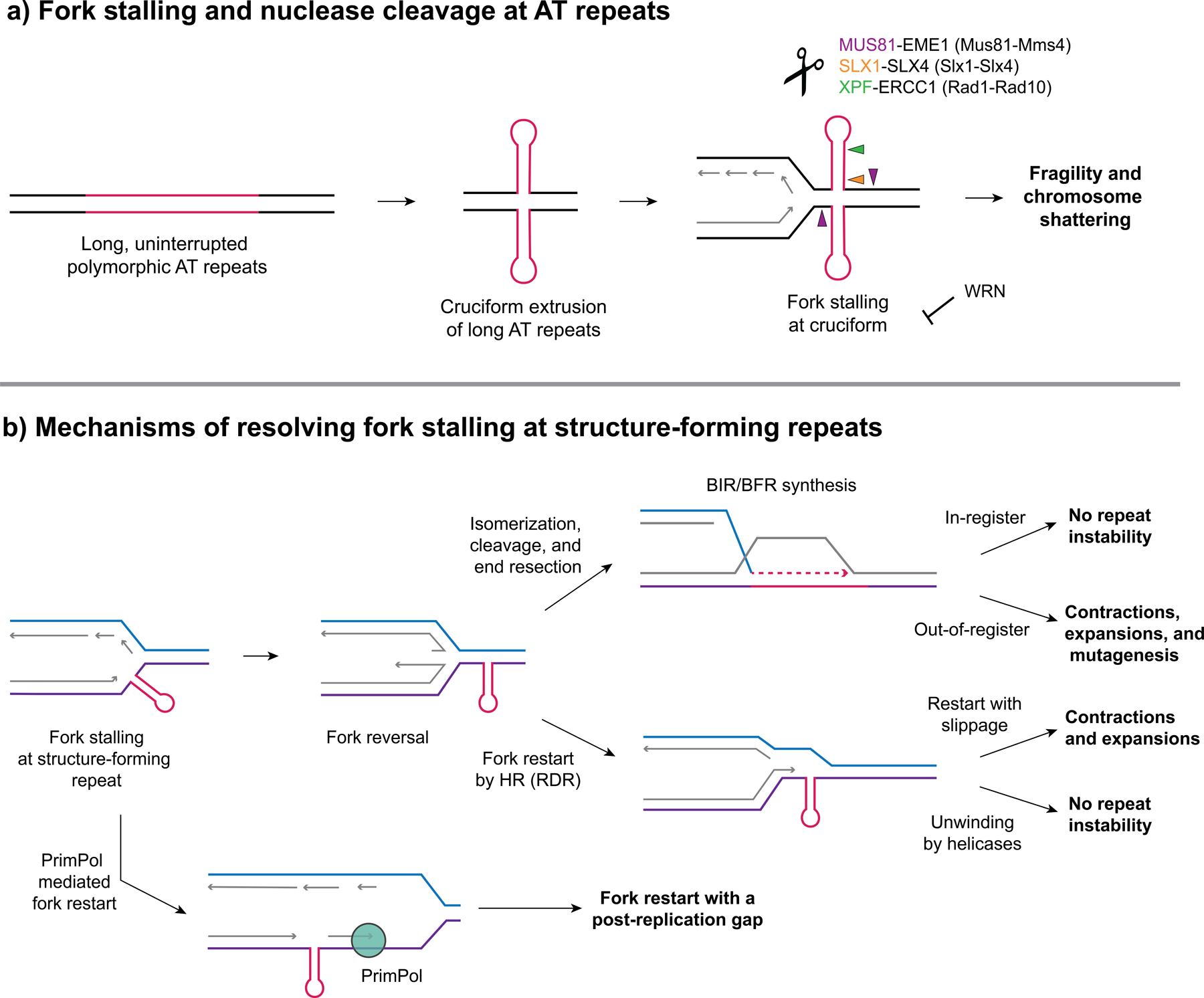
* This study determined that a polymorphic AT repeat from the common fragile site FRA16D exhibited AT-length dependent fragility when inserted into a yeast chromosome. This fragility was dependent on Mus81-Mms4, Slx1-Slx4, and Rad1-Rad10 nucleases and breaks required the Sae2/MRX complex for processing and healing.
-
Publication types
MeSH terms
Substances
Grants and funding
LinkOut - more resources
Full Text Sources
Other Literature Sources
