. 2021 Sep;42(9):1037-1045.
doi: 10.1017/ice.2020.1355. Epub 2020 Dec 7.

Infection control challenges in setting up community isolation and treatment facilities for patients with coronavirus disease 2019 (COVID-19): Implementation of directly observed environmental disinfection

Affiliations

Infection control challenges in setting up community isolation and treatment facilities for patients with coronavirus disease 2019 (COVID-19): Implementation of directly observed environmental disinfection

Shuk-Ching Wong et al. Infect Control Hosp Epidemiol. 2021 Sep.

Abstract

Background: Extensive environmental contamination by severe acute respiratory syndrome coronavirus 2 (SARS-CoV-2) has been reported in hospitals during the coronavirus disease 2019 (COVID-19) pandemic. We report our experience with the practice of directly observed environmental disinfection (DOED) in a community isolation facility (CIF) and a community treatment facility (CTF) in Hong Kong.

Methods: The CIF, with 250 single-room bungalows in a holiday camp, opened on July 24, 2020, to receive step-down patients from hospitals. The CTF, with 500 beds in open cubicles inside a convention hall, was activated on August 1, 2020, to admit newly diagnosed COVID-19 patients from the community. Healthcare workers (HCWs) and cleaning staff received infection control training to reinforce donning and doffing of personal protective equipment and to understand the practice of DOED, in which the cleaning staff observed patient and staff activities and then performed environmental disinfection immediately thereafter. Supervisors also observed cleaning staff to ensure the quality of work. In the CTF, air and environmental samples were collected on days 7, 14, 21, and 28 for SARS-CoV-2 detection by RT-PCR. Patient compliance with mask wearing was also recorded.

Results: Of 291 HCWs and 54 cleaning staff who managed 243 patients in the CIF and 674 patients in the CTF from July 24 to August 29, 2020, no one acquired COVID-19. All 24 air samples and 520 environmental samples collected in the patient area of the CTF were negative for SARS-CoV-2. Patient compliance with mask wearing was 100%.

Conclusion: With appropriate infection control measures, zero environmental contamination and nosocomial transmission of SARS-CoV-2 to HCWs and cleaning staff was achieved.


Figures
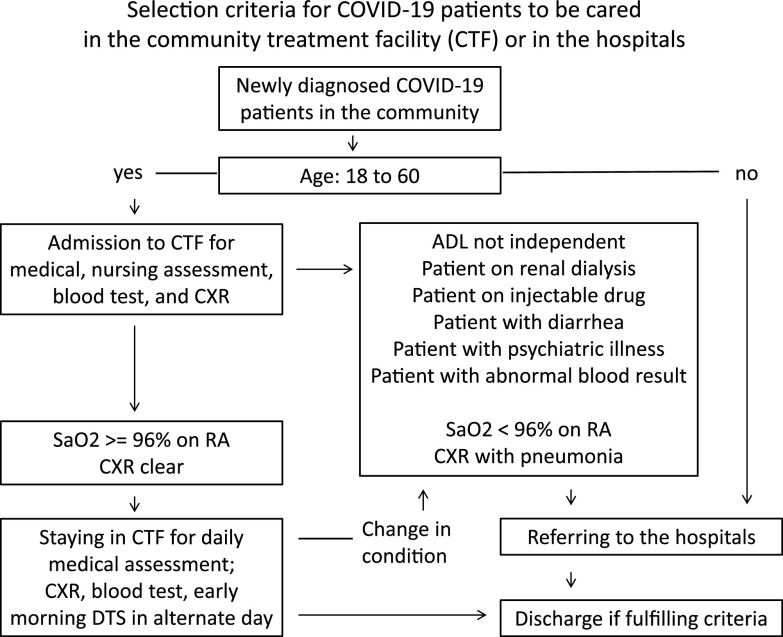
Fig. 1.
Fig. 1.
Selection criteria for COVID-19 patients to be cared in the community treatment facility or in the hospitals. Note. ADL, activities of daily living; CTF, community treatment facility; CXR, chest radiograph; DTS, deep throat saliva; RA, room air; SaO2, oxygen saturation. For the patient discharge criteria, patients can be discharged to the community if they are clinical stable and fulfill either of the following laboratory criteria: (1) with 2 clinical specimens of the same type (ie, respiratory or stool sample) tested negative for SARS-CoV-2 by reverse transcription polymerase chain reaction (RT-PCR) taken at least 24 hours apart, or (2) tested positive for SARS-CoV-2 antibody, anti–receptor-binding domain of the viral spike protein (anti-RBD IgG).
Fig. 2.
Fig. 2.
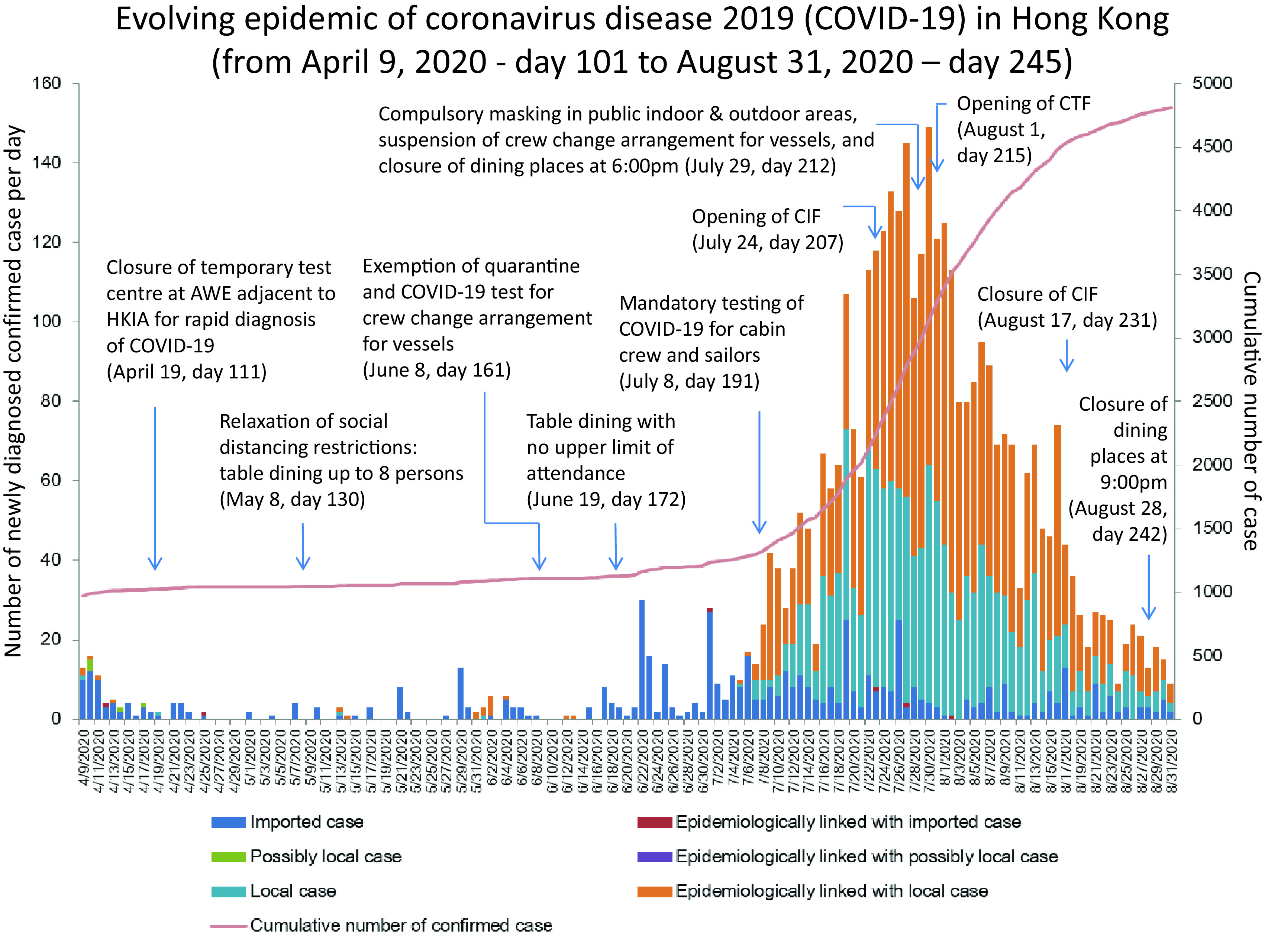
Evolving epidemic of COVID-19 in Hong Kong from April 9, 2020 (day 101) to August 31, 2020 (day 245). Official announcement of the community acquired pneumonia outbreak in Wuhan, Hubei Province by National Health Commission of the People’s Republic of China, on December 31, 2019 is defined as day 1. Note. AWE, AsiaWorld-Expo; HKIA, Hong Kong International Airport; CIF, community isolation facility at Lei Yue Mun Park and Holiday Village; CTF, community treatment facility at AsiaWorld-Expo adjacent to the Hong Kong International Airport.
Fig. 3.
Fig. 3.
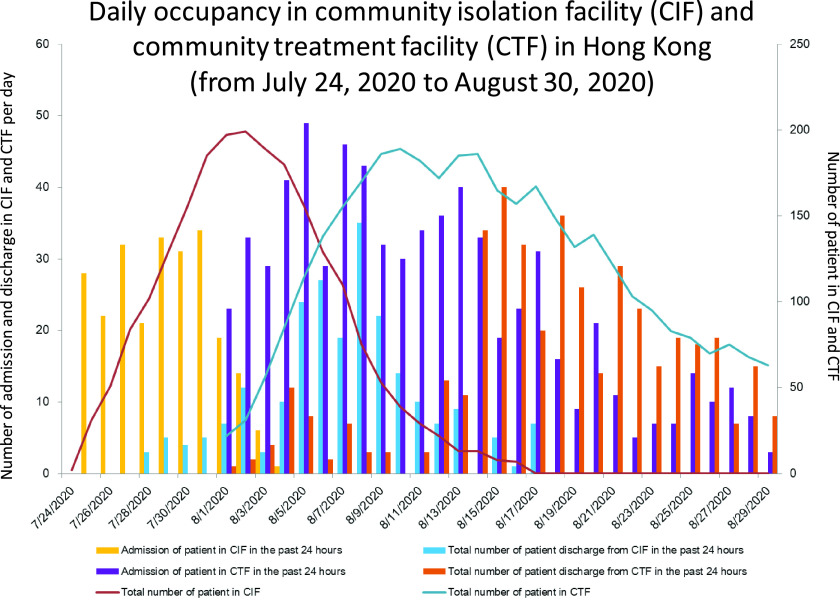
Daily occupancy in community isolation facility (CIF) and community treatment facility (CTF) in Hong Kong. In the CIF at Lei Yue Mun Park and Holiday Village, only site B was opened for step-down care of COVID-19 patients on July 24, 2020 (day 207). Site A was maintained in standby mode. Since the CTF at AsiaWorld-Expo adjacent to the Hong Kong International Airport opened on August 1, 2020 (day 215), and the community outbreak of COVID-19 was under control, the CIF was converted to standby mode on August 17, 2020 (day 231).
Fig. 4.
Fig. 4.
Layout and workflow of the community isolation facility (CIF) at Lei Yue Mun Park and Holiday Village. Note. Patient area (red zone) and staff area (green zone) are marked in red and green as the background colors, respectively. Healthcare workers (HCWs) were assigned a designated entrance and route to the central command station to report duty during the day or night shift. HCWs wore full personal protective equipment (PPE) with surgical respirator (ie, N95 respirator), cap, face shield, isolation gown, and gloves in the donning area before entering the consultation room. Upon ambulance arrival, HCWs with full PPE went out from the consultation room to escort patients from the ambulance drop-off point to the consultation room, where registration and clinical assessment were performed. Subsequently, patients were escorted to the patient waiting area to receive basic infection control training with emphasis on hand hygiene and wearing surgical mask, and to learn the housekeeping activities such as self-collection of deep throat saliva in the early morning, self-monitoring of blood pressure, pulse, and body temperature, the using of teleconsultation system inside patient rooms, as well as the delivery of meals and linens and disposal of wastes from the bungalows. HCWs then escorted patients to the assigned bungalow. Each bungalow occupied by either 1 patient or 1 family of 2 persons. HCWs returned from the bungalows, following a designated route for doffing and went to the central command station or staff dining room.
Fig. 5.
Fig. 5.
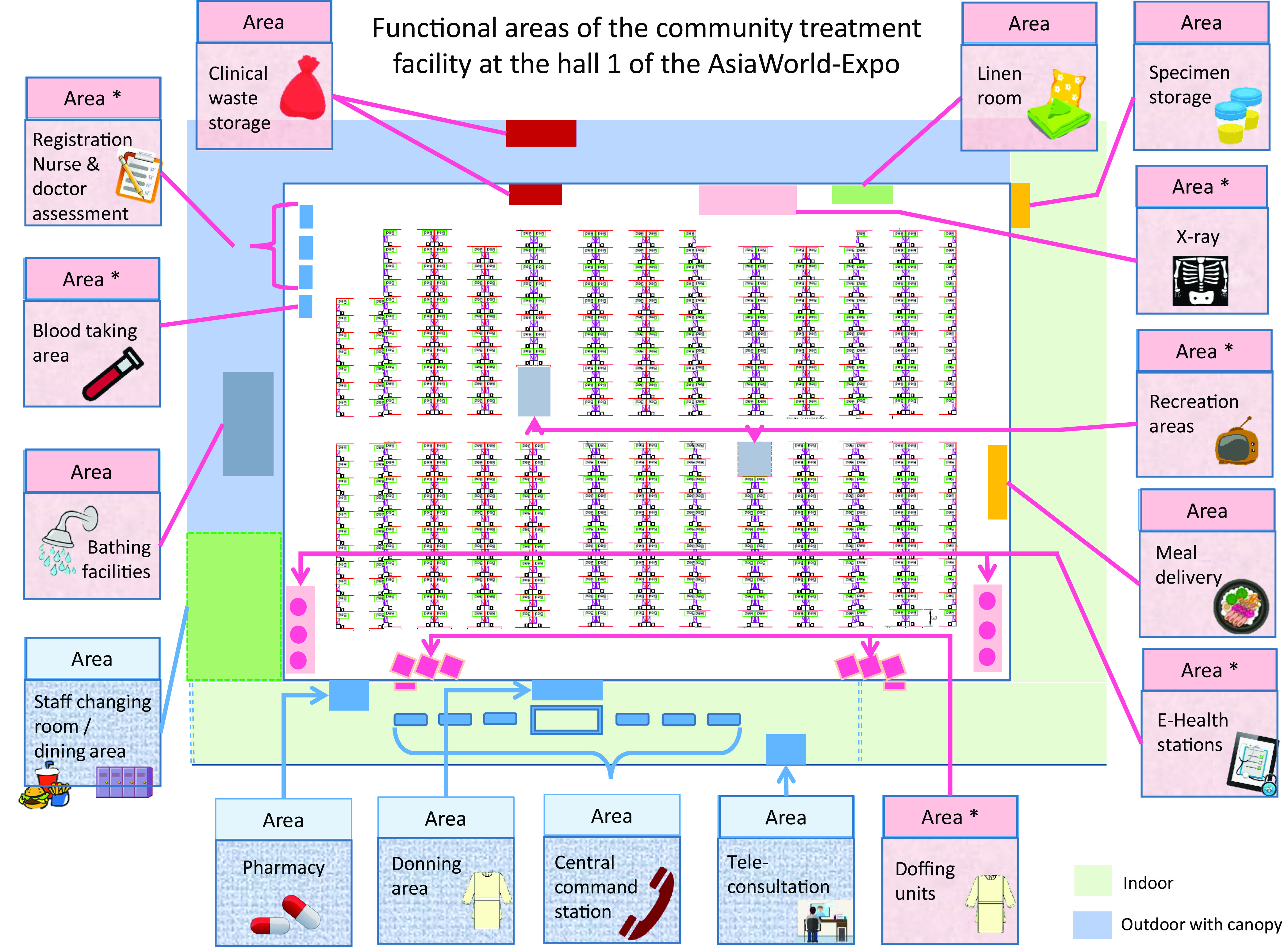
Functional areas of the community treatment facility (CTF) at the hall 1 of the AsiaWorld-Expo. Note. In the red zone, the functional areas marked with asterisk (*) represent the areas in frequent contact with either patients or healthcare workers. Environmental surface swabs were prospectively collected for 4 weeks to detect SARS-CoV-2 by RT-PCR. Air samples were collected at the registration area, 2 recreation areas, and at the bedsides of 3 patients with lowest, second lowest, and third lowest cycle threshold values of the deep throat saliva by RT-PCR on the day of sample collection. The registration area for nurse and doctor assessment, waiting area, blood taking area, radiograph area, E-health station, recreation area, and doffing area were disinfected manually by sodium hypochlorite solution (1,000 ppm) soaked in disposal wipe immediately after use under the scheme of directly observed environmental disinfection. If blood, secretions, vomitus, or excreta was spilled, the environmental surface was disinfected with sodium hypochlorite solution (10,000 ppm) soaked with a disposal wipe for 10 minutes before rinsing with water. Because the ventilation flow rate was 80 L per second per person and all patients wore surgical masks, it was not necessary to move the patients out during environmental disinfection.

References

    1. Coronavirus disease (COVID-19). Weekly epidemiological update. World Health Organization. https://www.who.int/publications/m/item/weekly-epidemiological-update---.... Published November 17, 2020. Accessed November 18, 2020.
    1. Orlowski EJW, Goldsmith DJA. Four months into the COVID-19 pandemic, Sweden’s prized herd immunity is nowhere in sight. J R Soc Med 2020;113:292–298. - PMC - PubMed
    1. Ngonghala CN, Iboi E, Gumel AB. Could masks curtail the post-lockdown resurgence of COVID-19 in the US? Math Biosci 2020:108452. - PMC - PubMed
    1. Cheng VC, Wong SC, Chuang VW, et al. The role of community-wide wearing of face mask for control of coronavirus disease 2019 (COVID-19) epidemic due to SARS-CoV-2. J Infect 2020;81:107–114. - PMC - PubMed
    1. Wong SC, Lam GK, AuYeung CH, et al. Absence of nosocomial influenza and respiratory syncytial virus infection in the coronavirus disease 2019 (COVID-19) era: implication of universal masking in hospitals. Infect Control Hosp Epidemiol 2020. doi: 10.1017/ice.2020.425. - DOI - PMC - PubMed