Review
. 2021 Jan;42(1):31-44.
doi: 10.1016/j.it.2020.11.003. Epub 2020 Nov 13.

Combining Antivirals and Immunomodulators to Fight COVID-19

Affiliations
Review

Combining Antivirals and Immunomodulators to Fight COVID-19

Vincent Feuillet et al. Trends Immunol. 2021 Jan.

Abstract

The majority of severe acute respiratory syndrome coronavirus 2 (SARS-CoV-2)-infected individuals remain paucisymptomatic, contrasting with a minority of infected individuals in danger of death. Here, we speculate that the robust disease resistance of most individuals is due to a swift production of type I interferon (IFNα/β), presumably sufficient to lower the viremia. A minority of infected individuals with a preexisting chronic inflammatory state fail to mount this early efficient response, leading to a delayed harmful inflammatory response. To improve the epidemiological scenario, we propose combining: (i) the development of efficient antivirals administered early enough to assist in the production of endogenous IFNα/β; (ii) potentiating early IFN responses; (iii) administering anti-inflammatory treatments when needed, but not too early to interfere with endogenous antiviral responses.

Keywords: COVID-19; IFNα/β; SARS-CoV-2; antiviral molecules; cytokine storm; immunomodulators.


Figures

Figure 1
Figure 1
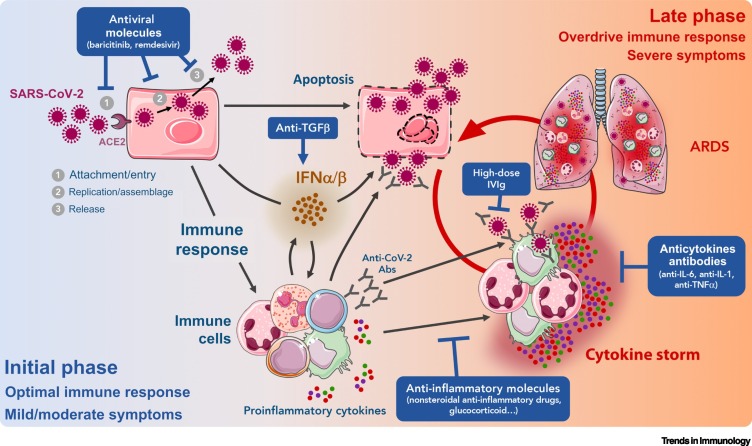
Hypothetical Model of the Two Phases of Coronavirus Disease 2019 (COVID-19) and the Steps at Which Various Treatments Are Likely to Be Efficient (Blue Rectangles). During the initial phase, infection of epithelial cells by severe acute respiratory syndrome coronavirus 2 (SARS-CoV-2) induces weak production of interferon (IFN) α/β by these cells and the initiation of a limited antiviral immune response, leading to apoptosis of infected cells, the production of proinflammatory molecules, and the recruitment of immune cells. At this time, the viral load might be reduced by antivirals combined with an antiviral IFNα/β response enhanced by immunomodulator treatments [e.g., potentially transforming growth factor β (TGFβ) blockade]. Later, in some patients, an excessive inflammatory/immune response might give rise to a cytokine storm and/or acute respiratory distress syndrome (ARDS). This deleterious hyperinflammatory immune response might be dampened by anti-inflammatory/immunosuppressive treatments. Abbreviations: Abs, antibodies; ACE2, angiotensin-converting enzyme 2; IVIg, intravenous immunoglobulin therapy; IL, interleukin; TNF, tumor necrosis factor.
Figure 2
Figure 2
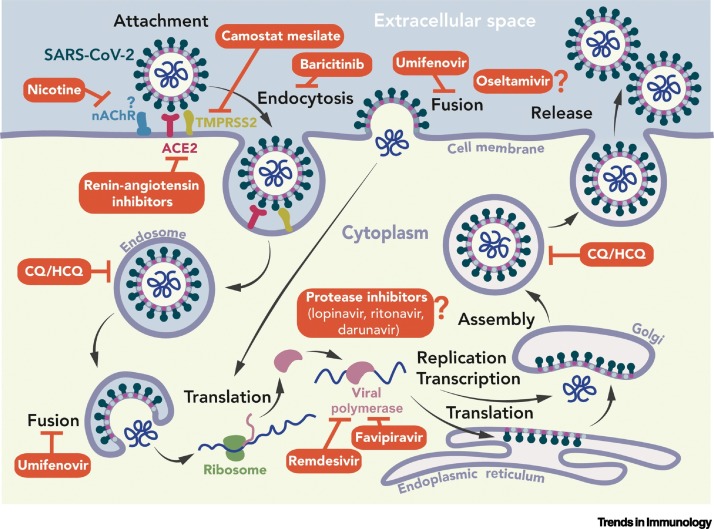
Coronavirus Life Cycle and Target Sites of Potential Antiviral Agents. The spike (S) protein binds to its main receptor, the cellular angiotensin-converting enzyme 2 (ACE2), and the virion enters through endocytosis and/or direct fusion of cell and viral membranes. The S protein is cleaved by various cellular proteases (e.g., TMPRSS2) into two subunits, S1 and S2 (‘priming process’) and at a S2′ site upstream of the fusion peptide [13]. The viral genome is translated into two polyproteins, which are cleaved by two viral proteases, chymotrypsin-like (3CLpro) and papain-like (PLpro), to generate a large replication and transcription complex orchestrating genome replication and the synthesis of mRNAs. New viral genomes recruit viral structural proteins to generate new virions released by exocytosis [6]. Red, potential inhibitors pointing towards their demonstrated targets. A question mark indicates that the target is putative, as discussed in the text. Abbreviations: CQ, chloroquine; HCQ, hydroxychloroquine; SARS-CoV-2, severe acute respiratory syndrome coronavirus 2.
Figure 3
Figure 3
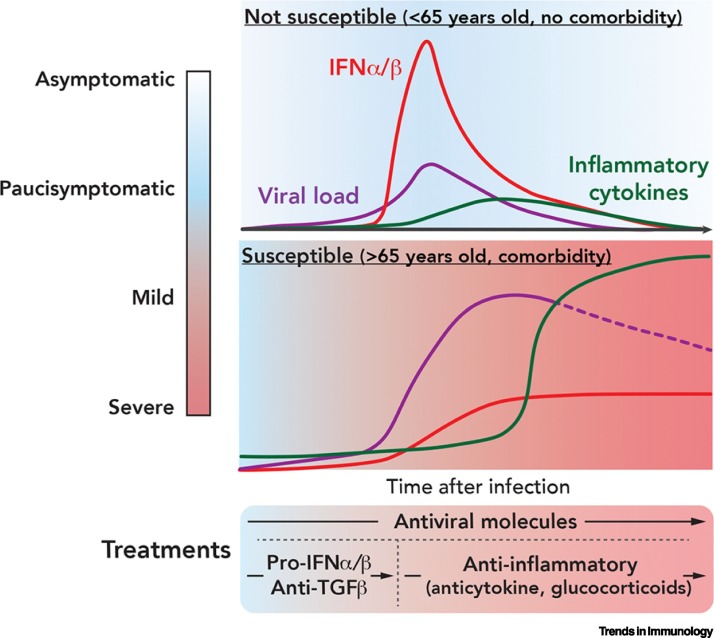
Kinetics of Severe Acute Respiratory Syndrome Coronavirus 2 (SARS-CoV-2) Viral Load Following Infection, in Parallel with the Interferon (IFN) α/β Response and the Evolution of Inflammatory Cytokines. Top: Illustrates the case of most individuals in the population who remain asymptomatic or paucisymptomatic. In these individuals, efficient antiviral immune responses – characterized by significant production of IFNα/β and limited production of inflammatory cytokines – can lead to virus eradication [1]. Bottom: Illustrates the case of patients more severely affected by the virus. These patients show ineffective/delayed production of IFNα/β, uncontrolled viral load, and subsequent overproduction of inflammatory cytokines (cytokine storm) [1]. In the latter case, we propose that antivirals should be administered to patients as soon as possible, and maintained, whereas immunomodulators should be given when the disease worsens because of harmful inflammation. Abbreviation: TGFβ, transforming growth factor β.

References

    1. Wiersinga W.J. Pathophysiology, transmission, diagnosis, and treatment of coronavirus disease 2019 (COVID-19): a review. JAMA. 2020;324:782–793. - PubMed
    1. Taubenberger J.K., Morens D.M. 1918 Influenza: the mother of all pandemics. Emerg. Infect. Dis. 2006;12:15–22. - PMC - PubMed
    1. Gordon D.E. A SARS-CoV-2 protein interaction map reveals targets for drug repurposing. Nature. 2020;583:459–468. - PMC - PubMed
    1. Wathelet M.G. Severe acute respiratory syndrome coronavirus evades antiviral signaling: role of nsp1 and rational design of an attenuated strain. J. Virol. 2007;81:11620–11633. - PMC - PubMed
    1. Kopecky-Bromberg S.A. Severe acute respiratory syndrome coronavirus open reading frame (ORF) 3b, ORF 6, and nucleocapsid proteins function as interferon antagonists. J. Virol. 2007;81:548–557. - PMC - PubMed

Publication types

MeSH terms