. 2021 Apr;6(4):387-398.
doi: 10.1016/j.bpsc.2020.09.007. Epub 2020 Sep 12.

Altered Neurocognitive Functional Connectivity and Activation Patterns Underlie Psychopathology in Preadolescence

Affiliations

Altered Neurocognitive Functional Connectivity and Activation Patterns Underlie Psychopathology in Preadolescence

Briana Lees et al. Biol Psychiatry Cogn Neurosci Neuroimaging. 2021 Apr.

Abstract

Background: Neurocognitive deficits are common among youth with mental disorders, and patterns of aberrant brain function generally cross diagnostic boundaries. This study investigated associations between functional neurocircuitry and broad transdiagnostic psychopathology dimensions in the critical preadolescent period when psychopathology is emerging.

Methods: Participants were 9- to 10-year-olds from the Adolescent Brain Cognitive Development Study. Factor scores of general psychopathology, externalizing, internalizing, and thought disorder dimensions were calculated from a higher-order model of psychopathology using confirmatory factor analysis (N = 11,721) and entered as explanatory variables into linear mixed models to examine associations with resting-state functional connectivity (n = 9074) and neural activation during the emotional n-back task (n = 6146) when covarying for sex, race/ethnicity, parental education, and cognitive function.

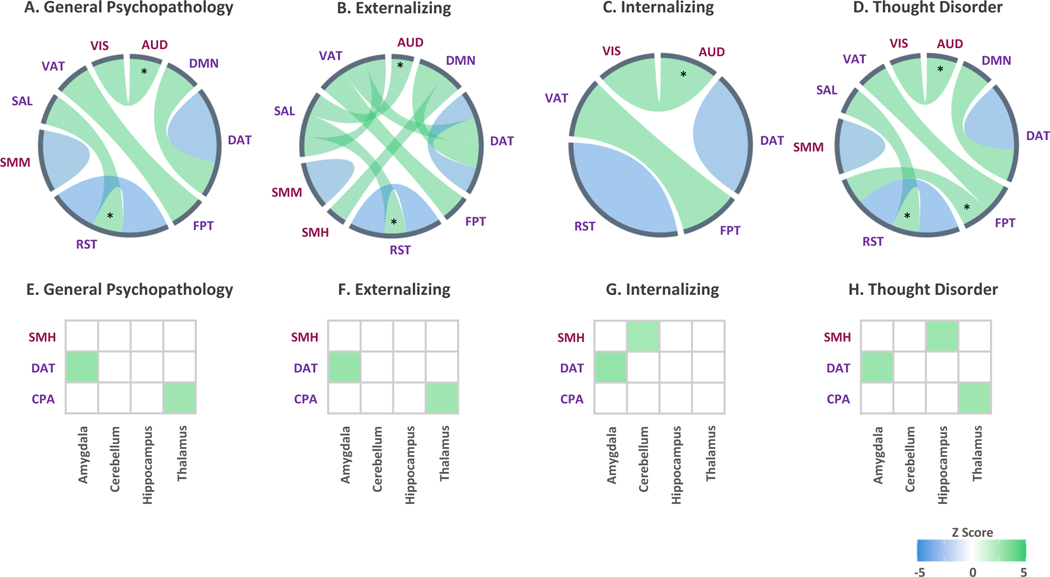
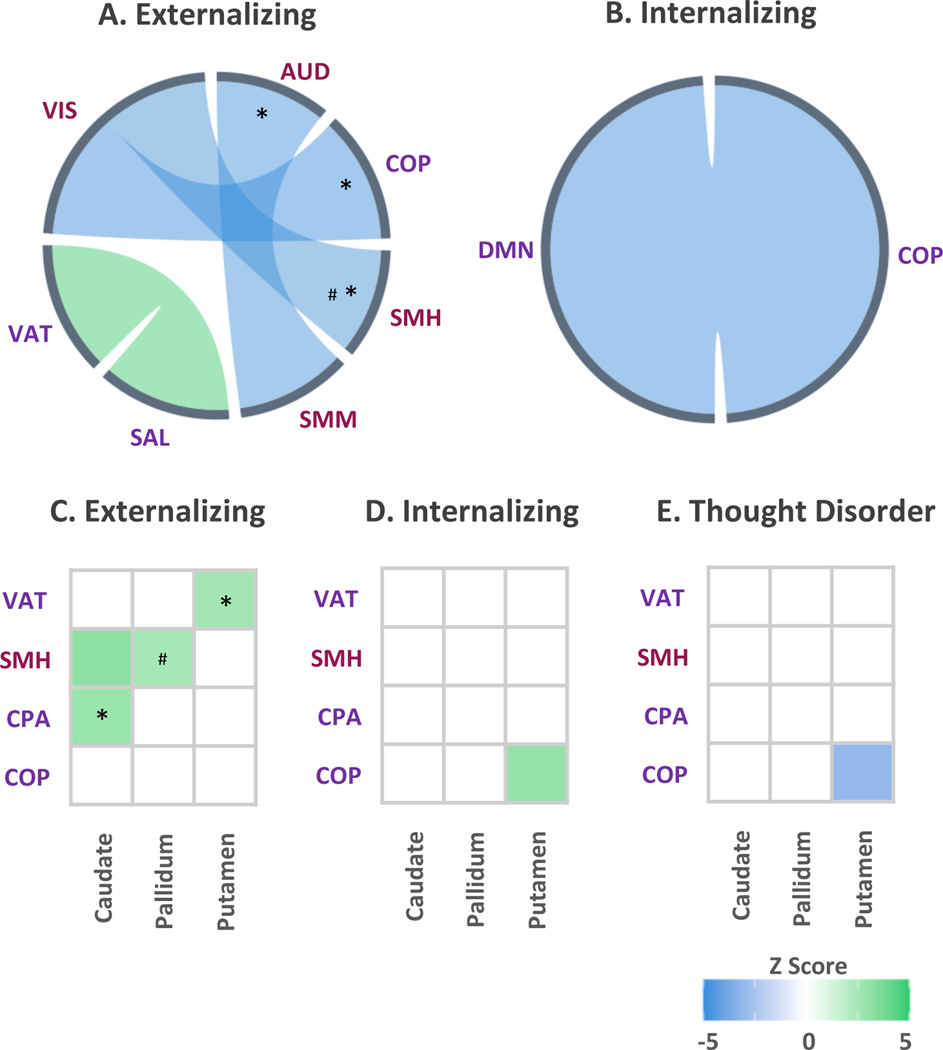
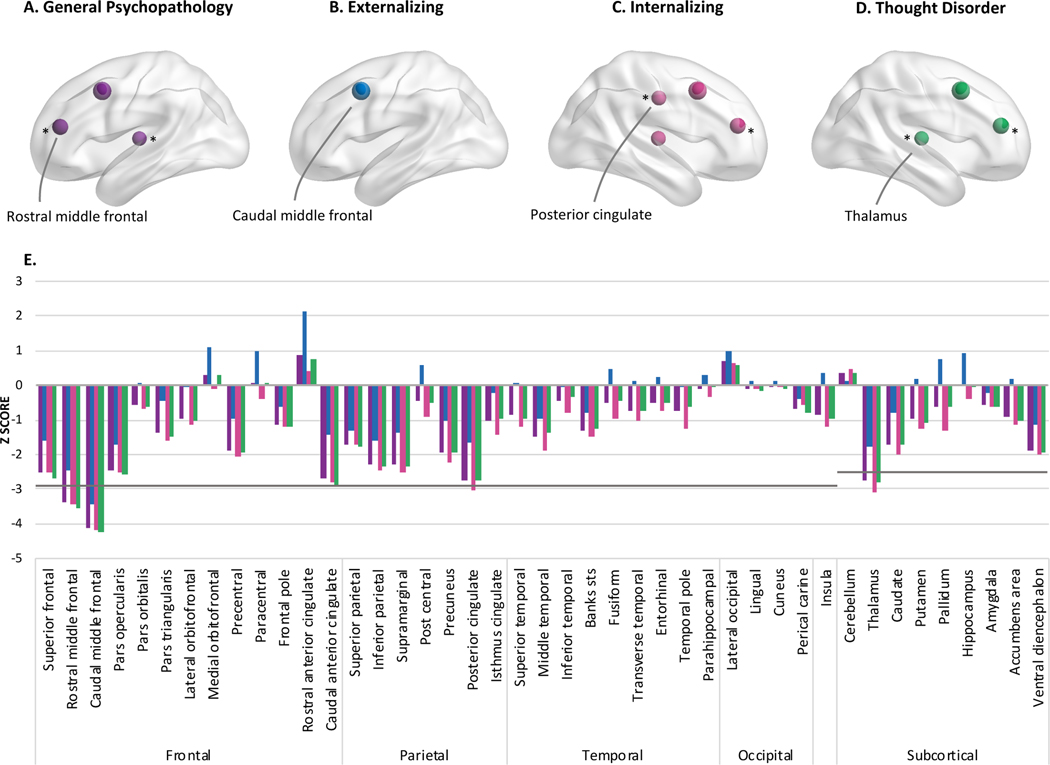
Results: All dimensions of psychopathology were commonly characterized by hypoconnectivity within the dorsal attention and retrosplenial-temporal networks, hyperconnectivity between the frontoparietal and ventral attention networks and between the dorsal attention network and amygdala, and hypoactivation of the caudal middle frontal gyrus. Externalizing pathology was uniquely associated with hyperconnectivity between the salience and ventral attention networks and hyperactivation of the cingulate and striatum. Internalizing pathology was uniquely characterized by hypoconnectivity between the default mode and cingulo-opercular networks. Connectivity between the cingulo-opercular network and putamen was uniquely higher for internalizing pathology and lower for thought disorder pathology.

Conclusions: These findings provide novel evidence that broad psychopathology dimensions are characterized by common and dissociable patterns, particularly for externalizing pathology, of functional connectivity and task-evoked activation throughout neurocognitive networks in preadolescence.

Keywords: Functional connectivity; Functional magnetic resonance imaging; Mental disorder; Neural activation; Preadolescence; Psychopathology.


Conflict of interest statement

Disclosures

The authors declare no biomedical financial interests or potential conflicts of interest.

Figures
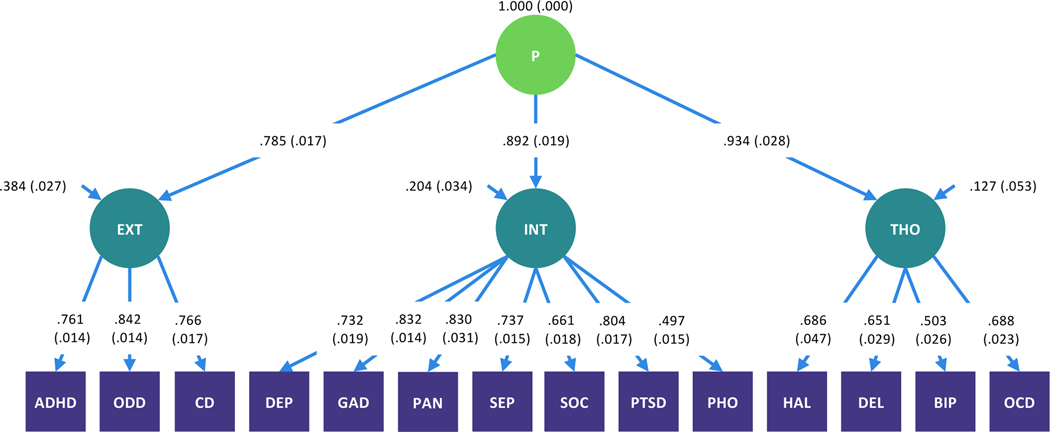
Figure 1
Figure 1
Higher order model of the structure of psychopathology in preadolescents. N=11,721. ADHD=attention deficit hyperactivity disorder, ODD=oppositional defiant disorder, CD=conduct disorder, DEP=major depressive disorder, GAD=generalized anxiety disorder, PAN=panic disorder, SEP=separation anxiety disorder, SOC=social anxiety disorder, PTSD=post-traumatic stress disorder, PHO=specific phobia, HAL=hallucinations, DEL=delusions, BIP=bipolar disorder, OCD=obsessive-compulsive disorder.
Figure 2
Figure 2
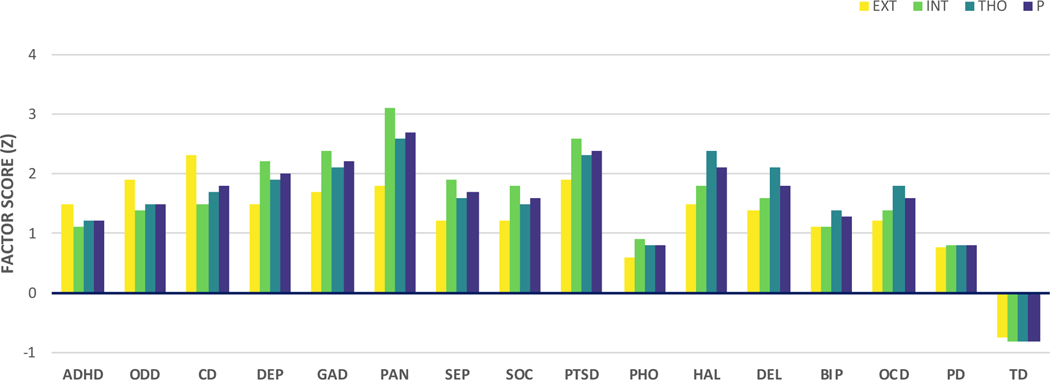
Mean factor scores of each psychopathology dimension for each case-control diagnostic category. ADHD=attention deficit hyperactivity disorder, ODD=oppositional defiant disorder, CD=conduct disorder, DEP=major depressive disorder, GAD=generalized anxiety disorder, PAN=panic disorder, SEP=separation anxiety disorder, SOC=social anxiety disorder, PTSD=post-traumatic stress disorder, PHO=specific phobia, HAL=hallucinations, DEL=delusions, BIP=bipolar disorder, OCD=obsessive-compulsive disorder, PD=any psychiatric disorder, TD=typically developing (i.e., those who did not meet criteria for any lifetime mental disorder).
Figure 3
Figure 3
A-D illustrate alterations in connectivity patterns within and between large-scale networks, and E-H illustrate alterations in connectivity between networks and bilateral subcortical regions, when adjusting for sex and race/ethnicity. Associations marked with an asterisk (*) or hash (#) were no longer significant when adjusting for cognitive function or parental education, respectively. Line thickness reflects relative strength of associations within each dimension. N=9,074. AUD = auditory, COP = cingulo-opercular, CPA = cingulo-parietal, DMN = default mode, DAT = dorsal attention, FPT = frontoparietal, RST = retrosplenial-temporal, SMH = sensorimotor-hand, SMM = sensorimotor-mouth, SAL = salience, VAT = ventral attention, VIS = visual.
Figure 4
Figure 4
A-B illustrate alterations in connectivity patterns within and between large-scale networks, and C-E alterations in connectivity between networks and bilateral subcortical regions, when adjusting for sex and race/ethnicity. Associations marked with an asterisk (*) or hash (#) were no longer significant when adjusting for cognitive function or parental education, respectively. Line thickness reflects relative strength of associations within each dimension. N=9,074. AUD = auditory, COP = cingulo-opercular, CPA = cingulo-parietal, DMN = default mode, DAT = dorsal attention, FPT = frontoparietal, RST = retrosplenial-temporal, SMH = sensorimotor-hand, SMM = sensorimotor-mouth, SAL = salience, VAT = ventral attention, VIS = visual.
Figure 5
Figure 5
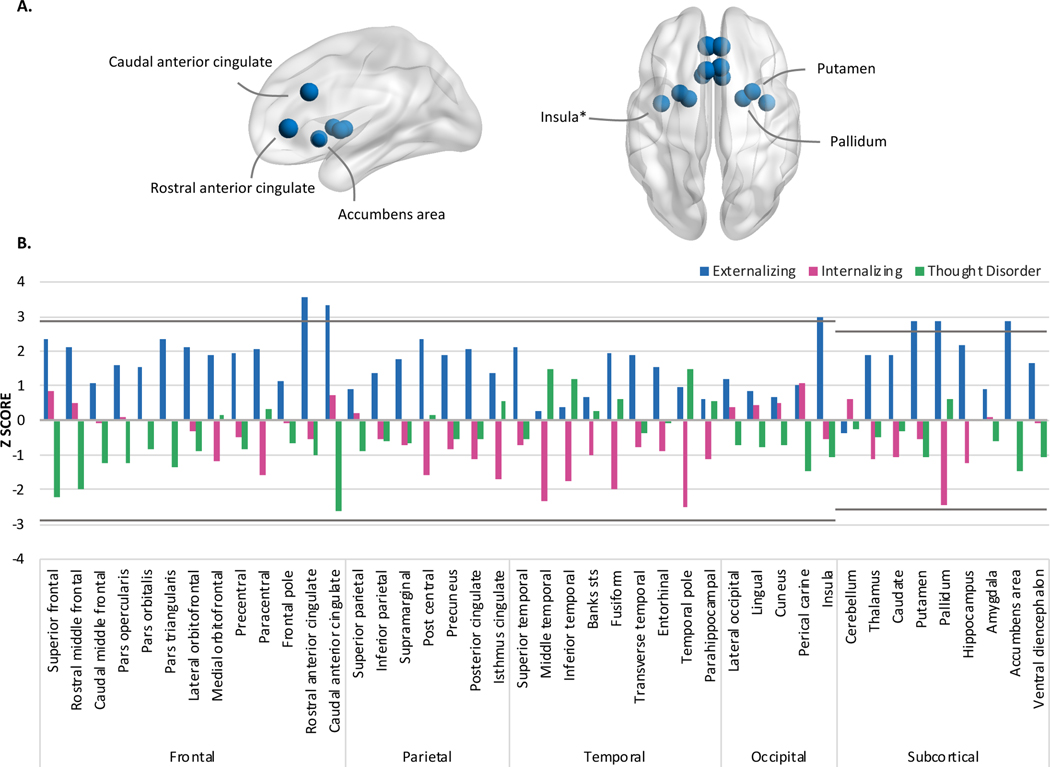
Lower task-evoked activation during the Emotional N-back task (2 vs 0 contrast) was observed for dimensions of psychopathology in the middle frontal gyrus (A,C,D), posterior cingulate (C), and thalamus (A,C,D). Associations in A-D marked with an asterisk (*) or hash (#) were no longer significant when adjusting for cognitive function or parental education, respectively. E illustrates the Z-scores for all parcellations and segmentations examined when entered as predictors into mixed models separately. N=6,146. The nodes on the brain figures represent the location where activation differed for youth with higher psychopathology factor scores and the size corresponds to the z-score.
Figure 6
Figure 6
A illustrates the regions exhibiting heightened connectivity which is uniquely associated with externalizing pathology during the Emotional N-back task (2 vs 0 contrast). Associations marked with an asterisk (*) or hash (#) were no longer significant when adjusting for cognitive function or parental education, respectively. B illustrates the Z-scores for all parcellations and segmentations when examined in multiple regression framework. N=6,146. The nodes on the brain figures represent the location where activation differed for youth with higher externalizing pathology factor scores and the size corresponds to the z-score.

References

    1. Caspi A, Houts RM, Ambler A, Danese A, Elliott ML, Hariri A, et al. Longitudinal Assessment of Mental Health Disorders and Comorbidities Across 4 Decades Among Participants in the Dunedin Birth Cohort Study. JAMA Network Open. 2020;3(4):e203221-e. - PMC - PubMed
    1. Kessler RC, Amminger GP, Aguilar-Gaxiola S, Alonso J, Lee S, Ustün TB. Age of onset of mental disorders: a review of recent literature. Curr Opin Psychiatry. 2007;20(4):359–64. - PMC - PubMed
    1. Kessler RC, Petukhova M, Sampson NA, Zaslavsky AM, Wittchen HU. Twelve-month and lifetime prevalence and lifetime morbid risk of anxiety and mood disorders in the United States. Int J Methods Psychiatr Res. 2012;21(3):169–84. - PMC - PubMed
    1. Conway CC, Forbes MK, Forbush KT, Fried EI, Hallquist MN, Kotov R, et al. A Hierarchical Taxonomy of Psychopathology Can Transform Mental Health Research. Perspect Psychol Sci. 2019;14(3):419–36. - PMC - PubMed
    1. Caspi A, Moffitt TE. All for One and One for All: Mental Disorders in One Dimension. American Journal of Psychiatry. 2018;175(9):831–44. - PMC - PubMed

Publication types