


Poverty eradication and food security through agriculture in Africa: Rethinking objectives and entry points
- PMID: 33281227
- PMCID: PMC7684531
- DOI: 10.1177/0030727019888513
Poverty eradication and food security through agriculture in Africa: Rethinking objectives and entry points
Abstract
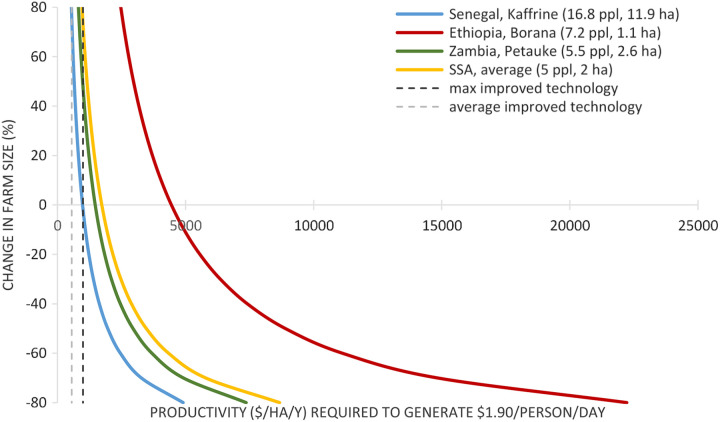
Agriculture in Africa is expected to meet the dual objectives of providing food and helping people to escape poverty. African agriculture is dominated by smallholdings and donors generally target their agricultural support at the smallholder sector. The expectation is that if the gap between actual and potential yields can be closed, smallholders will grow sufficient crops to feed their families, with a surplus to sell, thus meeting food security needs and bringing in an income to move them out of poverty. In practice, this is often not possible. While technologies already exist that can raise smallholder farmers' yields 3 or 4 times, even under rainfed conditions, the small size of land available to them limits how much can be grown and the per capita income from agriculture is insufficient to allow people to move above the current World Bank-defined poverty line of US$1.90 per day. We link this finding with farmer typologies to further explain that there are large differences between individual farming households themselves in terms of their investment incentives and capability to benefit from field-level technologies that are aimed at increasing farm productivity. We argue for more differentiated policies for agricultural development in Africa and suggest that policymakers should be much more aware of the heterogeneity of farms and target interventions accordingly. It is important to understand where and for whom agriculture will have the main purpose of ensuring food and nutritional security and where and for whom there is the potential for significant increases in incomes and a contribution to wider economic growth. Let us recognize the distinctiveness of these targets and underlying target groups and work towards solutions that address the underlying needs.
Keywords: Africa; Targeting; agricultural research for development; intensification; rural development; smallholder farmers.
© The Author(s) 2019.
Conflict of interest statement
Declaration of conflicting interests: The author(s) declared no potential conflicts of interest with respect to the research, authorship, and/or publication of this article.
Figures
References
-
- AGRA (2016) Africa agriculture status report 2016: progress towards agricultural transformation (Nairobi).
-
- CCAFS (2015) CCAFS household baseline survey 2010–2012. Harvard Dataverse. DOI: 10.7910/DVN/IUJQZV.
-
- Dercon S, Gilligan DO, Hoddinott J, et al. (2009) The impact of agricultural extension and roads on poverty and consumption growth in fifteen Ethiopian villages. American Journal of Agricultural Economics 91:1007–1021.
-
- Dercon S, Gollin D. (2014) Agriculture in African development: theories and strategies. Annual Review of Resource Economics 6:471–492.
-
- Dorward A, Anderson S, Bernal YN, et al. (2009) Hanging in, stepping up and stepping out: livelihood aspirations and strategies of the poor. Development in Practice 19:240–247.
LinkOut - more resources
Full Text Sources
Miscellaneous