Review
. 2020 Nov 13:11:531543.
doi: 10.3389/fimmu.2020.531543. eCollection 2020.

Maternal-Fetal Inflammation in the Placenta and the Developmental Origins of Health and Disease

Affiliations
Review

Maternal-Fetal Inflammation in the Placenta and the Developmental Origins of Health and Disease

Jeffery A Goldstein et al. Front Immunol. .

Abstract

Events in fetal life impact long-term health outcomes. The placenta is the first organ to form and is the site of juxtaposition between the maternal and fetal circulations. Most diseases of pregnancy are caused by, impact, or are reflected in the placenta. The purpose of this review is to describe the main inflammatory processes in the placenta, discuss their immunology, and relate their short- and long-term disease associations. Acute placental inflammation (API), including maternal and fetal inflammatory responses corresponds to the clinical diagnosis of chorioamnionitis and is associated with respiratory and neurodevelopmental diseases. The chronic placental inflammatory pathologies (CPI), include chronic villitis of unknown etiology, chronic deciduitis, chronic chorionitis, eosinophilic T-cell vasculitis, and chronic histiocytic intervillositis. These diseases are less-well studied, but have complex immunology and show mechanistic impacts on the fetal immune system. Overall, much work remains to be done in describing the long-term impacts of placental inflammation on offspring health.

Keywords: DOHaD; asthma; chorioamnionitis; chronic villitis; maternal-fetal inflammation; neurodevelopmental outcomes; placenta.


Figures

Figure 1
Figure 1
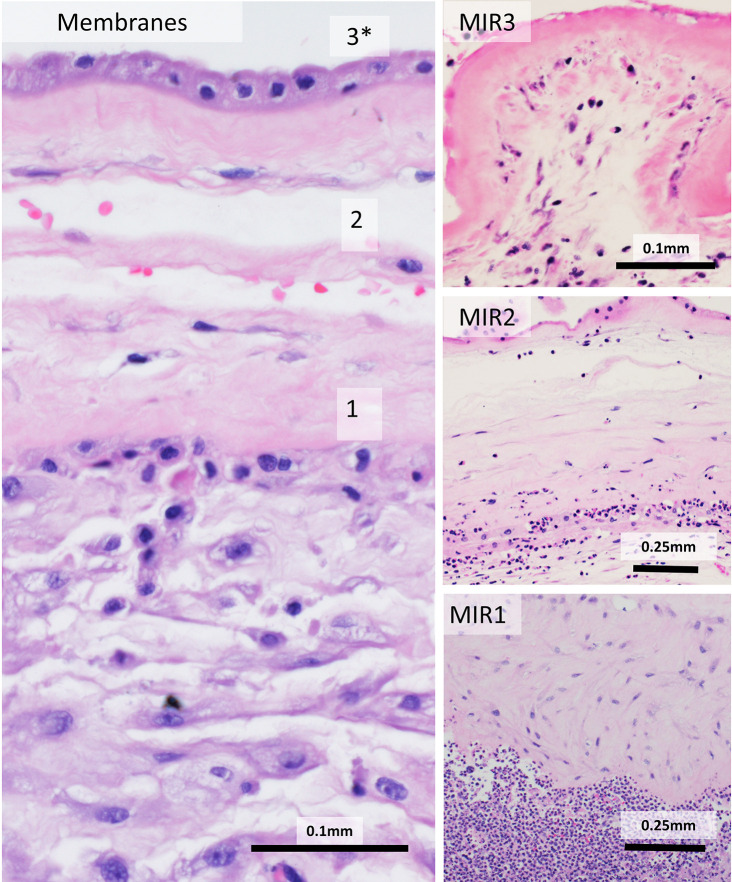
Maternal inflammatory response (MIR) stages: Normal membranes (left) contain amnion (top), fibrous chorion (middle) and decidua (bottom). Maternal inflammation is staged by the location and state of neutrophils. Neutrophils lined up at the decidua/chorion border are MIR1. Once neutrophils cross into the chorion, MIR2 is reached. Neutrophilic debris, death of amnion cells, and thickened basement membrane are diagnostic of MIR3.
Figure 2
Figure 2
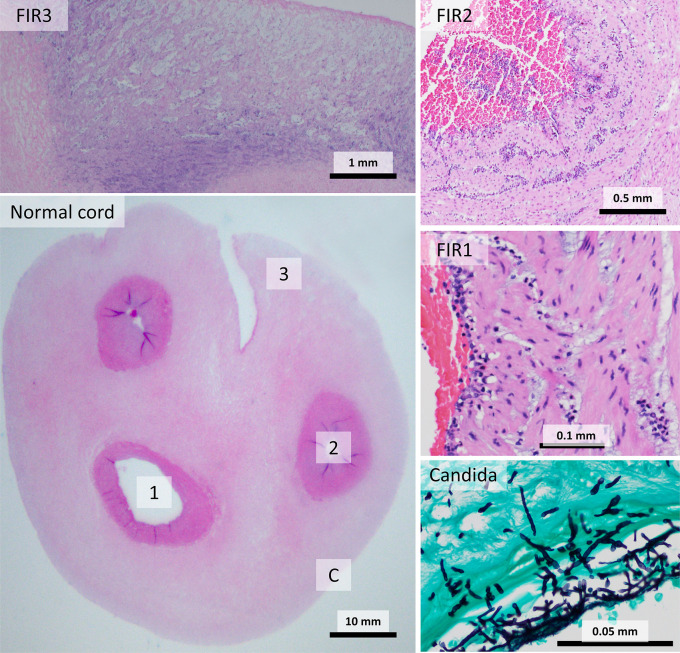
Fetal inflammatory response (FIR) stages: A normal umbilical cord (bottom left) includes two arteries (circular vessels) and one vein (larger, ovoid vessel) surrounded by Wharton’s jelly. FIR1 consists of inflammation of the vein. Arterial inflammation is diagnostic of FIR2. Inflammation of Wharton’s jelly with necrosis is FIR3. Candida infections produce peripheral abscesses with invasive organisms (Grocott Methenamine Silver stain).
Figure 3
Figure 3
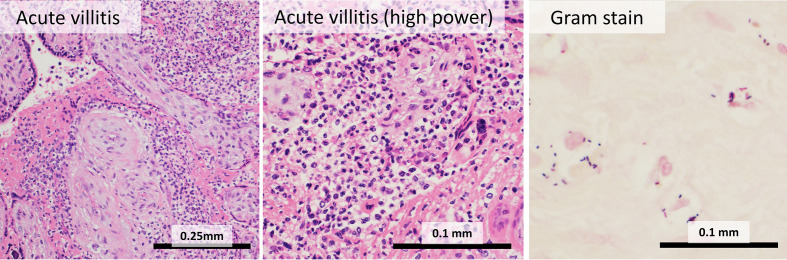
Acute villitis: In acute villitis, terminal villi show dense inflammation with fibrin. Gram stain demonstrates bacterial forms.
Figure 4
Figure 4
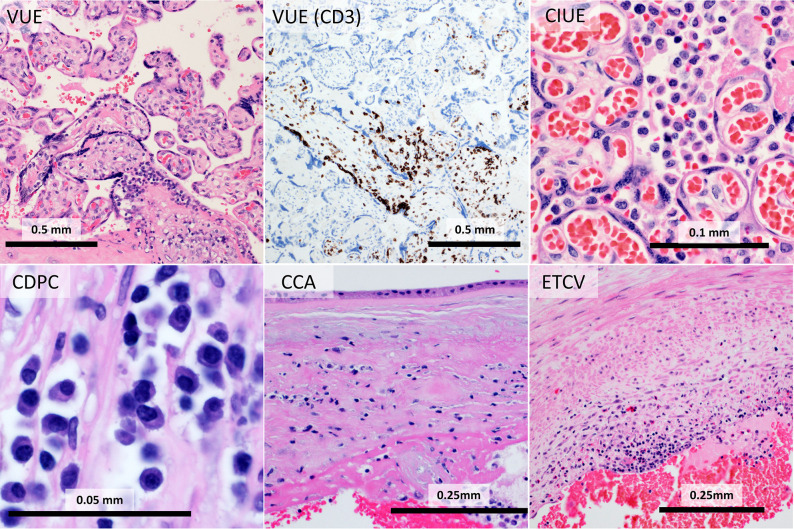
Chronic placental inflammation (CPI): In chronic villitis of unknown etiology (VUE), CD3-positive T-cells infiltrate fetal villi. Chronic intervillositis of unknown etiology (CIUE) is characterized by intense histiocytic inflammation filling the intervillous space. Chronic deciduitis with plasma cells (CDPC) shows plasmacytic inflammation in the decidua. Chronic chorionitis (CCA) consists of maternal T-cells in the chorion. In eosinophilic T-cell vasculitis (ETCV), fetal T-cells and eosinophils inflame fetal vessels.
Figure 5
Figure 5
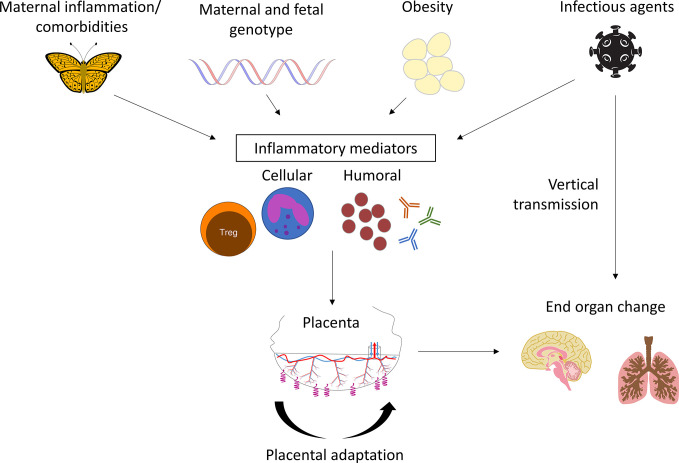
Model of placental inflammation in pregnancy: Maternal inflammation integrates maternal autoimmune diseases, genetic risk factors, obesity, and infectious organisms. Cellular and humoral mediators induce placental adaptation and maladaptation. The final results are lifelong abnormalities in end organ function.

References

    1. Wadhwa PD, Buss C, Entringer S, Swanson JM. Developmental origins of health and disease: brief history of the approach and current focus on epigenetic mechanisms. Semin Reprod Med (2009) 27:358–68. 10.1055/s-0029-1237424 - DOI - PMC - PubMed
    1. Norris SA, Daar A, Balasubramanian D, Byass P, Kimani-Murage E, Macnab A, et al. Understanding and acting on the developmental origins of health and disease in Africa would improve health across generations. Glob Health Action (2017) 10:1334985. 10.1080/16549716.2017.1334985 - DOI - PMC - PubMed
    1. Goldstein JA, Norris SA, Aronoff DM. DOHaD at the intersection of maternal immune activation and maternal metabolic stress: a scoping review. J Dev Orig Health Dis (2017) 8:273–83. 10.1017/S2040174417000010 - DOI - PubMed
    1. Helgertz J, Bengtsson T. The Long-Lasting Influenza: The Impact of Fetal Stress During the 1918 Influenza Pandemic on Socioeconomic Attainment and Health in Sweden, 1968-2012. Demography (2019) 56:1389–425. 10.1007/s13524-019-00799-x - DOI - PMC - PubMed
    1. Acquah JK, Dahal R, Sloan FA. 1918 Influenza Pandemic: In Utero Exposure in the United States and Long-Term Impact on Hospitalizations. Am J Public Health (2017) 107:1477–83. 10.2105/AJPH.2017.303887 - DOI - PMC - PubMed

Publication types

LinkOut - more resources