Review
. 2020 Nov 17:7:602088.
doi: 10.3389/fcvm.2020.602088. eCollection 2020.

Adipose Tissue Immunomodulation: A Novel Therapeutic Approach in Cardiovascular and Metabolic Diseases

Affiliations
Review

Adipose Tissue Immunomodulation: A Novel Therapeutic Approach in Cardiovascular and Metabolic Diseases

Ibrahim AlZaim et al. Front Cardiovasc Med. .

Abstract

Adipose tissue is a critical regulator of systemic metabolism and bodily homeostasis as it secretes a myriad of adipokines, including inflammatory and anti-inflammatory cytokines. As the main storage pool of lipids, subcutaneous and visceral adipose tissues undergo marked hypertrophy and hyperplasia in response to nutritional excess leading to hypoxia, adipokine dysregulation, and subsequent low-grade inflammation that is characterized by increased infiltration and activation of innate and adaptive immune cells. The specific localization, physiology, susceptibility to inflammation and the heterogeneity of the inflammatory cell population of each adipose depot are unique and thus dictate the possible complications of adipose tissue chronic inflammation. Several lines of evidence link visceral and particularly perivascular, pericardial, and perirenal adipose tissue inflammation to the development of metabolic syndrome, insulin resistance, type 2 diabetes and cardiovascular diseases. In addition to the implication of the immune system in the regulation of adipose tissue function, adipose tissue immune components are pivotal in detrimental or otherwise favorable adipose tissue remodeling and thermogenesis. Adipose tissue resident and infiltrating immune cells undergo metabolic and morphological adaptation based on the systemic energy status and thus a better comprehension of the metabolic regulation of immune cells in adipose tissues is pivotal to address complications of chronic adipose tissue inflammation. In this review, we discuss the role of adipose innate and adaptive immune cells across various physiological and pathophysiological states that pertain to the development or progression of cardiovascular diseases associated with metabolic disorders. Understanding such mechanisms allows for the exploitation of the adipose tissue-immune system crosstalk, exploring how the adipose immune system might be targeted as a strategy to treat cardiovascular derangements associated with metabolic dysfunctions.

Keywords: adipose tissue; adipose tissue browning; adipose tissue immunology; adipose tissue inflammation-definition of metabolic syndrome-insulin resistance-myokines-systemic inflammation; immunometabolism.


Figures

Figure 1
Figure 1
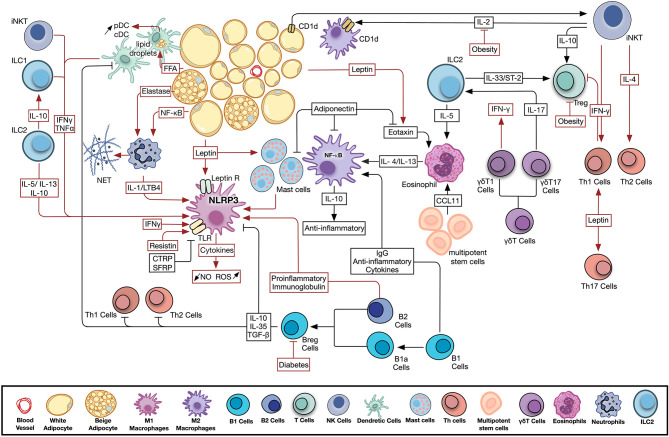
Adipose tissue resident and infiltrating immune cells activity in health and disease. Significant crosstalk exists among adipocytes, adipokines, and resident and infiltrating, innate and adaptive immune cells. Metabolic disease conditions modulate the adipokine profile and immune cell activity leading to the observed chronic low-grade inflammation. Pathways involved in AT homeostasis are depicted in black arrows, while those activated by metabolic dysfunction are shown in red. B Cell, B Lymphocyte; Breg Cells, Regulatory B Lymphocyte; CCL11, C-C motif chemokine 11; CD1d, Cluster of Differentiation 1d; cDC, Conventional Dendritic Cell; FFA, Free Fatty Acids; IFNγ, Interferon Gamma; IgG, Immunoglobulin G; IL, Interleukin; ILC, Innate Lymphoid Cell; iNKT Cell, Invariant Natural Killer T Cell; LTB4, Leukotriene B4; NET, Neutrophil Extracellular Trap; NF-κB, Nuclear Factor Kapp-light-chain-enhancer of Activated B cells; NLRP3, NLR Family Pyrin Domain Containing 3; NO, Nitric Oxide; pDC, Plasmacytoid Dendritic Cell; ROS, Reactive Oxygen Species; T Cell, T Lymphocyte; TGF-β, Transforming Growth Factor Beta; Th Cell, Helper T Lymphocyte; TLR, Toll Like Receptor; TNFα, Tumor Necrosis Factor Alpha; Treg, Regulatory T Lymphocyte.
Figure 2
Figure 2
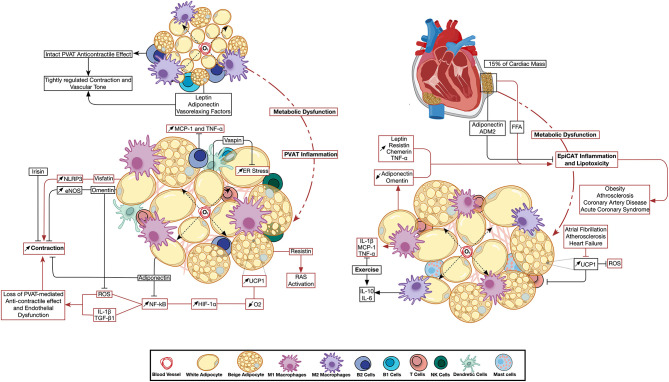
Perivascular and epicardiac adipose tissue dysfunction: the emerging role of immune cell and adipokine profile dysregulation. Metabolic impairment triggers changes in PVAT (left) and EpiCAT (right) adipokine environment and immune cell activity. Inflammation has a direct effect on the neighboring vascular and cardiac tissue. Changes in UCP1 expression were reported to have opposite effects in either depot. Pathways active in basal PVAT and EpiCAT homeostasis are depicted in black arrows, while those activated during inflammation are shown in red. ADM2, Adrenomedullin-2; eNOS, Endothelial Nitric Oxide Synthase; EpiCAT, Epicardial Adipose Tissue; ER Stress, Endoplasmic Reticulum Stress; HIF-1α, Hypoxia-induced Factor 1 Alpha; IL, Interleukin; MCP-1, Monocyte Chemoattractant Protein 1; NF-κB, Nuclear Factor Kapp-light-chain-enhancer of Activated B cells; NLRP3, NLR Family Pyrin Domain Containing 3; O2, Oxygen; PVAT, Perivascular Adipose Tissue; RAS, Renin Angiotensin System; ROS, Reactive Oxygen Species; TGF-β, Transforming Growth Factor Beta; TNFα, Tumor Necrosis Factor Alpha; UCP1, Uncoupling Protein 1.
Figure 3
Figure 3
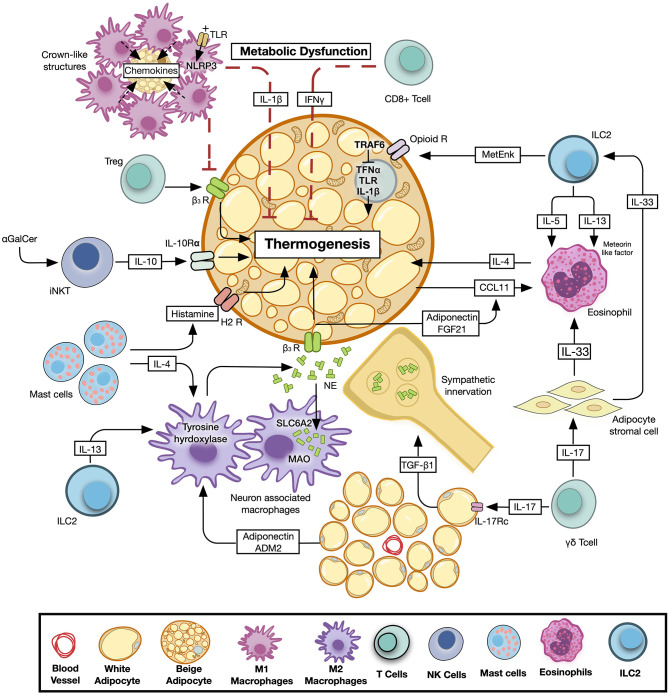
Immune cells-mediated regulation of adaptive thermogenesis. Different types of immune cells exert various modes of control on thermogenesis by either directly modulating the adipocyte function or affecting sympathetic nerve activity and norepinephrine turn-over. Pathways promoting thermogenesis are depicted in black, while inhibitory pathways are shown in red. ADM2, Adrenomedullin-1; β3-AR, Beta 3-adrenergic Receptor; CCL11, C-C motif chemokine 11; FGF21, Fibroblast Growth Factor 21; H2R, Histamine 2 Receptor; γGalCer, Alpha-galactosylceramide; IL, Interleukin; ILC, Innate Lymphoid Cell; MAO, Monoamine Oxidase; NE, Norepinephrine; Opioid R, Opioid Receptor; SCL6A2, Solute Carrier Family 6 Member 2; TGF-β, Transforming Growth Factor Beta; Treg, Regulatory T Lymphocyte.

References

    1. Guilherme A, Virbasius JV, Puri V, Czech MP. Adipocyte dysfunctions linking obesity to insulin resistance and type 2 diabetes. Nat Rev Mol Cell Biol. (2008) 9:367–77. 10.1038/nrm2391 - DOI - PMC - PubMed
    1. Chouchani ET, Kazak L, Spiegelman BM. New advances in adaptive thermogenesis: UCP1 and beyond. Cell Metab. (2019) 29:27–37. 10.1016/j.cmet.2018.11.002 - DOI - PubMed
    1. Zatterale F, Longo M, Naderi J, Raciti GA, Desiderio A, Miele C, et al. Chronic adipose tissue inflammation linking obesity to insulin resistance and type 2 diabetes. Front Physiol. (2020) 10:1607. 10.3389/fphys.2019.01607 - DOI - PMC - PubMed
    1. Lumeng CN, Saltiel AR. Inflammatory links between obesity and metabolic disease. J Clin Invest. (2011) 121:2111–7. 10.1172/JCI57132 - DOI - PMC - PubMed
    1. Kunath A, Klöting N. Adipocyte biology and obesity-mediated adipose tissue remodeling. Obes Med. (2016) 4:15–20. 10.1016/j.obmed.2016.10.001 - DOI