


Statin therapy and risk of Alzheimer's and age-related neurodegenerative diseases
- PMID: 33283039
- PMCID: PMC7687291
- DOI: 10.1002/trc2.12108
Statin therapy and risk of Alzheimer's and age-related neurodegenerative diseases
Abstract
Introduction: Establishing efficacy of and molecular pathways for statins has the potential to impact incidence of Alzheimer's and age-related neurodegenerative diseases (NDD).
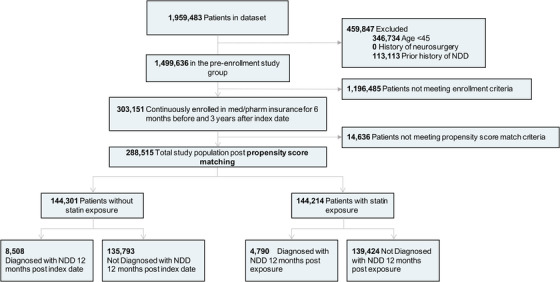
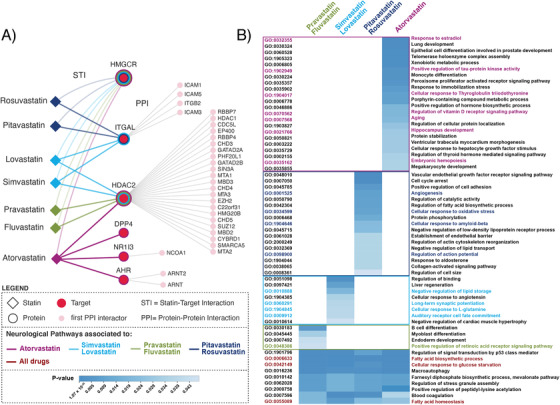
Methods: This retrospective cohort study surveyed US-based Humana claims, which includes prescription and patient records from private-payer and Medicare insurance. Claims from 288,515 patients, aged 45 years and older, without prior history of NDD or neurological surgery, were surveyed for a diagnosis of NDD starting 1 year following statin exposure. Patients were required to be enrolled with claims data for at least 6 months prior to first statin prescription and at least 3 years thereafter. Computational system biology analysis was conducted to determine unique target engagement for each statin.
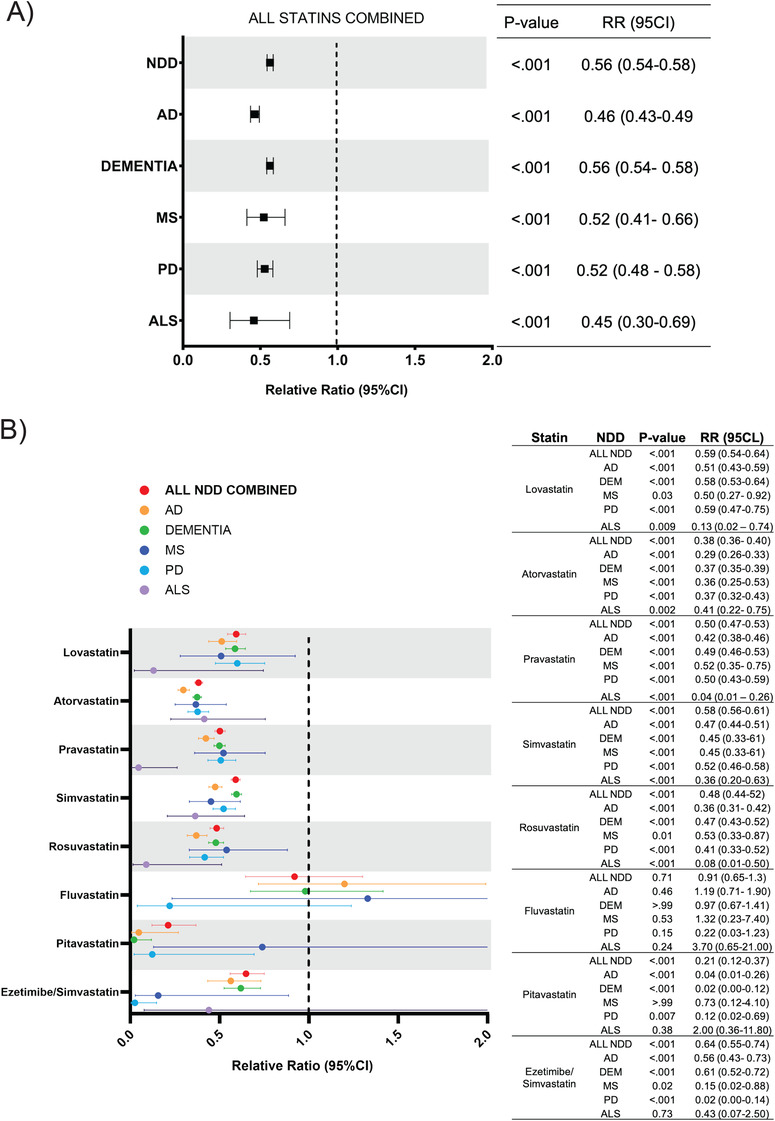
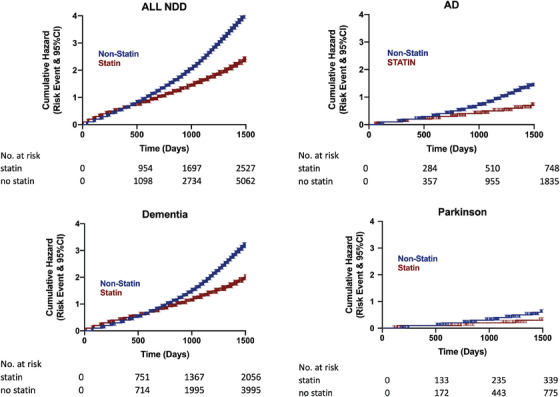
Results: Of the 288,515 participants included in the study, 144,214 patients (mean [standard deviation (SD)] age, 67.22 [3.8] years) exposed to statin therapies, and 144,301 patients (65.97 [3.2] years) were not treated with statins. The mean (SD) follow-up time was 5.1 (2.3) years. Exposure to statins was associated with a lower incidence of Alzheimer's disease (1.10% vs 2.37%; relative risk [RR], 0.4643; 95% confidence interval [CI], 0.44-0.49; P < .001), dementia 3.03% vs 5.39%; RR, 0.56; 95% CI, 0.54-0.58; P < .001), multiple sclerosis (0.08% vs 0.15%; RR, 0.52; 95% CI, 0.41-0.66; P < .001), Parkinson's disease (0.48% vs 0.92%; RR, 0.53; 95% CI, 0.48-0.58; P < .001), and amyotrophic lateral sclerosis (0.02% vs 0.05%; RR, 0.46; 95% CI, 0.30-0.69; P < .001). All NDD incidence for all statins, except for fluvastatin (RR, 0.91; 95% CI, 0.65-1.30; P = 0.71), was reduced with variances in individual risk profiles. Pathway analysis indicated unique and common profiles associated with risk reduction efficacy.
Discussion: Benefits and risks of statins relative to neurological outcomes should be considered when prescribed for at-risk NDD populations. Common statin activated pathways indicate overarching systems required for risk reduction whereas unique targets could advance a precision medicine approach to prevent neurodegenerative diseases.
Keywords: Alzheimer's disease; Parkinson's disease; age; amyotrophic lateral sclerosis; bioinformatics; biology pathway analysis; cholesterol; multiple sclerosis; neurodegenerative diseases; statins.
© 2020 The Authors. Alzheimer's & Dementia: Translational Research & Clinical Interventions published by Wiley Periodicals, Inc. on behalf of Alzheimer's Association.
Conflict of interest statement
Dr Brinton reported receiving grants from the Women's Alzheimer's Movement and the National Institute on Aging during the conduct of the study. No other disclosures were reported.
Figures
References
-
- Gooch C, Pracht E, Borenstein AR. The burden of neurological disease in the United States: a summary report and call to action. Ann Neurol. 2017;81(4):479‐484. - PubMed
-
- Alzheimer's Association. 2020 Alzheimer's disease facts and figures. Alzheimer's Dement. 2020:391‐460.
-
- National Multiple Sclerosis Society. https://www.nationalmssociety.org/. Accessed November 6, 2020.
-
- Parkinson's Foundation . https://www.parkinson.org/. Accessed November 6, 2020.
-
- Wu YT, Beiser AS, Breteler MMB, et al. The changing prevalence and incidence of dementia over time‐current evidence. Nat Rev Neurol. 2017;13(6):327‐339. - PubMed
Grants and funding
LinkOut - more resources
Full Text Sources