


Distinct Cognitive Trajectories in Late Life and Associated Predictors and Outcomes: A Systematic Review
- PMID: 33283167
- PMCID: PMC7683100
- DOI: 10.3233/ADR-200232
Distinct Cognitive Trajectories in Late Life and Associated Predictors and Outcomes: A Systematic Review
Abstract
Background: Cognitive aging is a dynamic process in late life with significant heterogeneity across individuals.
Objective: To review the evidence for latent classes of cognitive trajectories and to identify the associated predictors and outcomes.
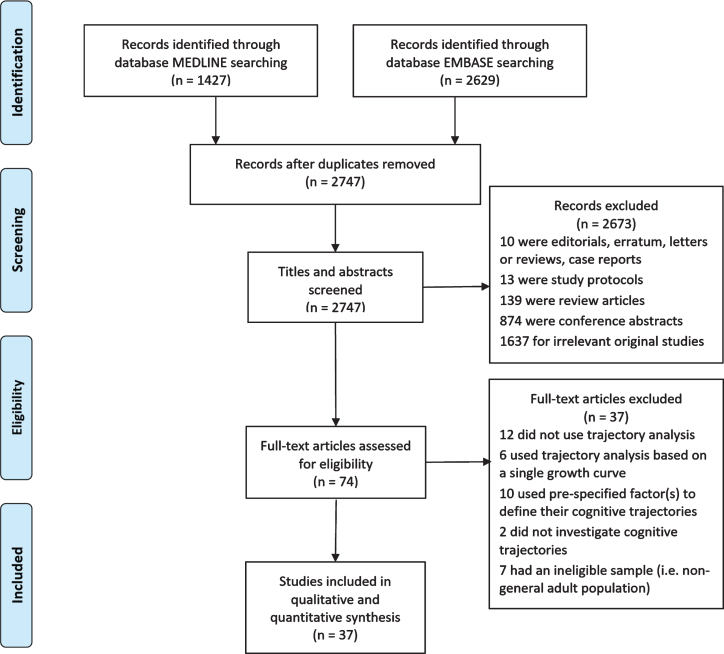
Methods: A systematic search was performed in MEDLINE and EMBASE for articles that identified two or more cognitive trajectories in adults. The study was conducted following the PRISMA statement.
Results: Thirty-seven studies were included, ranging from 219 to 9,704 participants, with a mean age of 60 to 93.4 years. Most studies (n = 30) identified distinct cognitive trajectories using latent class growth analysis. The trajectory profile commonly consisted of three to four classes with progressively decreasing baseline and increasing rate of decline-a 'stable-high' class characterized as maintenance of cognitive function at high level, a 'minor-decline' class or 'stable-medium' class that declines gradually over time, and a 'rapid-decline' class with the steepest downward slope. Generally, membership of better classes was predicted by younger age, being female, more years of education, better health, healthier lifestyle, higher social engagement and lack of genetic risk variants. Some factors (e.g., education) were found to be associated with cognitive function over time only within individual classes.
Conclusion: Cognitive aging in late life is a dynamic process with significant inter-individual variability. However, it remains unclear whether similar patterns of cognitive aging are observed across all cognitive domains. Further research into unique factors which promote the maintenance of high-cognitive function is needed to help inform public policy.
Keywords: Cognitive function; longitudinal; older adults; prospective; risk factors; trajectory.
© 2020 – IOS Press and the authors. All rights reserved.
Conflict of interest statement
The authors have no conflict of interest to report.
Figures
References
-
- World Health Organization, What is Healthy Ageing?, Copyright World Health Organization (WHO) 2020, https://www.who.int/ageing/healthy-ageing/en/, Accessed on March 3, 2020.
-
- Bellou V, Belbasis L, Tzoulaki I, Middleton LT, Ioannidis JPA, Evangelou E (2017) Systematic evaluation of the associations between environmental risk factors and dementia: An umbrella review of systematic reviews and meta-analyses. Alzheimers Dement 13, 406–418. - PubMed
-
- Sun JH, Tan L, Wang HF, Tan MS, Tan L, Li JQ, Xu W, Zhu XC, Jiang T, Yu JT (2015) Genetics of vascular dementia: Systematic review and meta-analysis. J Alzheimers Dis 46, 611–629. - PubMed
Publication types
LinkOut - more resources
Full Text Sources
