. 2020 Dec 7;9(12):giaa134.
doi: 10.1093/gigascience/giaa134.

Accurate assembly of the olive baboon (Papio anubis) genome using long-read and Hi-C data

Affiliations

Accurate assembly of the olive baboon (Papio anubis) genome using long-read and Hi-C data

Sanjit Singh Batra et al. Gigascience. .

Abstract

Background: Baboons are a widely used nonhuman primate model for biomedical, evolutionary, and basic genetics research. Despite this importance, the genomic resources for baboons are limited. In particular, the current baboon reference genome Panu_3.0 is a highly fragmented, reference-guided (i.e., not fully de novo) assembly, and its poor quality inhibits our ability to conduct downstream genomic analyses.

Findings: Here we present a de novo genome assembly of the olive baboon (Papio anubis) that uses data from several recently developed single-molecule technologies. Our assembly, Panubis1.0, has an N50 contig size of ∼1.46 Mb (as opposed to 139 kb for Panu_3.0) and has single scaffolds that span each of the 20 autosomes and the X chromosome.

Conclusions: We highlight multiple lines of evidence (including Bionano Genomics data, pedigree linkage information, and linkage disequilibrium data) suggesting that there are several large assembly errors in Panu_3.0, which have been corrected in Panubis1.0.


Conflict of interest statement

The authors declare that they have no competing interests.

Figures
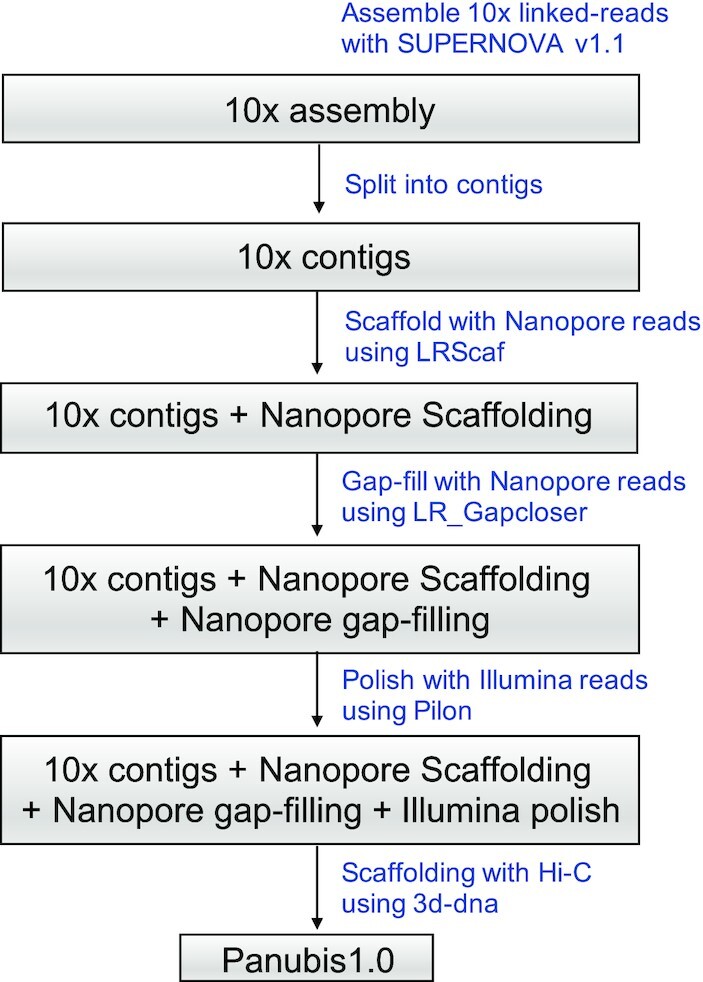
Figure 1:
Figure 1:
Illustration of our genome assembly strategy.
Figure 2:
Figure 2:
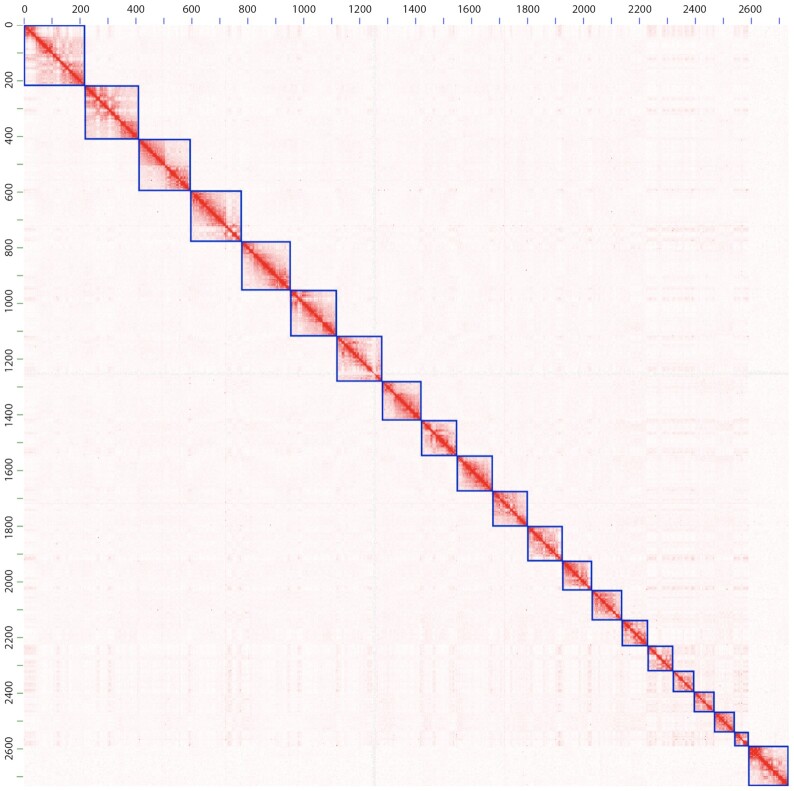
Hi-C map of our Panubis1.0 genome. The figure represents the Hi-C map obtained by aligning Hi-C paired-end reads to the Panubis1.0 genome assembly laid out on the X-axis as well as the Y-axis. Because each read-pair consists of 2 reads, a position (i, j) on this map represents the number of read-pairs where one read aligned to position i and the other read aligned to position j on the Panubis1.0 genome. The intensity of each pixel in this Hi-C map represents the number of reads aligning within that bin. The Hi-C map has been drawn at a resolution of 1.25 Mb. Each blue square on the diagonal represents a chromosome-length scaffold. Autosomes are listed first, ordered by size, and the last square corresponds to the X chromosome. The axes are labeled in units of megabases.
Figure 3:
Figure 3:
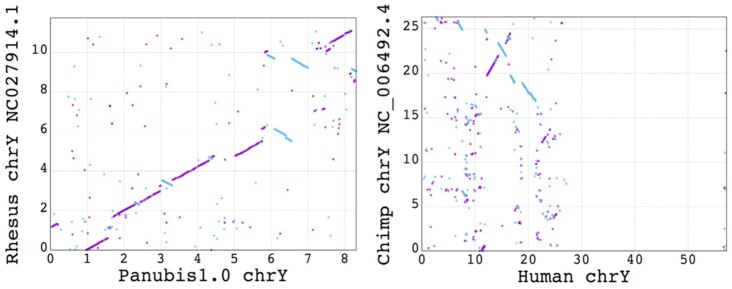
Dot plots showing chromosome Y synteny suggest that the Panubis1.0 chromosome Y is putatively at least a part of the true chromosome Y. A dot plot between rhesus chromosome Y and Panubis1.0 putative chromosome Y is shown on the left, while a dot plot between the chimpanzee chromosome Y and the human chromosome Y is shown on the right. Each dot represents an aligned block, with purple representing an alignment on the positive strand and cyan an alignment on the negative strand. The axis labels are in units of megabases. The phylogenetic distance between baboon and rhesus macaque is similar to that between human and chimpanzee. Hence, the broadly conserved synteny between the rhesus and baboon putative chromosome Y as compared to the synteny between the chimp and human chromosome Y suggests that the scaffold representing the putative chromosome Y in the Panubis1.0 assembly is indeed capturing at least a large part of chromosome Y.
Figure 4:
Figure 4:
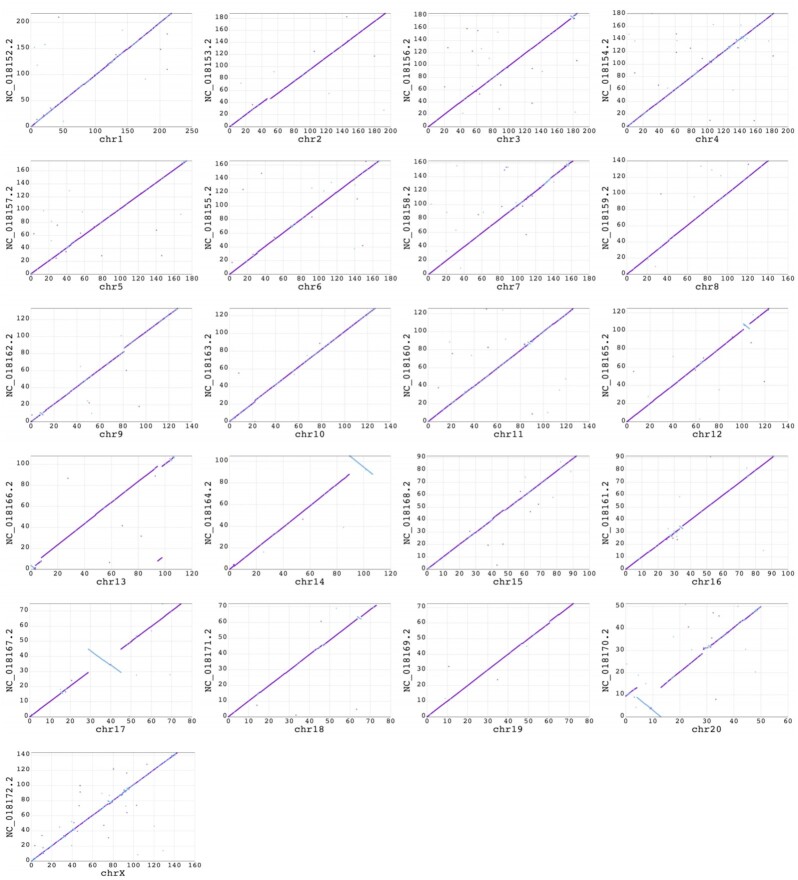
Dot plots showing alignment of Panu_3.0 reference-assisted chromosomes vs Panubis1.0 chromosome-length scaffolds. The Panu_3.0 assembly is shown on the Y-axis and the Panubis1.0 assembly is shown on the X-axis. Each dot represents the position of a syntenic block between the 2 assemblies as determined by the nucmer alignment. The color of the dot reflects the orientation of the individual alignments (purple indicates consistent orientation and blue indicates inconsistent orientation). The dot plots illustrate that there are chromosomes containing large inversions and translocations in the Panu_3.0 assembly with respect to the Panubis1.0 assembly.
Figure 5:
Figure 5:
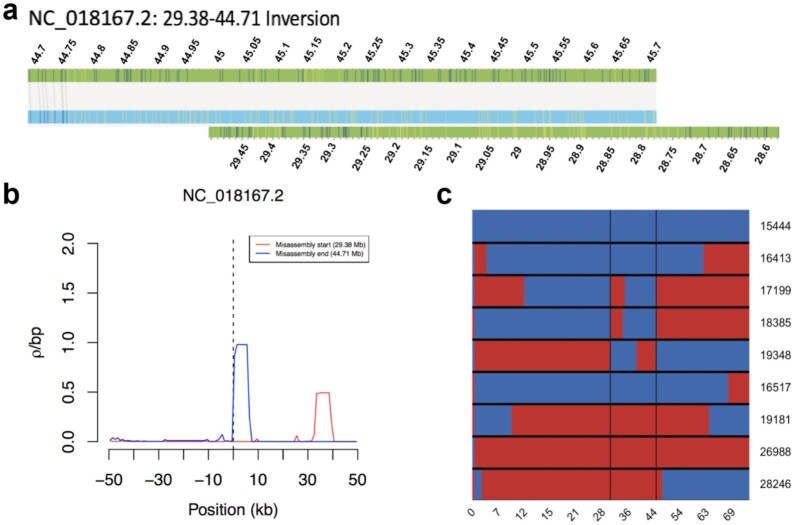
Evidence for misassembly on chromosome NC_018167.2 in Panu_3.0. (a) Bionano optical map alignment to the Panu_3.0 assembly demonstrates an inversion on chromosome NC_018167.2 beginning at ∼29.38 Mb and ending at ∼44.71 Mb. (b) Estimates of the population recombination rate ρ near the potential synteny breaks of the inversion identified on chromosome NC_018167.2. (c) The x-axis shows positions along chromosome NC_018167.2 in Panu_3.0, where each row represents 1 of the 9 offspring of sire 10,173. Switches between red and blue within a row represent a recombination event. The 2 vertical black lines represent locations where ≥3 recombinations occur at the same locus, indicating a potential misassembly.
Figure 6:
Figure 6:
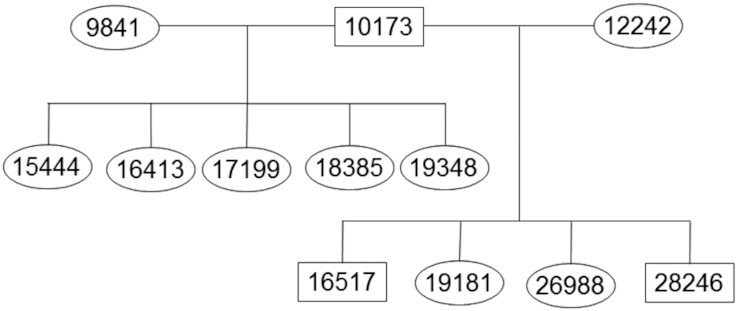
Pedigree of baboons used in linkage analysis. Circles represent females, and squares, males.

References

    1. VandeBerg JL, Williams-Blangero S, Tardif SD, eds. The Baboon in Biomedical Research. Springer; 2009.
    1. McGill HC, McMahan CA, Kruski AW, et al. Responses of serum lipoproteins to dietary cholesterol and type of fat in the baboon. Arteriosclerosis. 1981;1:337–44. - PubMed
    1. Kushwaha RS, Reardon CA, Lewis DS, et al. Effect of dietary lipids on plasma activity and hepatic mRNA levels of cholesteryl ester transfer protein in high- and low-responding baboons (Papio species). Metabolism. 1994;43:1006–12. - PubMed
    1. Singh AT, Rainwater DL, Kammerer CM, et al. Dietary and genetic effects on LDL size measures in baboons. Arterioscler Thromb Vasc Biol. 1996;16:1448–53. - PubMed
    1. Kammerer CM, Rainwater DL, Cox LA, et al. Locus controlling LDL cholesterol response to dietary cholesterol is on baboon homologue of human chromosome 6. Arterioscler Thromb Vasc Biol. 2002;22:1720–5. - PubMed

Publication types