


The Escherichia coli FadR transcription factor: Too much of a good thing?
- PMID: 33283913
- PMCID: PMC8180525
- DOI: 10.1111/mmi.14663
The Escherichia coli FadR transcription factor: Too much of a good thing?
Abstract
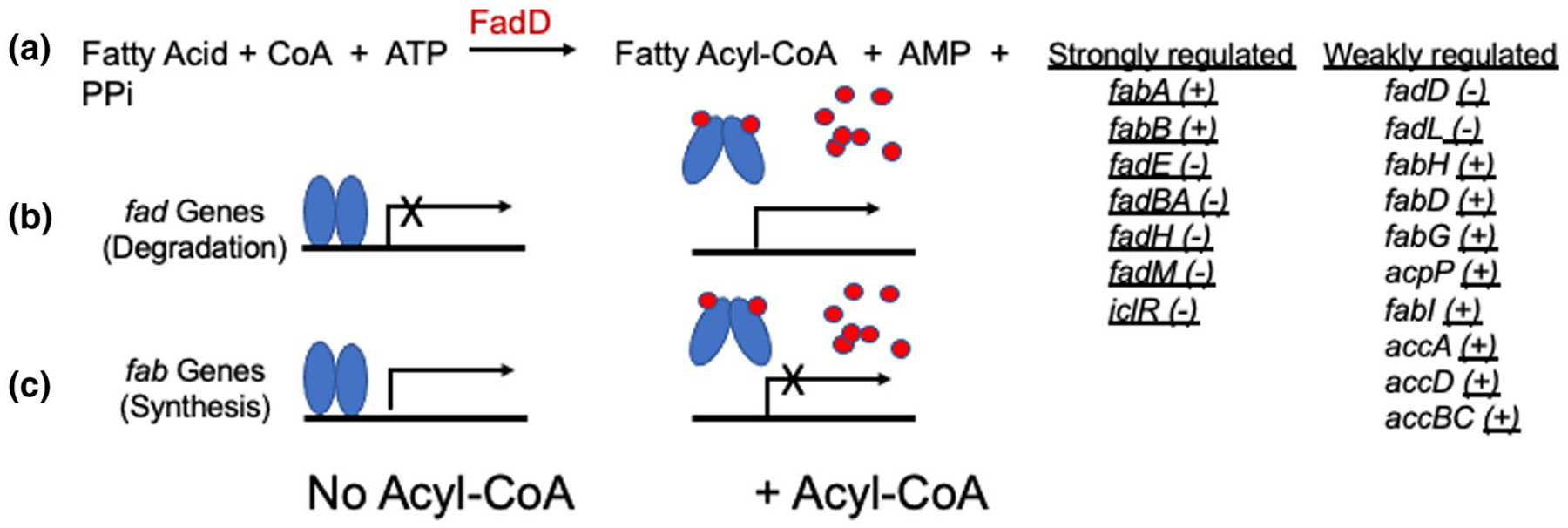
Escherichia coli FadR is a transcription factor regulated by acyl-CoA thioester binding that optimizes fatty acid (FA) metabolism in response to environmental FAs. FadR represses the fad genes of FA degradation (β-oxidation) and activates the fab genes of FA synthesis thereby allowing E. coli to have its cake (acyl chains for phospholipid synthesis) and eat it (degrade acyl chains to acetyl-CoA). Acyl-CoA binding of FadR derepresses the transcription of the fad genes and cancels fab gene transcriptional activation. Activation of fab genes was thought restricted to the fabA and fabB genes of unsaturated FA synthesis, but FadR overproduction markedly increases yields of all FA acyl chains. Subsequently, almost all of the remaining fab genes were shown to be transcriptionally activated by FadR binding, but binding was very weak. Why are the low-affinity sites retained? What effects on cell physiology would result from their conversion to high-affinity sites (thereby mimicking FadR overproduction)? Investigations of E. coli cell size determinants showed that FA synthesis primarily determines E. coli cell size. Upon modest induction of FadR, cell size increases, but at the cost of growth rate and accumulation of intracellular membranes. Greater induction resulted in further growth rate decreases and abnormal cells. Hence, too much FadR is bad. FadR is extraordinarily conserved in γ-proteobacteria but has migrated. Mycobacterium tuberculosis encodes FadR orthologs one of which is functional in E. coli. Strikingly, the FadR theme of acyl-CoA-dependent transcriptional regulation is found in a different transcription factor family where two Bacillus species plus bacterial and archaeal thermophiles contain related proteins of similar function.
Keywords: FadR; Fatty acid synthesis; acyl-CoA; binding sites; thioesterase.
© 2020 John Wiley & Sons Ltd.
Figures
References
-
- Agari Y, Agari K, Sakamoto K, Kuramitsu S and Shinkai A (2011) TetR-family transcriptional repressor Thermus thermophilus FadR controls FA degradation. Microbiology, 157,1589–1601. - PubMed
-
- Campbell JW, Morgan-Kiss RM and Cronan JE (2003) A new Escherichia coli metabolic competency: growth on fatty acids by a novel anaerobic β-oxidation pathway. Molecular Microbiology, 47, 793–805. - PubMed
-
- Carranza G, Angius F, Ilioaia O, Solgadi A, Miroux B and Arechaga I (2017) Cardiolipin plays an essential role in the formation of intracellular membranes in Escherichia coli. Biochimica et Biophysica Acta (BBA) - Biomembranes, 1859,1124–1132. - PubMed
Publication types
MeSH terms
Substances
Grants and funding
LinkOut - more resources
Full Text Sources
Research Materials
Miscellaneous
