


Neutrophil-to-lymphocyte ratio predicts early mortality in females with metastatic triple-negative breast cancer
- PMID: 33284847
- PMCID: PMC7721150
- DOI: 10.1371/journal.pone.0243447
Neutrophil-to-lymphocyte ratio predicts early mortality in females with metastatic triple-negative breast cancer
Abstract
Background: The aim of this study was to determine the utility of the neutrophil-to-lymphocyte ratio (NLR) as a biomarker for predicting early-mortality (<2 years) among females with metastatic triple-negative breast cancer (mTNBC).
Methods: We reviewed 118 medical records of females with mTNBC. The cut-off value for the NLR (<2.5 and ≥2.5) was determined with receiver operating characteristic curves (area under the curve: 0.73; 95% CI: 0.62-0.85). Survival curves were estimated using the Kaplan-Meier method and compared with the Log-rank test. Multivariate Cox regression was used to identify the risk of mortality at two years. Moreover, we performed sensitivity analyses with different cut-off values and a subgroup analysis in females that only received chemotherapy.
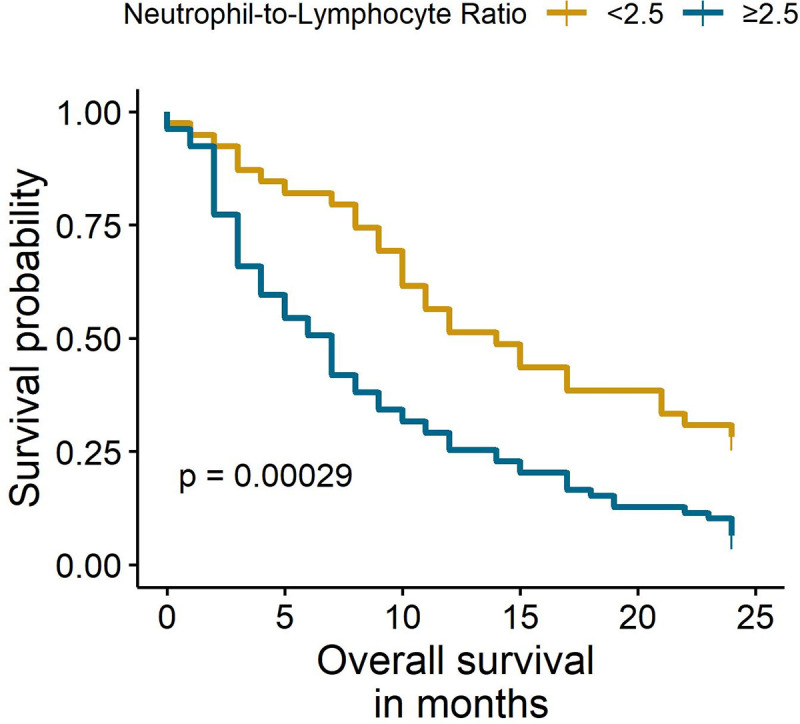
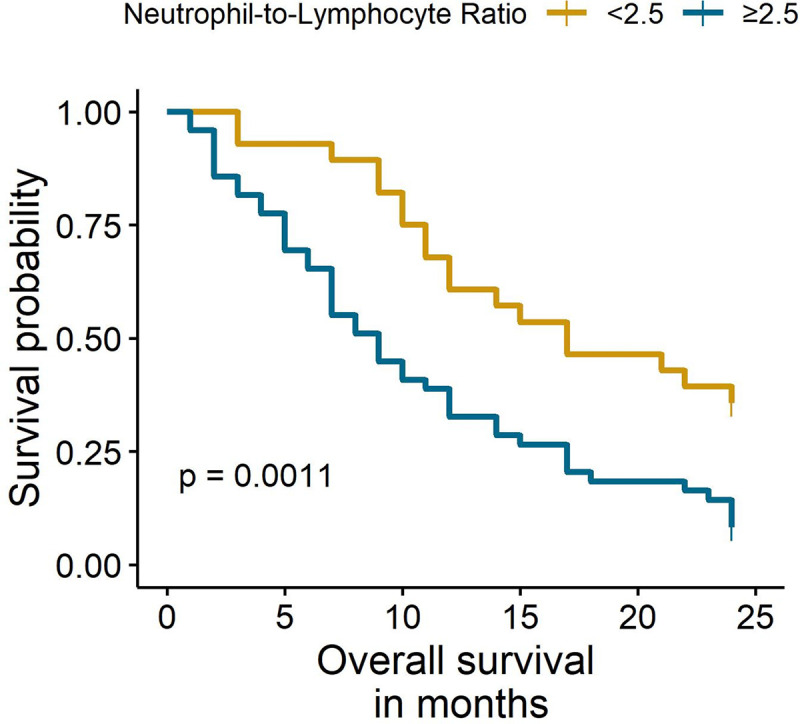
Results: The median follow-up was 24 months. Females with NLR ≥2.5 had a poor overall survival compared to females with NLR <2.5 (6% vs. 28%, p<0.001) at two years. This outcome remained when we stratified for females that only received chemotherapy (8% vs. 36%, p = 0.001). Multivariate analyses identified NLR ≥2.5 as a poor prognostic risk factor for mortality in the entire population (HR: 2.12, 95% CI: 1.32-3.39) and among females that received chemotherapy (HR: 2.68, 95% CI: 1.46-4.92).
Conclusion: The NLR is an accessible and reliable biomarker that predicts early mortality among females with mTNBC. Our results suggest that females with high NLR values have poor prognosis despite receiving standard chemotherapy. Health providers should evaluate the possibility to enroll these patients in novel immunotherapy trials.
Conflict of interest statement
The authors have declared that no competing interests exist.
Figures
References
-
- National Comprehensive Cancer Network. Breast Cancer (Version 3.2018). [cited January 3, 2020]. Available from: https://www.nccn.org/professionals/physician_gls/pdf/breast.pdf.
-
- Lara‐Medina F, Pérez‐Sánchez V, Saavedra‐Pérez D, Blake‐Cerda M, Arce C, Motola‐Kuba D, et al. Triple‐negative breast cancer in Hispanic patients: high prevalence, poor prognosis, and association with menopausal status, body mass index, and parity. Cancer. 2011;117(16):3658–69. 10.1002/cncr.25961 - DOI - PubMed
MeSH terms
Substances
LinkOut - more resources
Full Text Sources
