Review
. 2021 May 6:50:31-51.
doi: 10.1146/annurev-biophys-062420-081842. Epub 2020 Dec 7.

The Mechanosensory Transduction Machinery in Inner Ear Hair Cells

Affiliations
Review

The Mechanosensory Transduction Machinery in Inner Ear Hair Cells

Wang Zheng et al. Annu Rev Biophys. .

Abstract

Sound-induced mechanical stimuli are detected by elaborate mechanosensory transduction (MT) machinery in highly specialized hair cells of the inner ear. Genetic studies of inherited deafness in the past decades have uncovered several molecular constituents of the MT complex, and intense debate has surrounded the molecular identity of the pore-forming subunits. How the MT components function in concert in response to physical stimulation is not fully understood. In this review, we summarize and discuss multiple lines of evidence supporting the hypothesis that transmembrane channel-like 1 is a long-sought MT channel subunit. We also review specific roles of other components of the MT complex, including protocadherin 15, cadherin 23, lipoma HMGIC fusion partner-like 5, transmembrane inner ear, calcium and integrin-binding family member 2, and ankyrins. Based on these recent advances, we propose a unifying theory of hair cell MT that may reconcile most of the functional discoveries obtained to date. Finally, we discuss key questions that need to be addressed for a comprehensive understanding of hair cell MT at molecular and atomic levels.

Keywords: MET; TMC1; deafness; hair cells; hearing; ion channel; mechanotransduction.


Figures
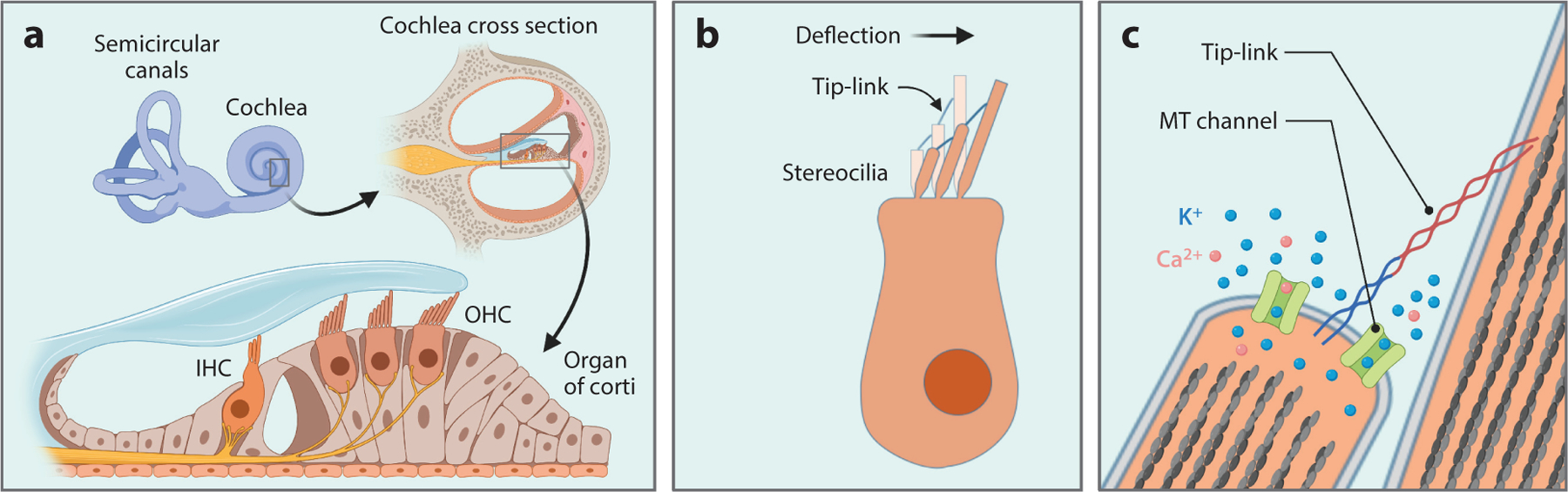
Figure 1
Figure 1
Schematic diagram illustrating the anatomy of the mammalian cochlea, hair cells, and mechanosensory transduction (MT) apparatus. (a) Illustration of three rows of outer hair cells (OHCs) and one row of inner hair cells (IHCs) in the organ of Corti in the cochlea of the inner ear. OHCs amplify input sound signals and connect to efferent neurons, while IHCs are innervated by afferent neuron fibers that carry sound information to the central nervous system. (b) Diagram of a hair cell showing the deflection of the hair bundle toward the tallest stereocilia in response to sound-induced vibration. The tops of shorter stereocilia are connected to the side walls of the next taller ones. (c) The opening of MT channels by tension in the tip-link during hair bundle deflection. MT channels are localized at the tips of shorter stereocilia near the lower end of the tip-link. Once activated, the channel pore carries K+ and Ca2+ ions from outside to inside the stereocilia, leading to depolarization of hair cells.
Figure 2
Figure 2
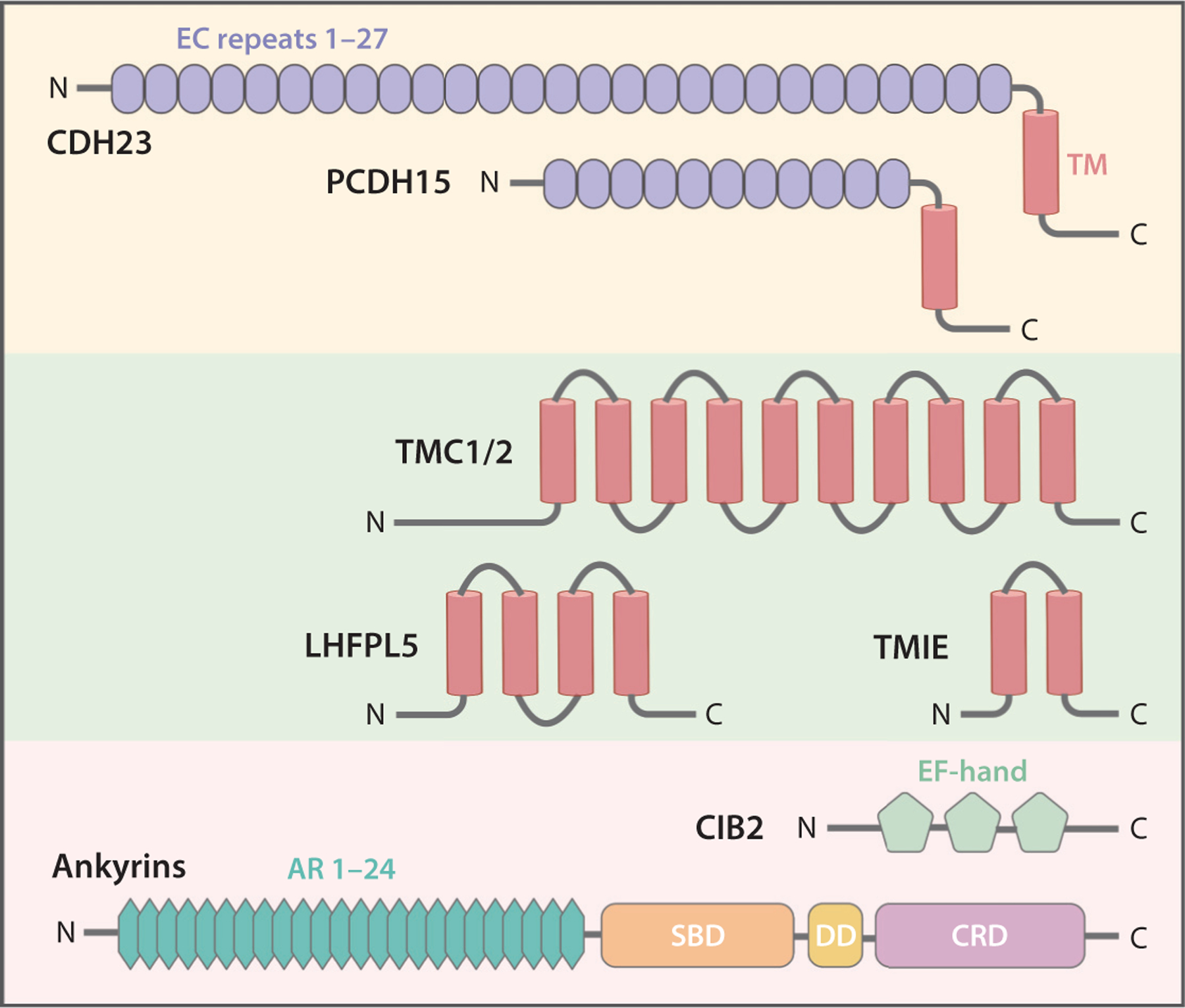
Protein molecules that are integral components of the transduction machinery. Secondary protein domain structures are indicated. Abbreviations: AR, ankyrin repeat; CDH23, cadherin 23; CIB2, calcium and integrin-binding family member 2; CRD, C-terminal regulatory domain; DD, death domain; EC, extracellular cadherin; LHFPL5, lipoma HMGIC fusion partner-like 5; PCDH15, protocadherin 15; SBD, spectrin-binding domain; TM, transmembrane domain; TMC1/2, transmembrane channel-like 1/2; TMIE, transmembrane inner ear.
Figure 3
Figure 3
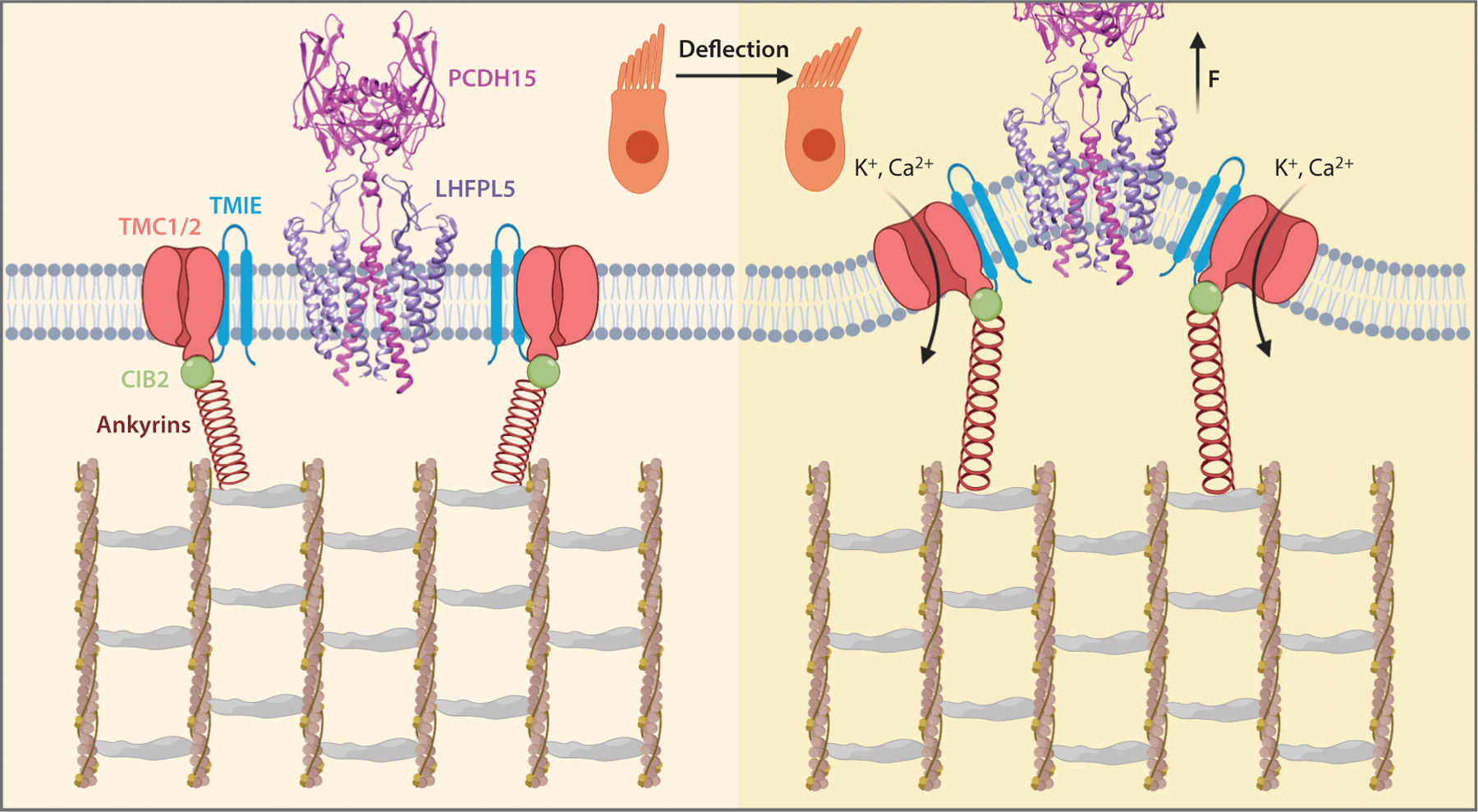
A grand unifying model of hair cell MT. The MT channel TMC1 is in complex with TMIE and is attached to the actin filament cytoskeleton via CIB2/ankyrin tether. The TMC1/TMIE complex sits in the membrane area surrounding the PCDH15/LHFPL5 complex, without physical connection. Upon hair bundle deflection, the tip membrane of shorter stereocilia is pulled away from the underlying cytoskeleton by the tip-link. TMC1 is then activated by tension in the membrane and ankyrin proteins, i.e., the gating spring. Abbreviations: CIB2, calcium and integrin-binding family member 2; LHFPL5, lipoma HMGIC fusion partner-like 5; MT, mechanosensory transduction; PCDH15, protocadherin 15; TMC1, transmembrane channel-like 1; TMIE, transmembrane inner ear.

References

    1. Ahmed ZM, Riazuddin S, Bernstein SL, Ahmed Z, Khan S, et al. 2001. Mutations of the protocadherin gene PCDH15 cause Usher syndrome type 1F. Am. J. Hum. Genet 69:25–34 - PMC - PubMed
    1. Alagramam KN, Goodyear RJ, Geng R, Furness DN, van Aken AF, et al. 2011. Mutations in protocadherin 15 and cadherin 23 affect tip links and mechanotransduction in mammalian sensory hair cells. PLOS ONE 6:e19183. - PMC - PubMed
    1. Alagramam KN, Yuan H, Kuehn MH, Murcia CL, Wayne S, et al. 2001. Mutations in the novel protocadherin PCDH15 cause Usher syndrome type 1F. Hum. Mol. Genet 10:1709–18 - PubMed
    1. Araya-Secchi R, Neel BL, Sotomayor M. 2016. An elastic element in the protocadherin-15 tip link of the inner ear. Nat. Commun 7:13458. - PMC - PubMed
    1. Asai Y, Pan B, Nist-Lund C, Galvin A, Lukashkin AN, et al. 2018. Transgenic Tmc2 expression preserves inner ear hair cells and vestibular function in mice lacking Tmc1. Sci. Rep 8:12124. - PMC - PubMed

Publication types

LinkOut - more resources