


Lignans and Gut Microbiota: An Interplay Revealing Potential Health Implications
- PMID: 33287261
- PMCID: PMC7731202
- DOI: 10.3390/molecules25235709
Lignans and Gut Microbiota: An Interplay Revealing Potential Health Implications
Abstract
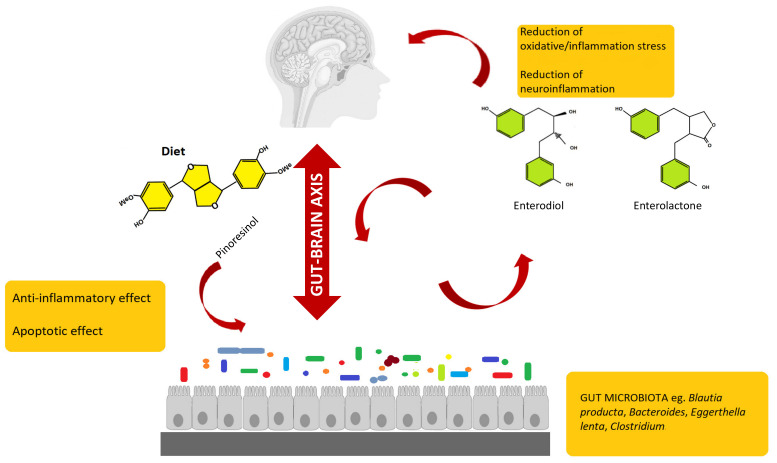
Plant polyphenols are a broad group of bioactive compounds characterized by different chemical and structural properties, low bioavailability, and several in vitro biological activities. Among these compounds, lignans (a non-flavonoid polyphenolic class found in plant foods for human nutrition) have been recently studied as potential modulators of the gut-brain axis. In particular, gut bacterial metabolism is able to convert dietary lignans into therapeutically relevant polyphenols (i.e., enterolignans), such as enterolactone and enterodiol. Enterolignans are characterized by various biologic activities, including tissue-specific estrogen receptor activation, together with anti-inflammatory and apoptotic effects. However, variation in enterolignans production by the gut microbiota is strictly related to both bioaccessibility and bioavailability of lignans through the entire gastrointestinal tract. Therefore, in this review, we summarized the most important dietary source of lignans, exploring the interesting interplay between gut metabolites, gut microbiota, and the so-called gut-brain axis.
Keywords: bioaccessibility; enterolignans; gut microbiota; gut–brain axis; phenolic compounds.
Conflict of interest statement
The authors declare no conflict of interest.
Figures
References
-
- Rothwell J.A., Urpi-Sarda M., Boto-Ordoñez M., Llorach R., Farran-Codina A., Barupal D.K., Neveu V., Manach C., Andres-Lacueva C., Scalbert A. Systematic analysis of the polyphenol metabolome using the Phenol-Explorer database. Mol. Nutr. Food Res. 2015;60:203–211. doi: 10.1002/mnfr.201500435. - DOI - PMC - PubMed
-
- Giuberti G., Rocchetti G., Lucini L. Interactions between phenolic compounds, amylolytic enzymes and starch: An updated overview. Curr. Opin. Food Sci. 2020;31:102–113. doi: 10.1016/j.cofs.2020.04.003. - DOI
-
- Zaineddin A.K., Buck K., Vrieling A., Heinz J., Flesch-Janys D., Linseisen J., Chang-Claude J. The association between dietary lignans, phytoestrogen-rich foods, and fiber intake and postmenopausal breast cancer risk: A German case-control study. Nutr. Cancer. 2012;64:652–665. doi: 10.1080/01635581.2012.683227. - DOI - PubMed
Publication types
MeSH terms
Substances
LinkOut - more resources
Full Text Sources
Other Literature Sources
