. 2020 Dec 3;9(12):863.
doi: 10.3390/antibiotics9120863.

Geranii Herba as a Potential Inhibitor of SARS-CoV-2 Main 3CLpro, Spike RBD, and Regulation of Unfolded Protein Response: An In Silico Approach

Affiliations

Geranii Herba as a Potential Inhibitor of SARS-CoV-2 Main 3CLpro, Spike RBD, and Regulation of Unfolded Protein Response: An In Silico Approach

Selvaraj Arokiyaraj et al. Antibiotics (Basel). .

Abstract

Background: Since the first patient identified with SARS-CoV-2 symptoms in December 2019, the trend of a spreading coronavirus disease 2019 (COVID-19) infection has remained to date. As for now, there is an urgent need to develop novel drugs or vaccines for the SARS-CoV-2 virus.

Methods: Polyphenolic compounds have potential as drug candidates for various diseases, including viral infections. In this study, polyphenolic compounds contained in Geranii Herba were chosen for an in silico approach. The SARS-CoV-2 receptor-binding domain (RBD), 3CLpro (Replicase polyprotein 1ab), and the cell surface receptor glucose-regulated protein 78 (GRP78) were chosen as target proteins.

Results: Based on the molecular docking analysis, ellagic acid, gallic acid, geraniin, kaempferitrin, kaempferol, and quercetin showed significant binding interactions with the target proteins. Besides, the molecular dynamic simulation studies support Geranii Herba's inhibition efficiency on the SARS-CoV-2 RBD. We assume that the active compounds in Geranii Herba might inhibit SARS-CoV-2 cell entry through the ACE2 receptor and inhibit the proteolytic process. Besides, these compounds may help to regulate the cell signaling under the unfolded protein response in endoplasmic reticulum stress through the binding with GRP78 and avoid the SARS-CoV-2 interaction.

Conclusions: Hence, the compounds present in Geranii Herba could be used as possible drug candidates for the prevention/treatment of SARS-CoV-2 infection.

Keywords: 3CLpro; GRP78; Geranii Herba; RBD; SARS-CoV-2; docking; polyphenols.


Conflict of interest statement

The authors declare no conflict of interest.

Figures
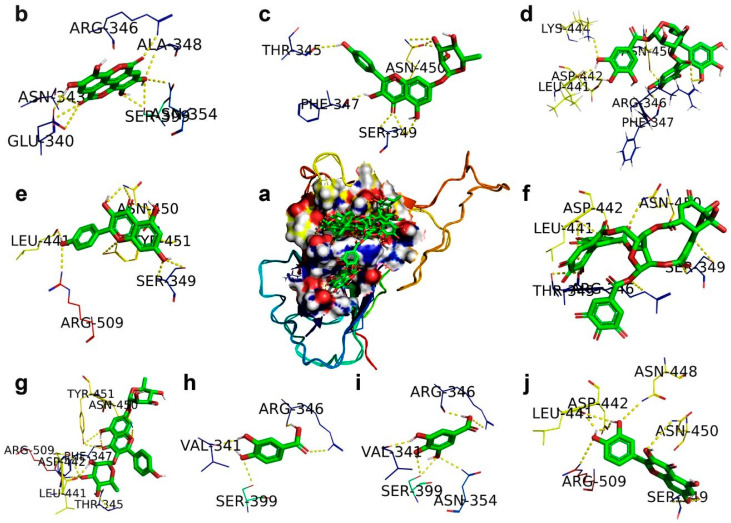
Figure 1
Figure 1
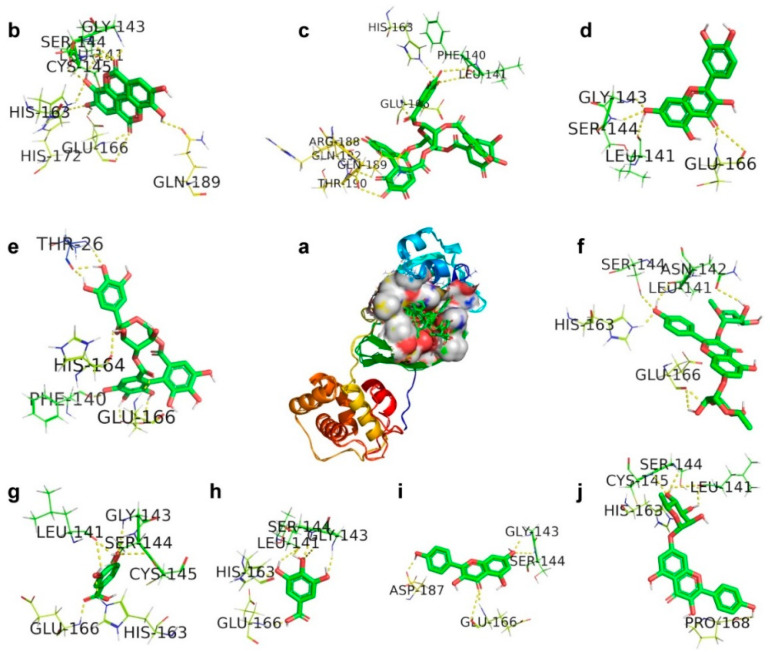
The docking mode of polyphenols present in Geranii Herba (Geraniaceae) with the SARS-CoV-2 spike receptor-binding domain (RBD). (a) The 9 polyphenols are retained in the cavity of the surface region of the RBD. (b) Ellagic acid. (c) Kaempferol 7-O-rhamnoside. (d) Corilagin. (e) Kaempferol. (f) Geraniin. (g) Kaempferitrin. (h) Protocatechuic acid. (i) Gallic acid. (j) Quercetin.
Figure 2
Figure 2
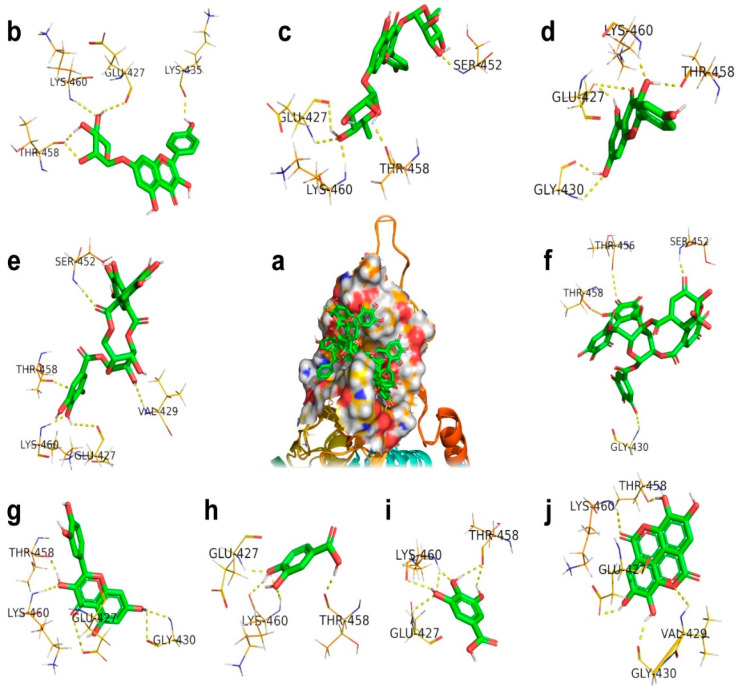
The docking mode of polyphenols present in Geranii Herba (Geraniaceae) with 3C-like proteinase (3CLpro). (a) The 9 polyphenols retained in the cavity of the surface region of 3CLpro. (b) Ellagic acid. (c) Geraniin. (d) Quercetin. (e) Corilagin. (f) Kaempferitrin. (g) Protocatechuic acid. (h) Gallic acid. (i) Kaempferol. (j) Kaempferol 7-O-rhamnoside.
Figure 3
Figure 3
The docking mode of polyphenols present in Geranii Herba (Geraniaceae) with glucose-regulated protein 78 (GRP78). (a) The 9 polyphenols retained in the cavity of the surface region of GRP78. (b) Kaempferol_7_O. (c) Kaempferitrin. (d) Kaempferol. (e) Corilagin. (f) Geraniin. (g) Quercetin. (h) Protocatechuic. (i) Gallic acid. (j) Ellagic acid.
Figure 4
Figure 4
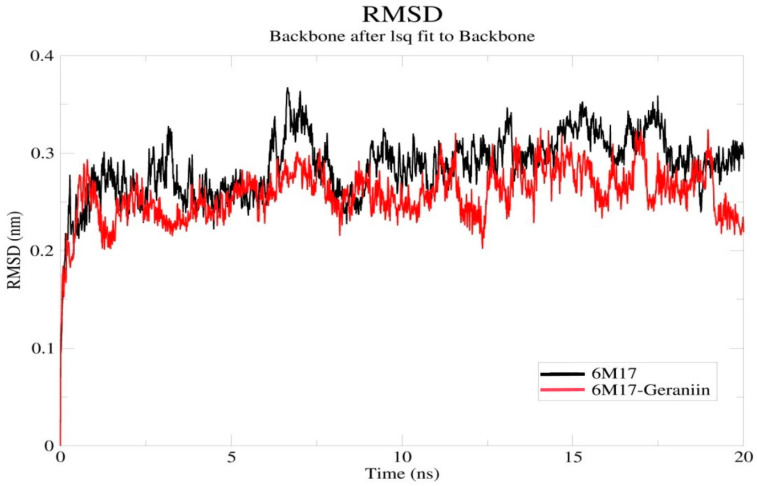
Backbone RMSDs of the apo 6M17 and 6M17–geraniin complex structures. RMSD Å (nm) is the ordinate, and time ns is the abscissa. The black and red lines indicate the 6M17 and 6M17–geraniin complex, respectively. (RMSD—Root Mean Square Deviation).
Figure 5
Figure 5
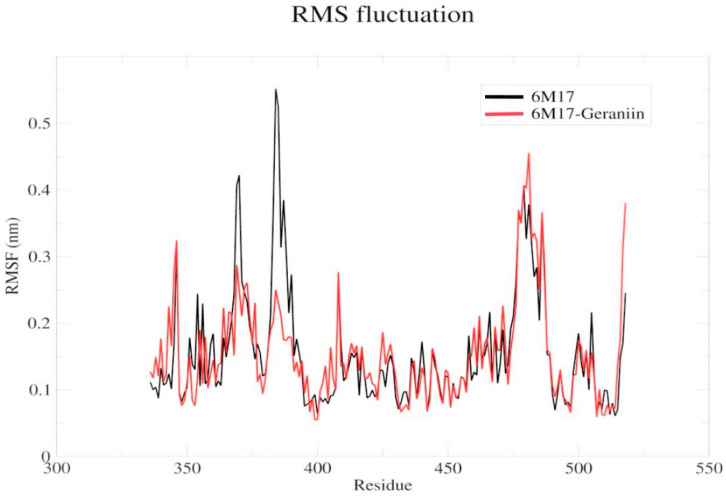
Backbone RMSFs of the apo 6M17 and 6M17–geraniin complex structures. The black and red lines indicate the comparison of the apo 6M17 and 6M17–geraniin complex, respectively. The x and y axes indicate the residue numbers and the mobility in nm, respectively. (RMSF—Root Mean Square Fluctuation).
Figure 6
Figure 6
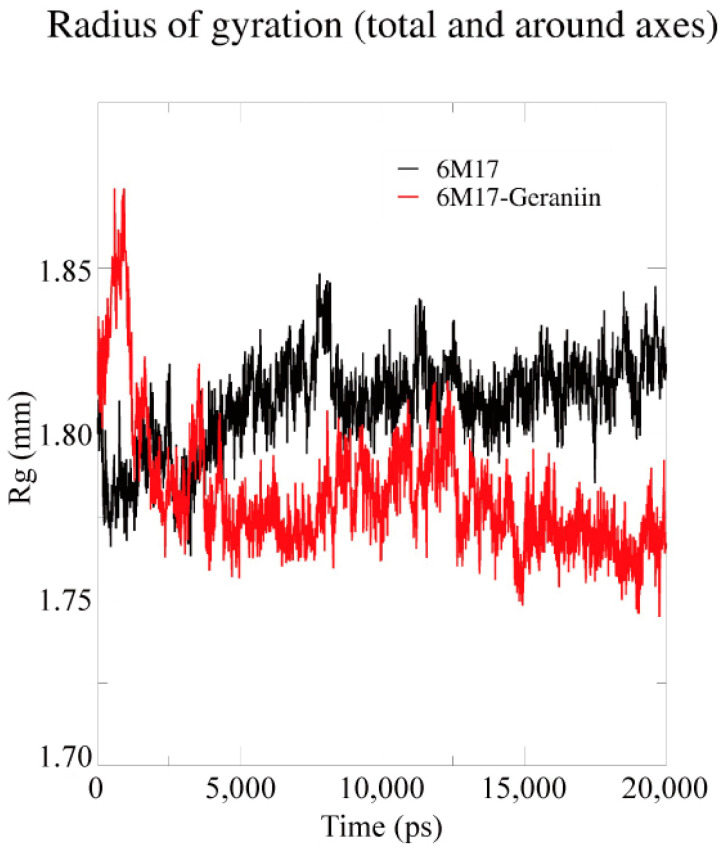
Radius of gyration (Rg) of backbone atoms of the apo 6M17 and 6M17–geraniin complex proteins. The ordinate is Rg (Å (nm)), and the abscissa is time (ns). The black and red lines indicate the apo 6M17 and 6M17–geraniin complex, respectively.

References

    1. Hui D.S., Azhar E.I., Madani T.A., Ntoumi F., Kock R., Dar O., Ippolito G., McHugh T.D., Memish Z.A., Drosten C., et al. The continuing 2019-nCoV epidemic threat of novel coronaviruses to global health—The latest 2019 novel coronavirus outbreak in Wuhan, China. Int. J. Infect. Dis. 2020;91:264–266. doi: 10.1016/j.ijid.2020.01.009. - DOI - PMC - PubMed
    1. Lu R., Zhao X., Li J., Niu P., Yang B., Wu H., Wang W., Song H., Huang B., Zhu N., et al. Genomic characterisation and epidemiology of 2019 novel coronavirus: Implications for virus origins and receptor binding. Lancet. 2020;395:565–574. doi: 10.1016/S0140-6736(20)30251-8. - DOI - PMC - PubMed
    1. Ren L.L., Wang Y.M., Wu Z.Q., Xiang Z.C., Guo L., Xu T., Jiang Y.Z., Xiong Y., Li Y.J., Li X.W., et al. Identification of a novel coronavirus causing severe pneumonia in human: A descriptive study. Chin. Med. J. (Engl.) 2020;133:1015–1024. doi: 10.1097/CM9.0000000000000722. - DOI - PMC - PubMed
    1. Elfiky A.A. Anti-HCV, nucleotide inhibitors, repurposing against COVID-19. Life Sci. 2020;248:117477. doi: 10.1016/j.lfs.2020.117477. - DOI - PMC - PubMed
    1. Elfiky A.A., Mahdy S.M., Elshemey W.M. Quantitative structure-activity relationship and molecular docking revealed a potency of anti-hepatitis C virus drugs against human corona viruses. J. Med. Virol. 2017;89:1040–1047. doi: 10.1002/jmv.24736. - DOI - PMC - PubMed