Review
. 2020 Dec 3;21(23):9229.
doi: 10.3390/ijms21239229.

Endocrine-Disrupting Chemicals' (EDCs) Effects on Tumour Microenvironment and Cancer Progression: Emerging Contribution of RACK1

Affiliations
Review

Endocrine-Disrupting Chemicals' (EDCs) Effects on Tumour Microenvironment and Cancer Progression: Emerging Contribution of RACK1

Erica Buoso et al. Int J Mol Sci. .

Abstract

Endocrine disruptors (EDCs) can display estrogenic and androgenic effects, and their exposure has been linked to increased cancer risk. EDCs have been shown to directly affect cancer cell regulation and progression, but their influence on tumour microenvironment is still not completely elucidated. In this context, the signalling hub protein RACK1 (Receptor for Activated C Kinase 1) could represent a nexus between cancer and the immune system due to its roles in cancer progression and innate immune activation. Since RACK1 is a relevant EDCs target that responds to steroid-active compounds, it could be considered a molecular bridge between the endocrine-regulated tumour microenvironment and the innate immune system. We provide an analysis of immunomodulatory and cancer-promoting effects of different EDCs in shaping tumour microenvironment, with a final focus on the scaffold protein RACK1 as a pivotal molecular player due to its dual role in immune and cancer contexts.

Keywords: EMT; ER; RACK1; cancer; cytokine release; endocrine disruptors; immune system; inflammation; signal transduction; tumour microenvironment.


Conflict of interest statement

The authors declare no conflict of interest.

Figures
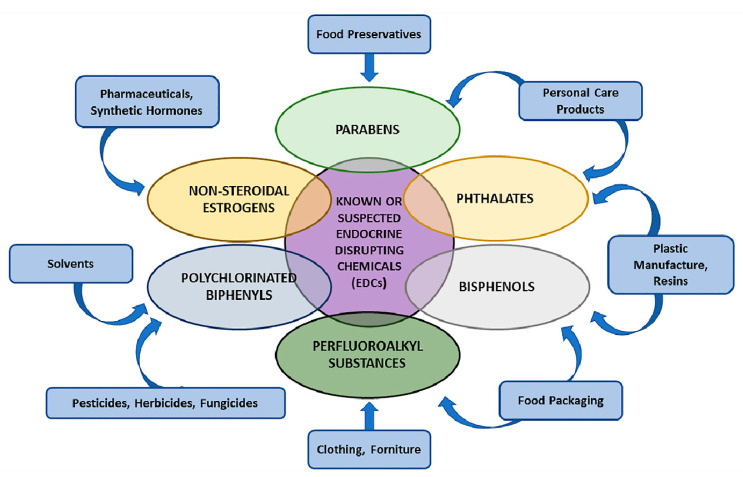
Figure 1
Figure 1
Most known EDCs’ chemical features and their classification. Suspected and known chemicals, having the potential to interfere with the endocrine system, are present in a variety of sources and result in human adverse health effects (see text for details).
Figure 2
Figure 2
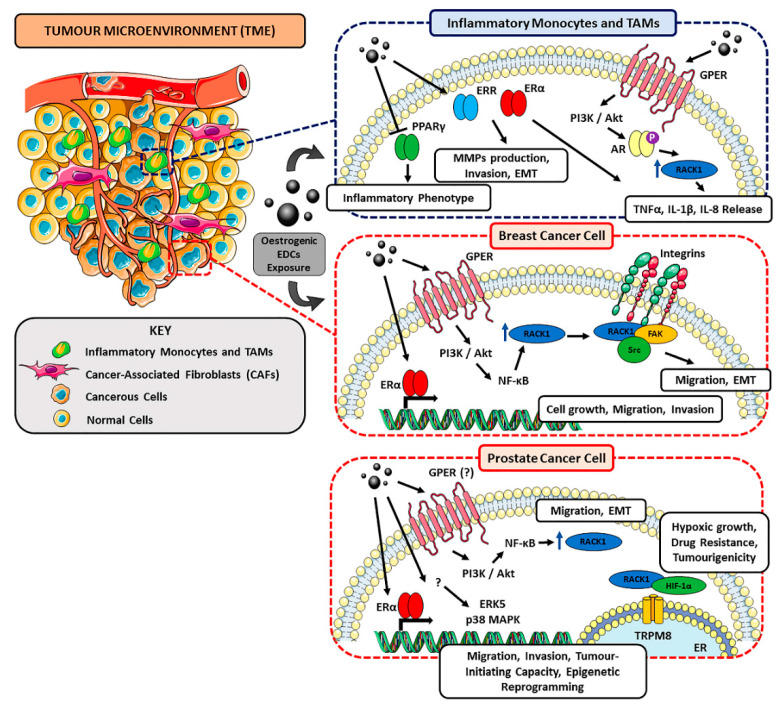
Schematic representation of the possible dual role of RACK1 in immune and breast/prostate cancer contexts in EDC-related TME and tumour progression. Oestrogenic EDCs (e.g., BPA, DES, ZEA) can promote the proliferation and migration of hormone-responsive and triple-negative BC cells where RACK1 appears to be involved due to its role in favouring proliferation and Epithelial-Mesenchymal Transition (EMT). Regarding prostate cancer, although RACK1 has been reported to promote PC cell proliferation, migration and invasion [256] and to mediate hypoxic growth, chemoresistance and tumorigenicity through TRPM8 channel and HIF-1α axis [257], most EDC-mediated mechanisms have still to be completely elucidated and further investigation is required. Altogether, oestrogenic EDCs can display cancer-promoting effects by inducing alterations in the immune system, including an increased release of pro-inflammatory cytokines and ECM-remodelling factors (see text for details).
Figure 3
Figure 3
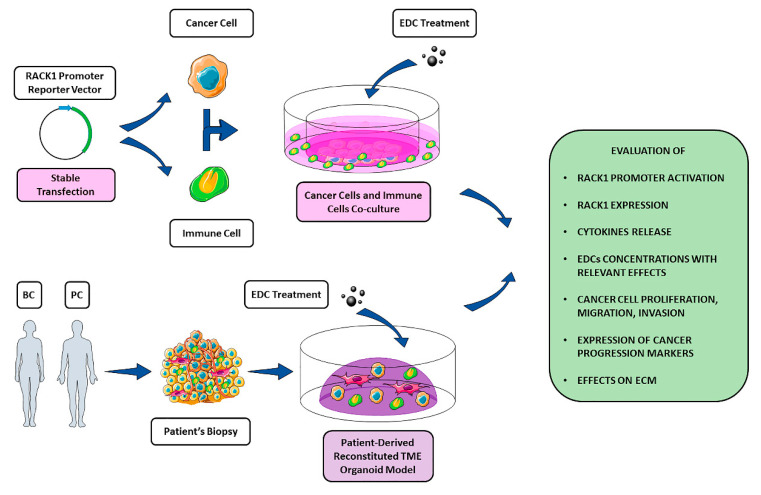
Schematic representation of in vitro and ex vivo strategies to investigate EDCs effects on TME. Due to its involvement in different key pathways in both cancer and immune context, RACK1 could be potentially used as a molecular tool to evaluate EDCs immune-correlated and tumorigenic effects. A panel of different evaluation targets is illustrated within the figure. While a strictly in vitro approach through cancer cells, immune cell co-cultures can benefit from genetic manipulation (i.e., stable transfection of both cell lines with a reporter construct containing RACK1 promoter region), an ex vivo strategy exploiting patient-derived organoid models for a better TME mimicking could allow the evaluation of EDC-mediated effects on the ECM.

References

    1. Whirledge S., Cidlowski J.A. In: Chapter 5—Steroid Hormone Action. Yen and Jaffe’s Reproductive Endocrinology (Eighth Edition), Physiology, Pathophysiology, and Clinical Management. Strauss J., Barbieri R., editors. Elsevier; Amsterdam, The Netherlands: 2018. pp. 115–131.
    1. La Merrill M.A., Vandenberg L.N., Smith J.R., Goodson W., Browne P., Patisaul H.B., Guyton K.Z., Kortenkamp A., Cogliano V.J., Woodruff T., et al. Consensus on the key characteristics of endocrine-disrupting chemicals as a basis for hazard identification. Nat. Rev. Endocrinol. 2020;16:45–57. doi: 10.1038/s41574-019-0273-8. - DOI - PMC - PubMed

    1. Axelstad M., Hass U., Scholze M., Christiansen S., Kortenkamp A., Boberg J. EDC IMPACT: Reduced sperm counts in rats exposed to human relevant mixtures of endocrine disrupters. Endocr. Connect. 2018;7:139–148. doi: 10.1530/EC-17-0307. - DOI - PMC - PubMed
    1. Johansson H.K.L., Svingen T., Fowler P.A., Vinggaard A.M., Boberg J. Environmental influences on ovarian dysgenesis—Developmental windows sensitive to chemical exposures. Nat. Rev. Endocrinol. 2017;13:400–414. doi: 10.1038/nrendo.2017.36. - DOI - PubMed
    1. Skakkebaek N.E. A Brief Review of the Link between Environment and Male Reproductive Health: Lessons from Studies of Testicular Germ Cell Cancer. Horm. Res. Paediatr. 2016;86:240–246. doi: 10.1159/000443400. - DOI - PubMed

MeSH terms