. 2021 Feb;44(2):358-366.
doi: 10.2337/dc20-1536. Epub 2020 Dec 7.

Interpretable Machine Learning Framework Reveals Robust Gut Microbiome Features Associated With Type 2 Diabetes

Affiliations

Interpretable Machine Learning Framework Reveals Robust Gut Microbiome Features Associated With Type 2 Diabetes

Wanglong Gou et al. Diabetes Care. 2021 Feb.

Abstract

Objective: To identify the core gut microbial features associated with type 2 diabetes risk and potential demographic, adiposity, and dietary factors associated with these features.

Research design and methods: We used an interpretable machine learning framework to identify the type 2 diabetes-related gut microbiome features in the cross-sectional analyses of three Chinese cohorts: one discovery cohort (n = 1,832, 270 cases of type 2 diabetes) and two validation cohorts (cohort 1: n = 203, 48 cases; cohort 2: n = 7,009, 608 cases). We constructed a microbiome risk score (MRS) with the identified features. We examined the prospective association of the MRS with glucose increment in 249 participants without type 2 diabetes and assessed the correlation between the MRS and host blood metabolites (n = 1,016). We transferred human fecal samples with different MRS levels to germ-free mice to confirm the MRS-type 2 diabetes relationship. We then examined the prospective association of demographic, adiposity, and dietary factors with the MRS (n = 1,832).

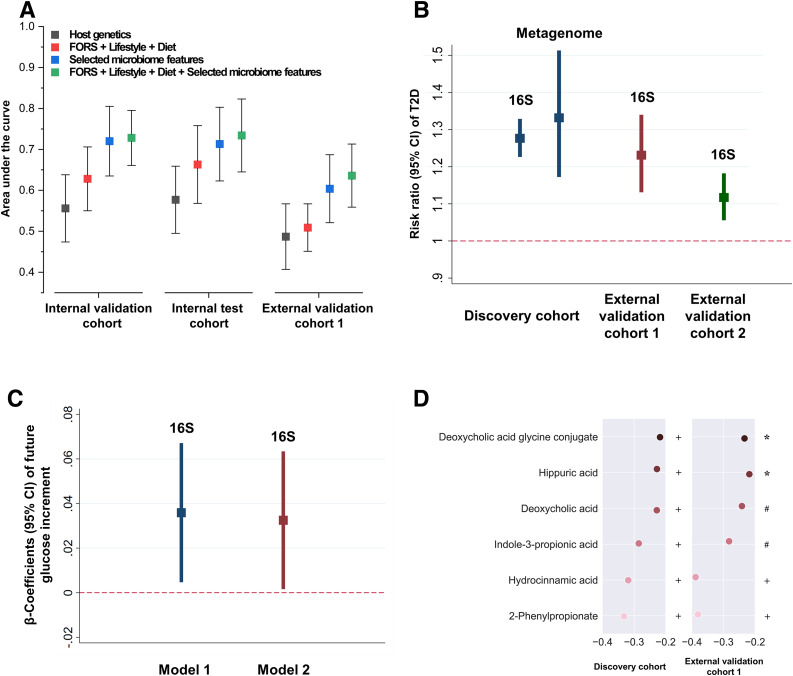
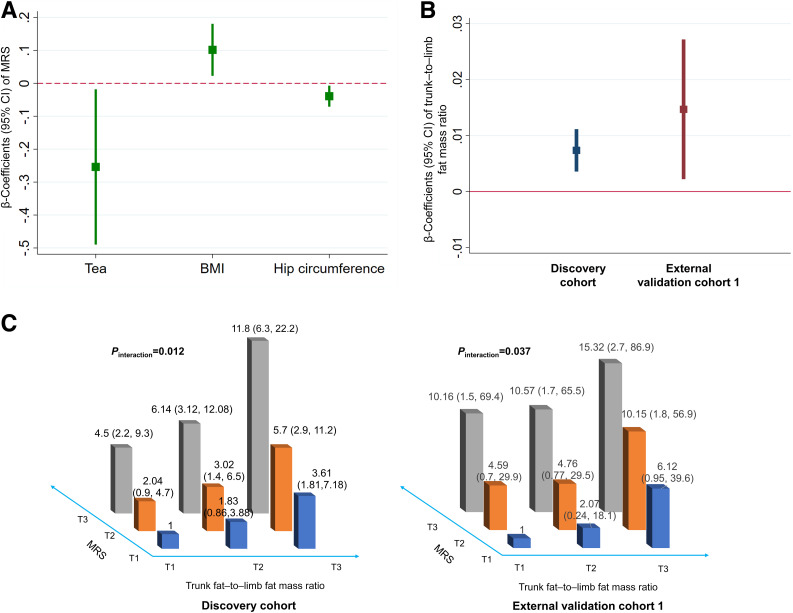
Results: The MRS (including 14 microbial features) consistently associated with type 2 diabetes, with risk ratio for per 1-unit change in MRS 1.28 (95% CI 1.23-1.33), 1.23 (1.13-1.34), and 1.12 (1.06-1.18) across three cohorts. The MRS was positively associated with future glucose increment (P < 0.05) and was correlated with a variety of gut microbiota-derived blood metabolites. Animal study further confirmed the MRS-type 2 diabetes relationship. Body fat distribution was found to be a key factor modulating the gut microbiome-type 2 diabetes relationship.

Conclusions: Our results reveal a core set of gut microbiome features associated with type 2 diabetes risk and future glucose increment.


Figures

Figure 1
Figure 1
Identified gut microbiota affect type 2 diabetes development and host serum metabolites. A: Algorithm performance in the discovery cohort and external validation cohort 1 based on the selected microbiome features, host genetics, lifestyle and diet, type 2 diabetes traditional risk factors (FORS, including age, sex, parental history of diabetes, BMI, systolic blood pressure, HDL, triglycerides, and waist circumference), and their combination. B: Association of the MRS with type 2 diabetes risk in the discovery cohort, external validation cohort 1, and external validation cohort 2. Poisson regression was used to estimate the RR and 95% CI of type 2 diabetes per 1-unit change in the MRS, with adjustment for demographic, dietary, and lifestyle factors. C: Association between the MRS and prospective glucose increments over 3 years in the discovery cohort. Linear regression was used to estimate the difference in future fasting glucose per unit change in the MRS in a cohort of 249 individuals without type 2 diabetes, with adjustment for demographic, dietary, and lifestyle factors (model 1). Sensitivity analyses were conducted by adding baseline fasting glucose in the above model 1 to test the influence of baseline fasting glucose on the performance of our model (model 2). D: Association of the MRS with host circulating metabolites. Spearman correlation coefficients between the MRS and the host serum metabolites were calculated. The MRS-metabolite associations were further replicated in the external validation cohort 1. *P < 0.05; #P < 0.01; +P < 0.001.
Figure 2
Figure 2
Adiposity and dietary factors modulate the association between gut microbiome and type 2 diabetes. A: Association of baseline adiposity and dietary factors with the microbiome risk score (MRS). Linear regression was used to estimate the difference in MRS per quartile (for continuous dietary factors), per unit (for adiposity factors), or per category (for ordinary factors) change in the baseline tested factors, with adjustment for demographic factors and type 2 diabetes medication use and mutual adjustment for the other tested adiposity, dietary, and lifestyle factors. We only present those adipose, dietary, or lifestyle factors showing significant association with the MRS in the figure. B: Association between MRS and trunk fat–to–limb fat mass ratio in the discovery cohort and external validation cohort 1. Linear regression was used to estimate the difference in trunk fat–to–limb fat mass ratio per unit change in the MRS, with adjustment for demographic, dietary, and lifestyle factors. C: Interaction between MRS and trunk fat–to–limb fat mass ratio for type 2 diabetes risk. Poisson regression was used to estimate the interaction of MRS and trunk fat–to–limb fat mass ratio for type 2 diabetes risk, with adjustment for demographic, dietary, and lifestyle factors. RR (95% CI) of type 2 diabetes by MRS stratified by trunk fat–to–limb fat mass ratio tertile (T) or RR (95% CI) of type 2 diabetes by trunk fat–to–limb fat mass ratio stratified by MRS tertile is presented.

References

    1. Franks PW, McCarthy MI. Exposing the exposures responsible for type 2 diabetes and obesity. Science 2016;354:69–73 - PubMed
    1. Zhou B, Lu Y, Kaveh Hajifathalian JB; NCD Risk Factor Collaboration (NCD-RisC) . Worldwide trends in diabetes since 1980: a pooled analysis of 751 population-based studies with 4.4 million participants. Lancet 2016;387:1513–1530 - PMC - PubMed
    1. Tilg H, Moschen AR. Microbiota and diabetes: an evolving relationship. Gut 2014;63:1513–1521 - PubMed
    1. Petrosino JF The microbiome in precision medicine: the way forward. Genome Med 2018;10:12. - PMC - PubMed
    1. Gurung M, Li Z, You H, et al. Role of gut microbiota in type 2 diabetes pathophysiology. EBioMedicine 2020;51:102590. - PMC - PubMed

Publication types