. 2020 Dec 29;117(52):32989-32995.
doi: 10.1073/pnas.2012647117. Epub 2020 Dec 7.

A Middle Eocene lowland humid subtropical "Shangri-La" ecosystem in central Tibet

Affiliations

A Middle Eocene lowland humid subtropical "Shangri-La" ecosystem in central Tibet

Tao Su et al. Proc Natl Acad Sci U S A. .

Abstract

Tibet's ancient topography and its role in climatic and biotic evolution remain speculative due to a paucity of quantitative surface-height measurements through time and space, and sparse fossil records. However, newly discovered fossils from a present elevation of ∼4,850 m in central Tibet improve substantially our knowledge of the ancient Tibetan environment. The 70 plant fossil taxa so far recovered include the first occurrences of several modern Asian lineages and represent a Middle Eocene (∼47 Mya) humid subtropical ecosystem. The fossils not only record the diverse composition of the ancient Tibetan biota, but also allow us to constrain the Middle Eocene land surface height in central Tibet to ∼1,500 ± 900 m, and quantify the prevailing thermal and hydrological regime. This "Shangri-La"-like ecosystem experienced monsoon seasonality with a mean annual temperature of ∼19 °C, and frosts were rare. It contained few Gondwanan taxa, yet was compositionally similar to contemporaneous floras in both North America and Europe. Our discovery quantifies a key part of Tibetan Paleogene topography and climate, and highlights the importance of Tibet in regard to the origin of modern Asian plant species and the evolution of global biodiversity.

Keywords: Tibetan Plateau; biodiversity; fossil; monsoon; topography.


Conflict of interest statement

The authors declare no competing interest.

Figures
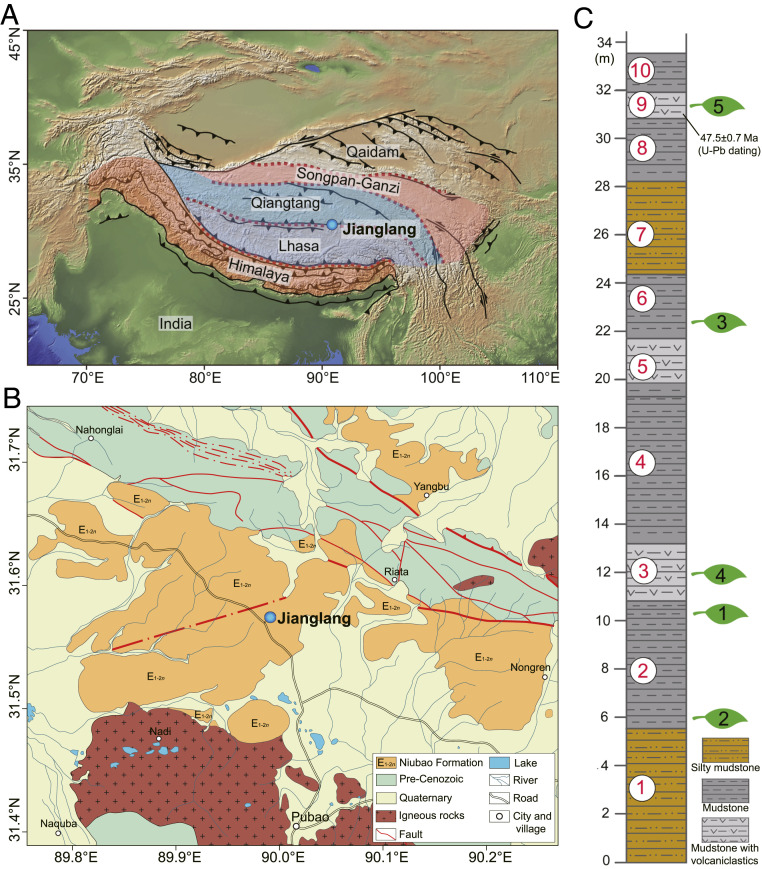
Fig. 1.
Fig. 1.
Map showing the fossil site near Jianglang village, Bangor Basin, central Tibet. (A) Location in relation to major terranes of the Tibetan Plateau. (B) Geological map showing the fossil site and adjacent area. (C) Stratigraphy of the Niubao Formation in the fossil site, Bangor Basin. Assemblage numbers indicated by leaf icons, bed numbers in red.
Fig. 2.
Fig. 2.
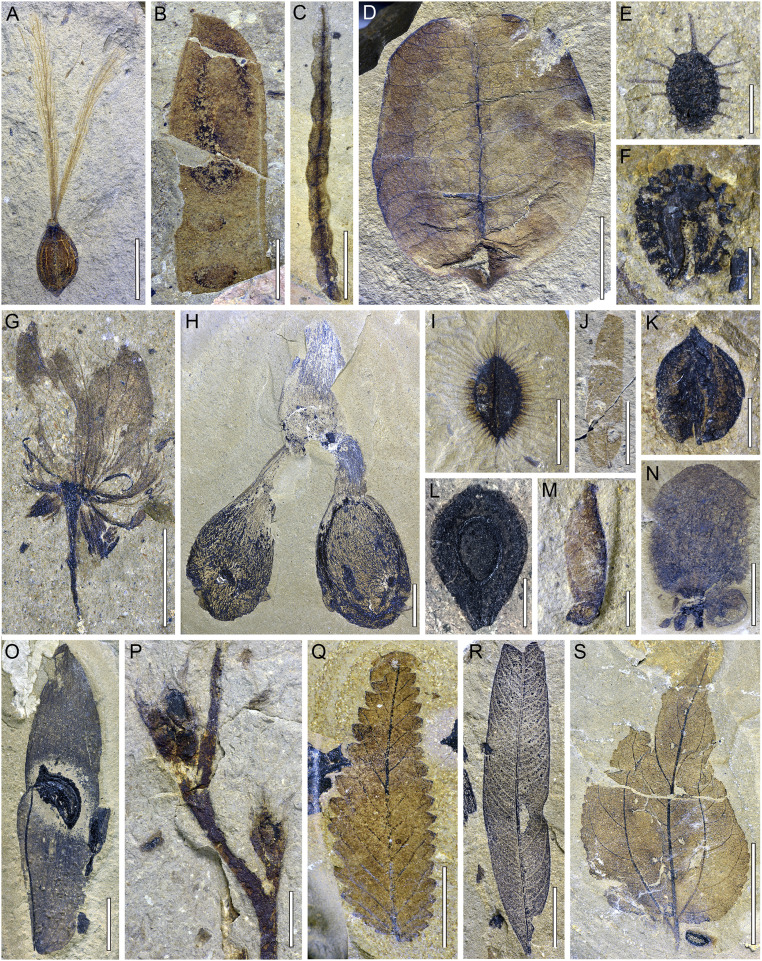
Representative plant taxa in the Middle Eocene Jianglang flora from central Tibetan Plateau. (A) Lagokarpos tibetensis fruit (XZBGJL1-0383). (B and C) legume fruits (XZBGJL1-0012, XZBGJL3-0009). (D) Koelreuteria (Sapindaceae) capsular valves (XZBGJL5-0029). (E) Ceratophyllum (Ceratophyllaceae) achene (XZBGJL5-0545). (F) Stephania (Menispermaceae) endocarp (XZBGJL5-0524). (G) Unknown flower (XZBGJL1-0008). (H) cf Colocasia (Araceae) tubers (XZBGJL5-0231). (I) Illigera (Hernandiaceae) fruit (XZBGJL1-0003). (J) legume leaflet (XZBGJL5-0123). (K) Vitaceae seed (XZBGJL1-0018). (L) Asclepiadospermum marginatum (Apocynaceae) seed (XZBGJL5-0432). (M) Cedreleae (Meliaceae) seed (XZBGJL5-0034). (N) Limnobiophyllum (Araceae) whole plant (XZBGJL5-0177). (O) Ailanthus maximus (Simaroubaceae) samara (XZBGJL5-0007). (P) Cedrelospermum (Ulmaceae) young fruit-bearing branch (XZBGJL5-0033). (Q) Cedrelospermum (Ulmaceae) leaf (XZBGJL5-0533). (R) Myrtales leaf (XZBGJL5-0166). (S) Ziziphus (Rhamnaceae) leaf (XZBGJL1-0023). (Scale bars, 10 mm: A, C, D, H, N, O, R, S; 5 mm: B, G, I, J, P, Q; 2 mm: E, F, K–M.)
Fig. 3.
Fig. 3.
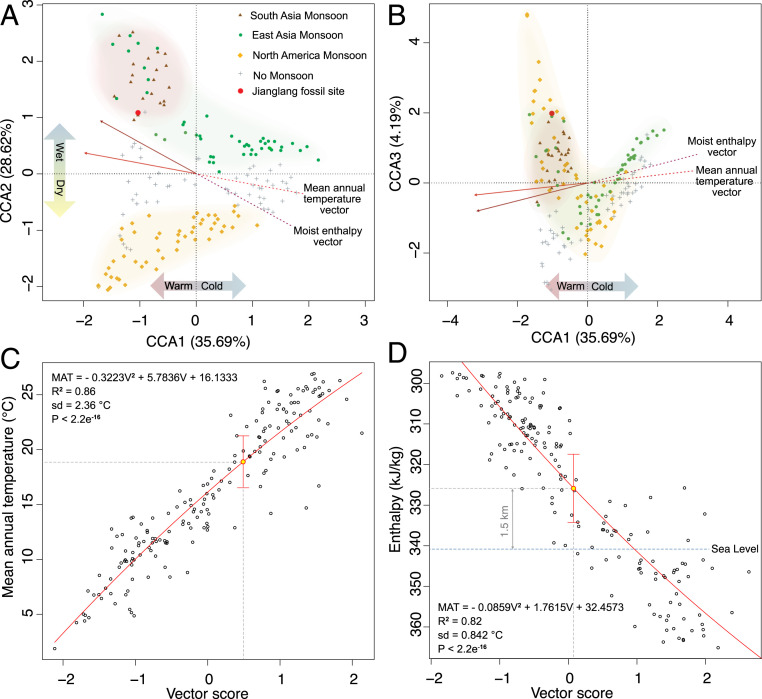
CLAMP physiognomic space plots showing the positions of modern vegetation reference sites coded for their adaptations to different monsoon climates (39). (A) CCA axis 1 (accounting for 35.69% of the total variance) versus axis 2 (28.62%). The Jianglang site (filled red circle) plots near modern vegetation exhibiting adaptations to both the South Asian (Indian) monsoon and the East Asia monsoon. (B) CCA axis 1 versus axis 3 (4.19%) showing the clear separation of the Jianglang fossil site from nonmonsoon adapted vegetation. The apparent proximity to the North American monsoon sites is an artifact of the projection. The climate trends across physiognomic space are shown for mean annual temperature (red arrow) and moist enthalpy (purple arrow). (C) MAT regression. The vector score is the relative position along the MAT vector in axes 1–4 space of the modern vegetation samples (open black circles) for which the MAT is known, and the fossil site (yellow-filled circle). The estimate of the MAT for the fossil site is given by its vector score (V), which defines its position along the regression curve and hence the MAT estimate. Two sigma uncertainties are indicated by the red bars. (D) The moist enthalpy regression showing both the position of the Jianglang fossil site and sea-level moist enthalpy derived from a climate model simulation constrained by proxy data (see Materials and Methods for details). The difference in moist enthalpy between sea level and the Jianglang site (14.75 kJ/kg) divided by the gravitational constant (9.81 cm/s2) yields an elevational difference of 1.5 km.

References

    1. England P., Searle M., The Cretaceous-Tertiary deformation of the Lhasa block and its implications for crustal thickening in Tibet. Tectonics 5, 1–14 (1986).
    1. Ding L., et al. , The Andean-type Gangdese mountains: Paleoelevation record from the Paleocene–Eocene Linzhou basin. Earth Planet. Sci. Lett. 392, 250–264 (2014).
    1. Guillot S., et al. , How and when did the Tibetan plateau grow? Russ. Geol. Geophys. 60, 957–977 (2019).
    1. Chang C.-F., Zheng X.-L., Some tectonic features of the Mt. Jolmo Lungma area, southern Tibet. Sci. Sin. 16, 257–265 (1973).
    1. Kapp P., DeCelles P. G., Mesozoic-Cenozoic geological evolution of the Himalayan-Tibetan orogen and working tectonic hypotheses. Am. J. Sci. 319, 159–254 (2019).

Publication types

LinkOut - more resources