Review
. 2019 Dec 6;2(1):vdz048.
doi: 10.1093/noajnl/vdz048. eCollection 2020 Jan-Dec.

Proceedings of the Comprehensive Oncology Network Evaluating Rare CNS Tumors (NCI-CONNECT) Oligodendroglioma Workshop

Collaborators, Affiliations
Review

Proceedings of the Comprehensive Oncology Network Evaluating Rare CNS Tumors (NCI-CONNECT) Oligodendroglioma Workshop

Marta Penas-Prado et al. Neurooncol Adv. .

Abstract

Background: Oligodendroglioma is a rare primary central nervous system (CNS) tumor with highly variable outcome and for which therapy is usually not curative. At present, little is known regarding the pathways involved with progression of oligodendrogliomas or optimal biomarkers for stratifying risk. Developing new therapies for this rare cancer is especially challenging. To overcome these challenges, the neuro-oncology community must be particularly innovative, seeking multi-institutional and international collaborations, and establishing partnerships with patients and advocacy groups thereby ensuring that each patient enrolled in a study is as informative as possible.

Methods: The mission of the National Cancer Institute's NCI-CONNECT program is to address the challenges and unmet needs in rare CNS cancer research and treatment by connecting patients, health care providers, researchers, and advocacy organizations to work in partnership. On November 19, 2018, the program convened a workshop on oligodendroglioma, one of the 12 rare CNS cancers included in its initial portfolio. The purpose of this workshop was to discuss scientific progress and regulatory challenges in oligodendroglioma research and develop a call to action to advance research and treatment for this cancer.

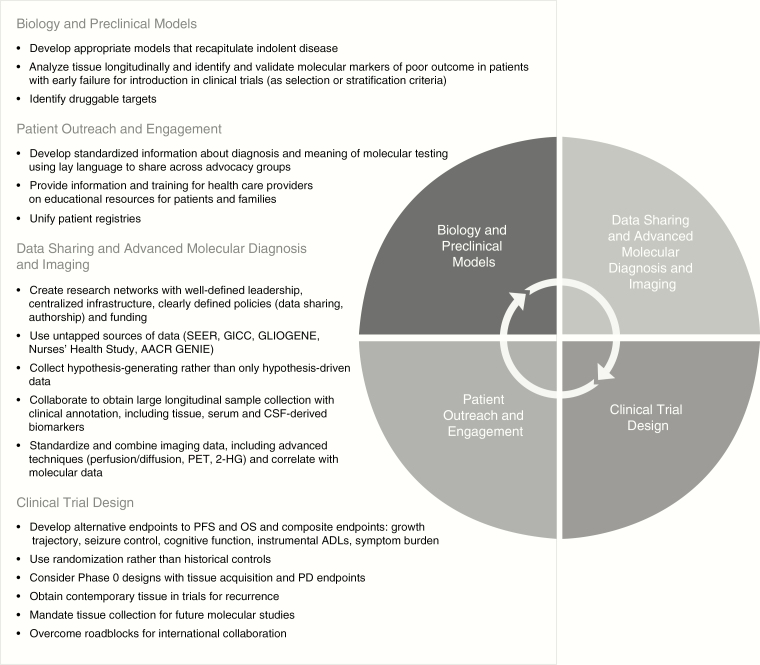
Results: The recommendations of the workshop include a multifaceted and interrelated approach covering: biology and preclinical models, data sharing and advanced molecular diagnosis and imaging; clinical trial design; and patient outreach and engagement.

Conclusions: The NCI-CONNECT program is well positioned to address challenges in oligodendroglioma care and research in collaboration with other stakeholders and is developing a list of action items for future initiatives.

Keywords: NCI-CONNECT; oligodendroglioma; rare CNS tumors; workshop.


Figures

Figure 1.
Figure 1.
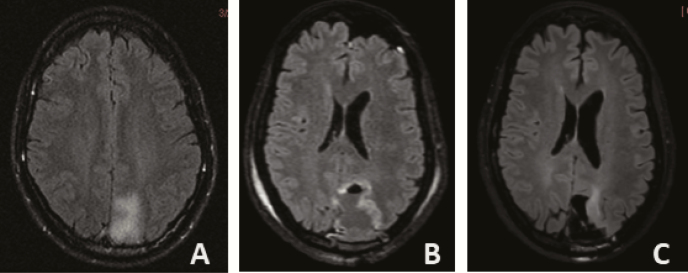
Axial T2/FLAIR MRI images of patient with left occipitoparietal oligodendroglioma WHO grade 2, IDH1 mutated, 1p19q codeleted with indolent course. (A) Incidental finding at age 39, followed with serial imaging without intervention. (B) Near total resection at age 41 after slight increase in T2/FLAIR hyperintensity and development of headaches, then followed without additional treatment. (C) Slight increase in T2/FLAIR hyperintensity adjacent to the surgical cavity at age 52 (13 years from initial imaging diagnosis; no prior radiation or chemotherapy).
Figure 2.
Figure 2.
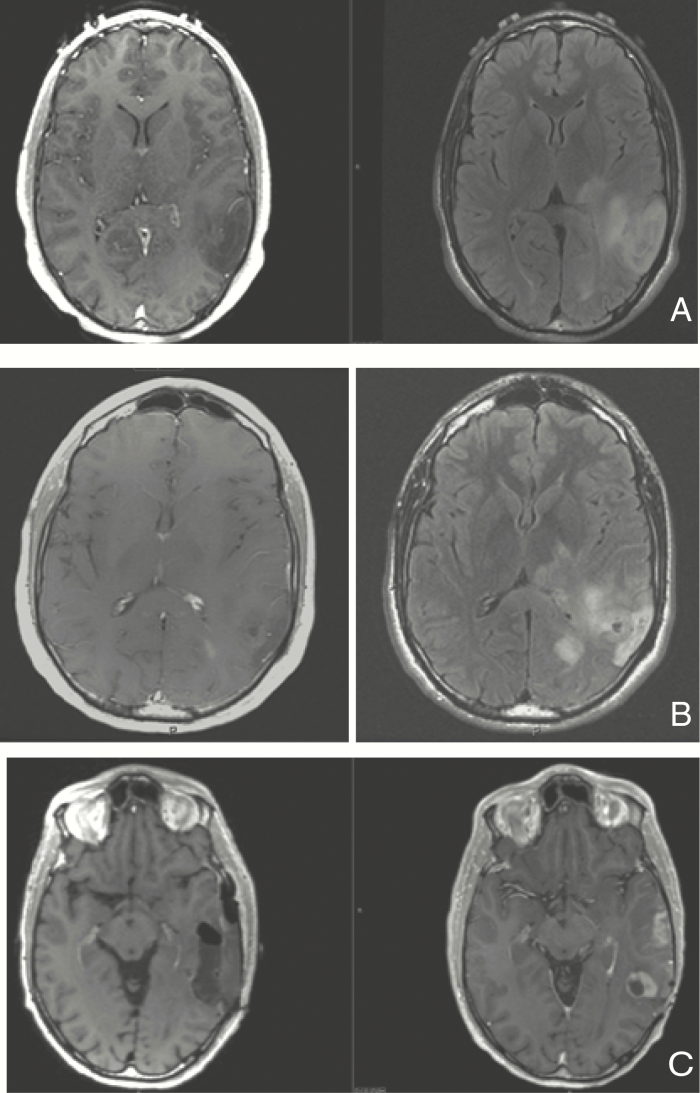
Axial T1 with contrast and T2/FLAIR MRI images of patient with left posterior temporal oligodendroglioma WHO grade 2, IDH1 mutated, 1p19q codeleted with aggressive course. (A) Imaging at age 28 after presenting with seizures; underwent biopsy without further treatment. (B) Imaging at age 31 after biopsy demonstrating transformation to anaplastic oligodendroglioma. Patient had received 2 years of therapy with temozolomide due to imaging progression detected 6 months after initial diagnosis. (C) Imaging preresection (right) and postresection (left) at the time of 4th progression (age 37), after having received radiation, procarbazine and lomustine; received subsequent treatment with re-irradiation and with a PD-1 inhibitor 3 years later for new recurrence.
Figure 3.
Figure 3.
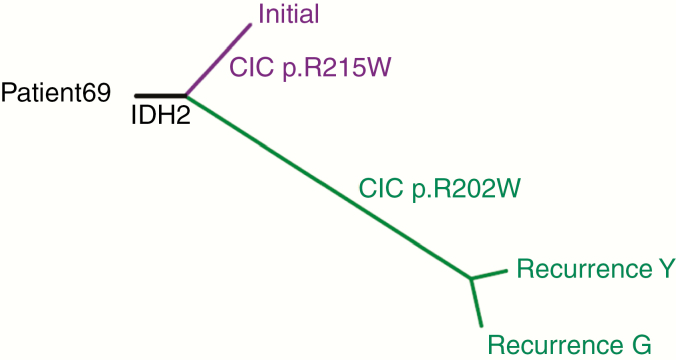
Early origin of recurrence from a grade II oligodendroglioma. Tumor evolution inferred from mutations in a primary 1p19q codeleted, IDH2 mutant low-grade oligodendroglioma and two tumor samples from a subsequent tumor recurrence from the same patient, resected years later (recurrence Y, recurrence G). The phylogenetic tree is derived from somatic mutations from exome sequencing of the tumor DNA samples. The length of each line in the phylogenetic tree is proportional to the number of mutations. The branch positions illustrate inferred points of evolutionary divergence among the samples. The IDH2 mutation is shared by all three samples whereas a different CIC mutation is found in the initial sample versus in the two tumor samples at recurrence.
Figure 4.
Figure 4.
Workshop recommendations.

References

    1. Louis DN, Perry A, Reifenberger G, et al. The 2016 World Health Organization Classification of Tumors of the Central Nervous System: a summary. Acta Neuropathol. 2016;131(6):803–820. - PubMed
    1. Cahill DP, Louis DN, Cairncross JG. Molecular background of oligodendroglioma: 1p/19q, IDH, TERT, CIC and FUBP1. CNS Oncol. 2015;4(5):287–294. - PMC - PubMed
    1. Bettegowda C, Agrawal N, Jiao Y, et al. Mutations in CIC and FUBP1 contribute to human oligodendroglioma. Science. 2011;333(6048):1453–1455. - PMC - PubMed
    1. Ostrom QT, Gittleman H, Liao P, et al. CBTRUS statistical report: primary brain and other central nervous system tumors diagnosed in the United States in 2010–2014. Neuro-oncology. 2017;19(suppl_5):v1–v88. - PMC - PubMed
    1. Rodriguez FJ, Tihan T, Lin D, et al. Clinicopathologic features of pediatric oligodendrogliomas: a series of 50 patients. Am J Surg Pathol. 2014;38(8):1058–1070. - PMC - PubMed