


The slowdown in the reduction rate of premature mortality from cardiovascular diseases puts the Americas at risk of achieving SDG 3.4: A population trend analysis of 37 countries from 1990 to 2017
- PMID: 33289261
- PMCID: PMC8029842
- DOI: 10.1111/jch.13922
The slowdown in the reduction rate of premature mortality from cardiovascular diseases puts the Americas at risk of achieving SDG 3.4: A population trend analysis of 37 countries from 1990 to 2017
Abstract
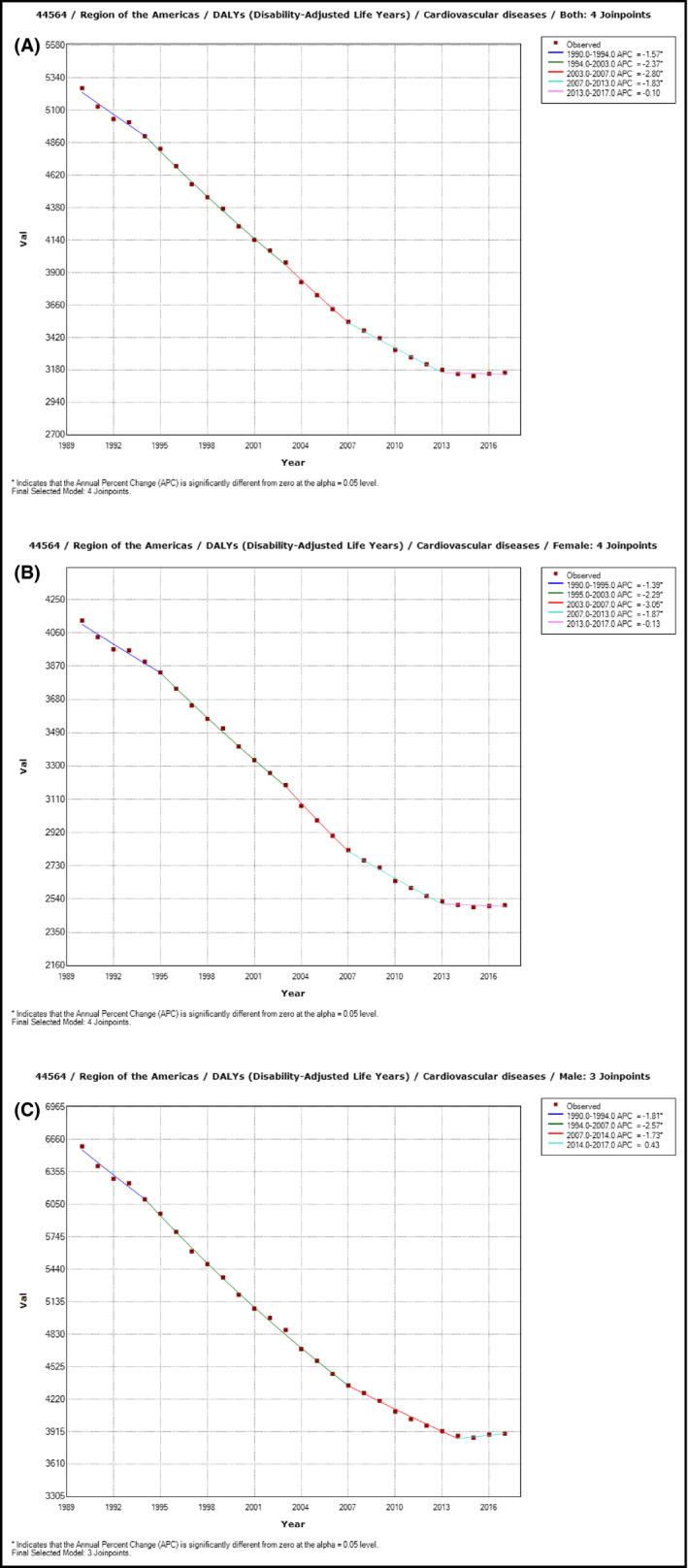
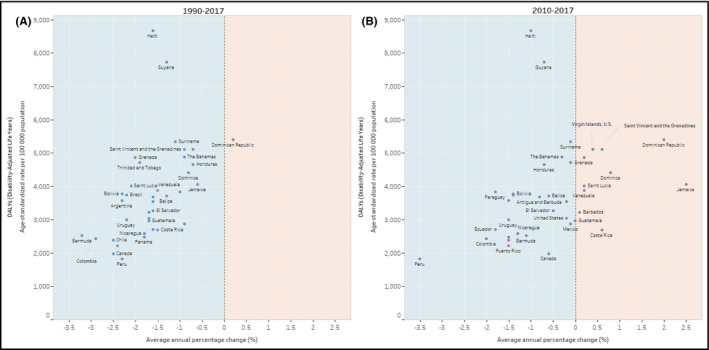
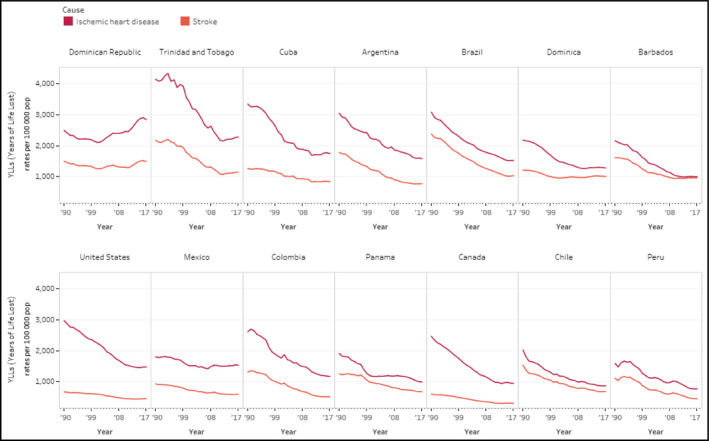
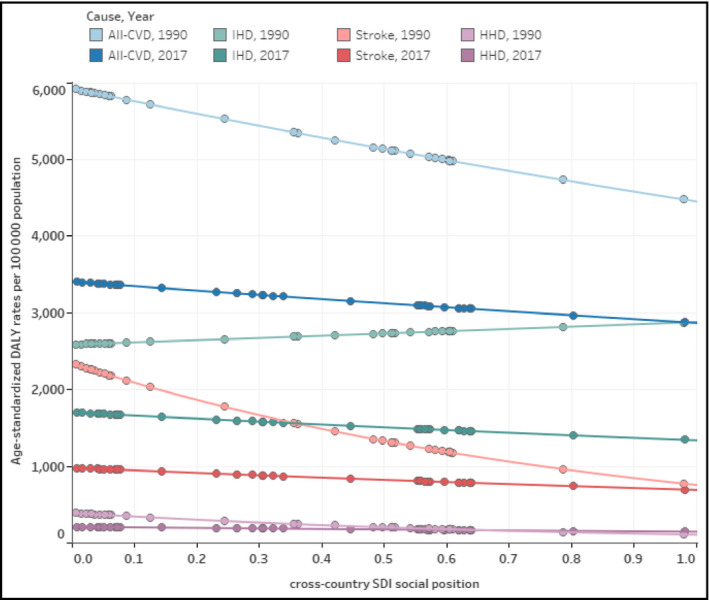
Cardiovascular diseases (CVD) are leading causes of mortality and morbidity in the Americas, resulting in substantial negative economic and social impacts. This study describes the trends and inequalities of CVD burden in the Americas to guide programmatic interventions and health system responses. We examined the CVD burden trends by age, sex, and countries between 1990 and 2017 and quantified social inequalities in CVD burden across countries. In 2017, CVD accounted for 2 million deaths in the Americas, 29% of total deaths. Age-standardized DALY rates caused by CVD declined by -1.9% (95% uncertainty interval, -2.0 to -1.7) annually from 1990 to 2017. This trend varied with a striking decreasing trend over the interval 1994-2003 (annual percent change (APC) -2.4% [-2.5 to 2.2]) and 2003-2007 (APC -2.8% [-3.4 to -2.2]). This was followed by a slowdown in the rate of decline over 2007-2013 (APC -1.83% [-2.1 to -1.6]) and a stagnation during the most recent period 2013-2017 (APC -0.1% [-0.5 to 0.3]). The social inequality in CVD burden along the socio-demographic gradient across countries decreased 2.75-fold. The CVD burden and related social inequality have both substantially decreased in the Americas since 1990, driven by the reduction in premature mortality. This trend occurred in parallel with the improvement in the socioeconomic development and health care of the region. The deceleration and stagnation in the rate of improvement of CVD burden and persistent social inequality pose major challenges to reduce the CVD burden and the achievement of the United Nations' Sustainable Development Goals Target 3.4.
Keywords: cardiovascular diseases; epidemiology; global burden of disease; health inequalities; trend analysis.
© 2020 Wiley Periodicals LLC. The Pan American Health Organization (PAHO) retains copyright and all other rights in the manuscript of this article as submitted for publication.
Conflict of interest statement
All authors declare no conflicts of interest with the content of this manuscript.
RM, PS, OJM, LR, and PO are staff members of the Pan American Health Organization. The authors alone are responsible for the views expressed in this publication, and they do not necessarily represent the decisions or policies of the Pan American Health Organization.
Figures
References
-
- Lloyd‐Sherlock P, Ebrahim S, Martinez R, McKee M, Ordunez P. Reducing the cardiovascular disease burden for people of all ages in the Americas region: analysis of mortality data, 2000–15. Lancet Global Health. 2019;7(5):e604‐e612. - PubMed
-
- Hachinski V, Azarpazhooh MR. Stroke is a burdensome but preventable brain disorder. Lancet Neurol. 2016;15(9):892‐893. - PubMed
-
- Martinez R, Lloyd‐Sherlock P, Soliz P, et al. Trends in premature avertable mortality from non‐communicable diseases for 195 countries and territories, 1990–2017: a population‐based study. Lancet Global Health. 2020;8(4):e511‐e523. - PubMed
Publication types
MeSH terms
LinkOut - more resources
Full Text Sources
