


An evaluation of the molecular mode of action of trans-resveratrol in the Porphyromonas gingivalis lipopolysaccharide challenged neuronal cell model
- PMID: 33289908
- PMCID: PMC7884301
- DOI: 10.1007/s11033-020-06024-y
An evaluation of the molecular mode of action of trans-resveratrol in the Porphyromonas gingivalis lipopolysaccharide challenged neuronal cell model
Abstract
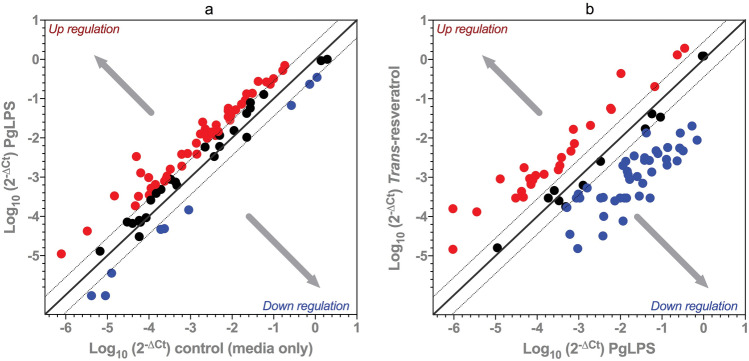
Porphyromonas gingivalis triggers a range of innate immune responses in the host that may contribute to the development of periodontitis and dementing diseases including Alzheimer's disease (AD). This study aimed to assess the mode of action of trans-resveratrol in modulating the P. gingivalis lipopolysaccharide (PgLPS) induced metabolic inflammation in a neuronal cell model. Confluent IMR-32 neuroblastoma cells were treated with trans-resveratrol from Polygonum cuspidatum in the presence or absence of PgLPS. The abundance of messenger ribo-nucleic acid (mRNA) transcripts of a panel of 92 genes was quantitatively assessed through targeted transcriptome profiling technique and the biochemical pathways affected were identified through Ingenuity Pathway Analysis. Gene expression analysis revealed that trans-resveratrol down-regulated the mRNA of multiple gene markers including growth factors, transcription factors, kinases, trans-membrane receptors, cytokines and enzymes that were otherwise activated by PgLPS treatment of IMR-32 neuroblastoma cells. Pathway analysis demonstrated that the cellular oxidative stress caused by the activation of phosphoinositide-3-kinase/Akt1 (PI3K/Akt1) pathway that leads to the production of reactive oxygen species (ROS), chronic inflammatory response induced by the activation of nuclear factor kappa-light-chain-enhancer of activated B cells (NF-kB) pathway and nutrient utilization pathways were favourably modulated by trans-resveratrol in the PgLPS challenged IMR-32 cells. This study demonstrates the potential of trans-resveratrol as a bioactive compound with multiple modes of intracellular action further supporting its therapeutic application in neuroinflammatory diseases.
Keywords: Biochemical pathways; LPS; Metabolic inflammation; NF-kB; Neuron; Oxidative stress; Reactive oxygen species.
Conflict of interest statement
The authors declare no conflict of interest/competing interests for this work.
Figures
References
-
- Dominy SS, Lynch C, Ermini F, Benedyk M, Marczyk A, Konradi A, Nguyen M, Haditsch U, Raha D, Griffin C, Holsinger LJ, Arastu-Kapur S, Kaba S, Lee A, Ryder MI, Potempa B, Mydel P, Hellvard A, Adamowicz K, Hasturk H, Walker GD, Reynolds EC, Faull RLM, Curtis MA, Dragunow M, Potempa J. Porphyromonas gingivalis in Alzheimer's disease brains: Evidence for disease causation and treatment with small-molecule inhibitors. Sci Adv. 2019;5(1):eaau3333. doi: 10.1126/sciadv.aau3333. - DOI - PMC - PubMed
-
- Wu Z, Ni J, Liu Y, Teeling JL, Takayama F, Collcutt A, Ibbett P, Nakanishi H. Cathepsin B plays a critical role in inducing Alzheimer's disease-like phenotypes following chronic systemic exposure to lipopolysaccharide from Porphyromonas gingivalis in mice. Brain Behav Immun. 2017;65:350–361. doi: 10.1016/j.bbi.2017.06.002. - DOI - PubMed
MeSH terms
Substances
LinkOut - more resources
Full Text Sources
Miscellaneous
