


Outcomes of Tofacitinib Dose Reduction in Patients with Ulcerative Colitis in Stable Remission from the Randomised RIVETING Trial
- PMID: 33290538
- PMCID: PMC8256630
- DOI: 10.1093/ecco-jcc/jjaa249
Outcomes of Tofacitinib Dose Reduction in Patients with Ulcerative Colitis in Stable Remission from the Randomised RIVETING Trial
Abstract
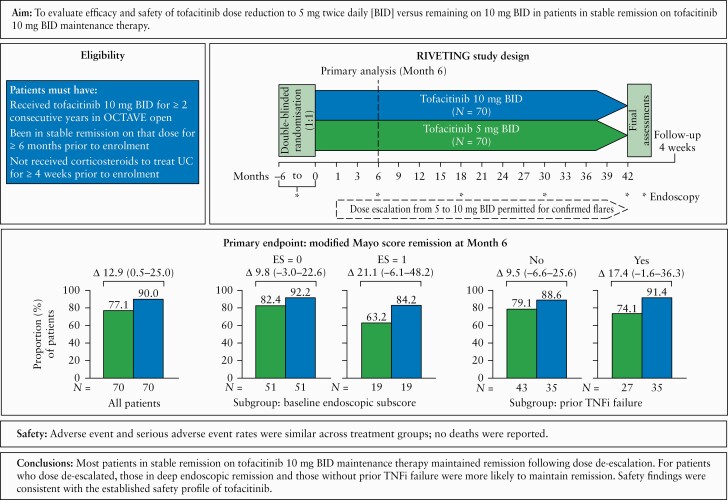
Background and aims: Tofacitinib is an oral, small molecule Janus kinase inhibitor for the treatment of ulcerative colitis. We present primary completion analysis from RIVETING, an ongoing, double-blind, randomised, parallel-group trial evaluating efficacy and safety of tofacitinib dose reduction to 5 mg twice daily [BID] versus remaining on 10 mg BID in patients in stable remission on tofacitinib 10 mg BID maintenance therapy.
Methods: Patients had received tofacitinib 10 mg BID for ≥ 2 consecutive years and been in stable remission for ≥ 6 months before enrolment. The primary endpoint was modified Mayo score remission at Month 6. Safety was assessed up to February 20, 2020 [data cut-off].
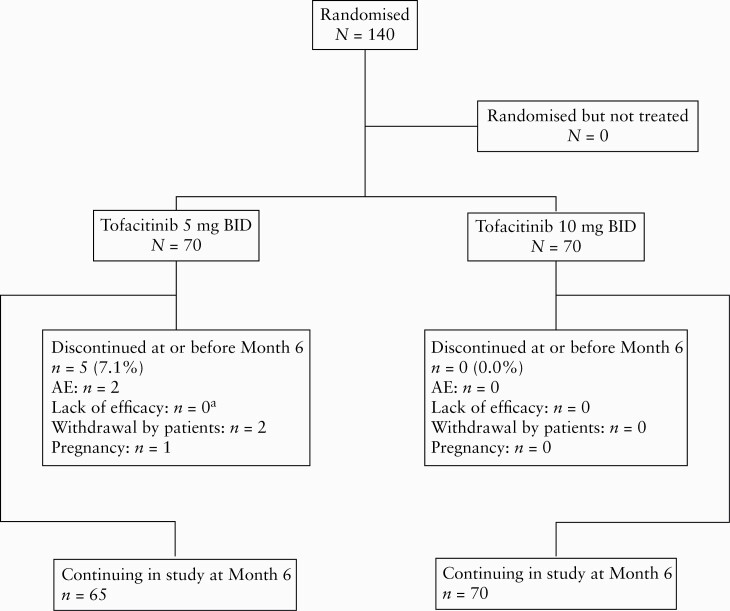
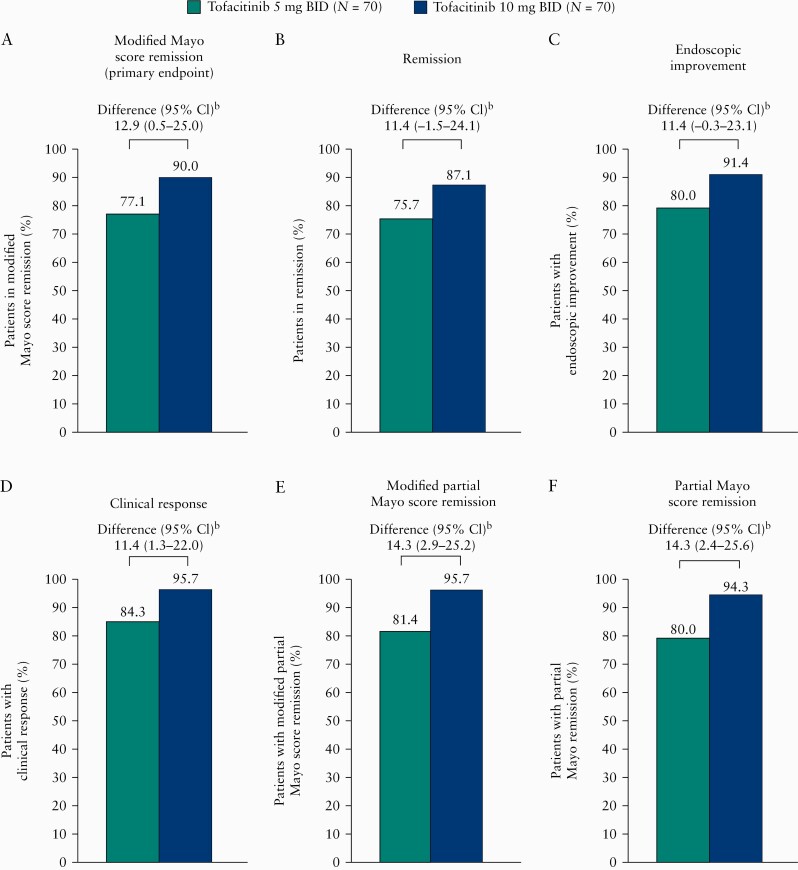
Results: In all, 140 patients were randomised [1:1] to tofacitinib 5 or 10 mg BID; 77.1% and 90.0% of patients in the 5 and 10 mg BID groups, respectively, were in modified Mayo score remission at Month 6 (adjusted difference 12.9%; 95% confidence interval [CI] 0.5-25.0). Smaller differences between treatment groups were seen in patients with baseline endoscopic subscore of 0 versus 1 [9.8%; -3.0-22.6, and 21.1%; -6.1-48.2, respectively], and in patients without versus with prior tumour necrosis factor inhibitor [TNFi] failure [9.5%; -6.6-25.6, and 17.4%; -1.6-36.3, respectively]. Adverse events [AE] and serious AE rates were similar across treatment groups; no deaths were reported.
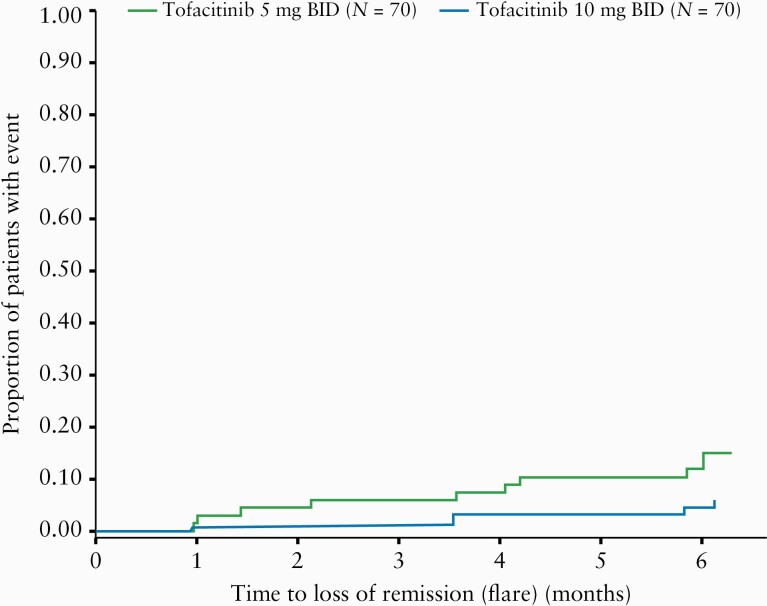
Conclusions: Most patients in stable remission on 10 mg BID maintenance therapy maintained remission following dose de-escalation. For patients who dose de-escalated, those in deep endoscopic remission and those without prior TNFi failure were more likely to maintain remission. Efficacy data were limited to the first 6 months; a longer duration of follow-up during RIVETING will further characterise the impact of dose reduction on maintenance of remission. Safety findings were consistent with the established safety profile of tofacitinib.
Keywords: Dose adjustment; maintenance; tofacitinib.
© The Author(s) 2020. Published by Oxford University Press on behalf of European Crohn’s and Colitis Organisation.
Figures
Comment in
-
Tofacitinib De-escalation Strategy in Ulcerative Colitis: Is It the End of the Story?J Crohns Colitis. 2021 Jul 5;15(7):1087-1088. doi: 10.1093/ecco-jcc/jjab006. J Crohns Colitis. 2021. PMID: 33619541 No abstract available.
References
-
- Ordás I, Eckmann L, Talamini M, Baumgart DC, Sandborn WJ. Ulcerative colitis. Lancet 2012;380:1606–19. - PubMed
-
- Ghosh S, Mitchell R. Impact of inflammatory bowel disease on quality of life: results of the European Federation of Crohn’s and Ulcerative Colitis Associations (EFCCA) patient survey. J Crohns Colitis 2007;1:10–20. - PubMed
-
- Harbord M, Eliakim R, Bettenworth D, et al. Third European evidence-based consensus on diagnosis and management of ulcerative colitis. Part 2: current management. J Crohns Colitis 2017;11:769–84. - PubMed
-
- Kornbluth A, Sachar DB; Practice Parameters Committee of the American College of Gastroenterology . Ulcerative colitis practice guidelines in adults: American College Of Gastroenterology, Practice Parameters Committee. Am J Gastroenterol 2010;105:501–23; quiz 524. - PubMed
Publication types
MeSH terms
Substances
Grants and funding
LinkOut - more resources
Full Text Sources
Medical
