. 2021 Jan 8;49(D1):D394-D403.
doi: 10.1093/nar/gkaa1106.

PANTHER version 16: a revised family classification, tree-based classification tool, enhancer regions and extensive API

Affiliations

PANTHER version 16: a revised family classification, tree-based classification tool, enhancer regions and extensive API

Huaiyu Mi et al. Nucleic Acids Res. .

Abstract

PANTHER (Protein Analysis Through Evolutionary Relationships, http://www.pantherdb.org) is a resource for the evolutionary and functional classification of protein-coding genes from all domains of life. The evolutionary classification is based on a library of over 15,000 phylogenetic trees, and the functional classifications include Gene Ontology terms and pathways. Here, we analyze the current coverage of genes from genomes in different taxonomic groups, so that users can better understand what to expect when analyzing a gene list using PANTHER tools. We also describe extensive improvements to PANTHER made in the past two years. The PANTHER Protein Class ontology has been completely refactored, and 6101 PANTHER families have been manually assigned to a Protein Class, providing a high level classification of protein families and their genes. Users can access the TreeGrafter tool to add their own protein sequences to the reference phylogenetic trees in PANTHER, to infer evolutionary context as well as fine-grained annotations. We have added human enhancer-gene links that associate non-coding regions with the annotated human genes in PANTHER. We have also expanded the available services for programmatic access to PANTHER tools and data via application programming interfaces (APIs). Other improvements include additional plant genomes and an updated PANTHER GO-slim.


Figures

Figure 1.
Figure 1.
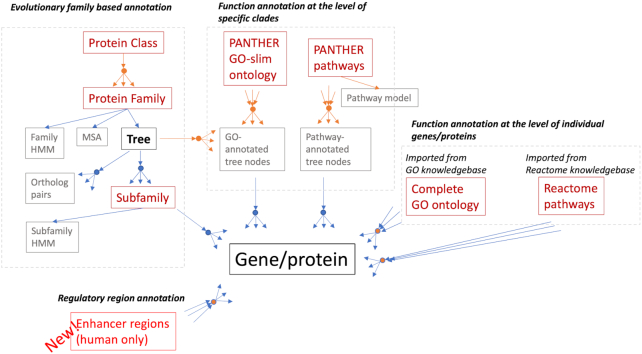
Relationships between classifications and data in PANTHER, showing the different ways in which a gene/protein (bottom) can be classified (red), as well as the other data available in PANTHER (gray). Classification types are shown in red. Arrows indicate the nature of the relationship (1:1, 1:many, many:many) and how the relationships are derived (blue = computationally, orange = expert curation, orange circle in blue = both methods). As a result, a given gene can be associated with only one subfamily, family and protein class, but can be associated with more than one GO term, pathway or enhancer region.
Figure 2.
Figure 2.
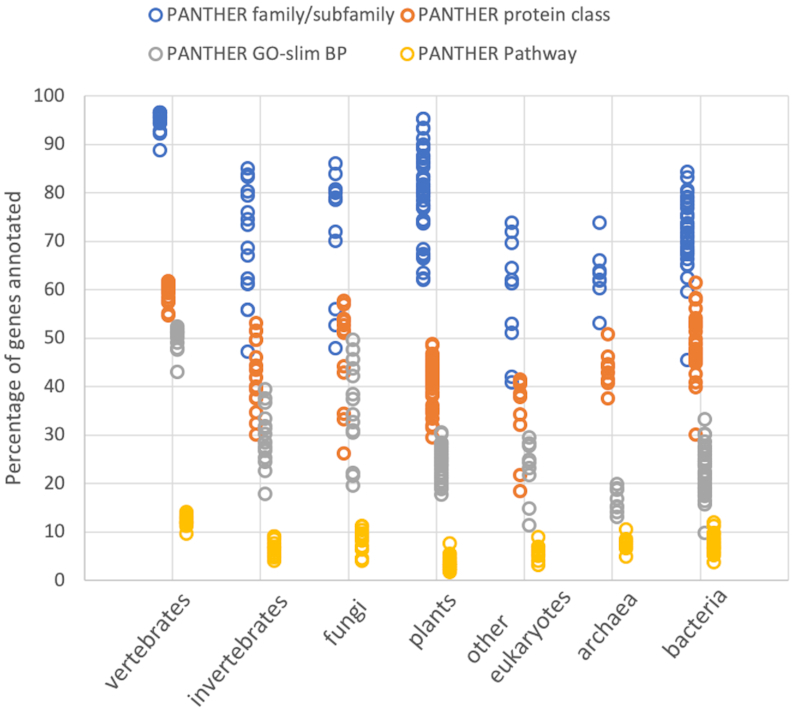
Coverage of protein-coding genes by PANTHER evolutionary and clade-level annotations. Each circle represents the coverage of one of the 142 PANTHER reference genomes, for different annotation types. Vertebrate genomes have the highest coverage for all annotation types, but other genomes are still covered to an appreciable extent.
Figure 3.
Figure 3.
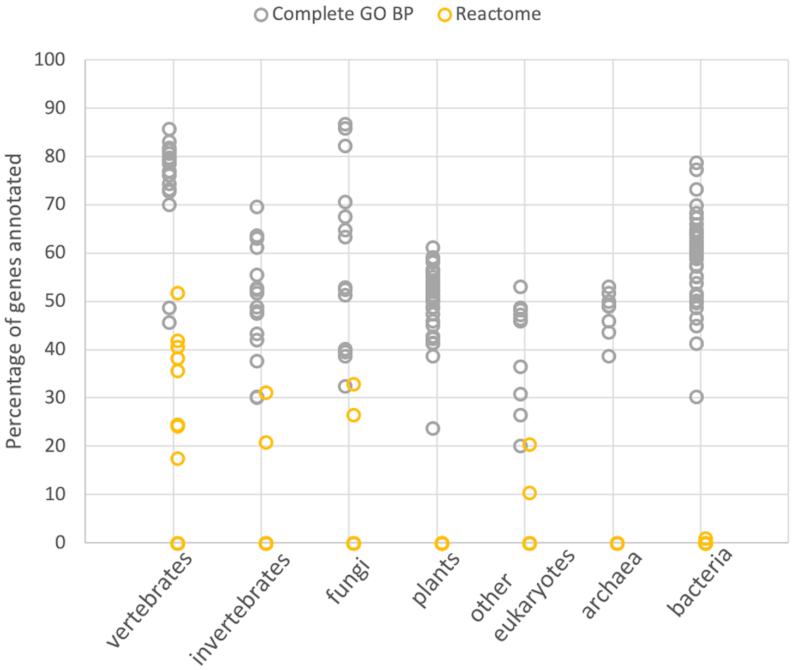
Coverage of protein-coding genes by individual protein-level annotations imported from GO and Reactome. Each circle represents the coverage of one of the 142 PANTHER reference genomes, for different annotation types. Coverage is more variable than for evolutionary and clade-level annotations, and most genomes are not covered by Reactome annotations (overlapping points at 0).
Figure 4.
Figure 4.
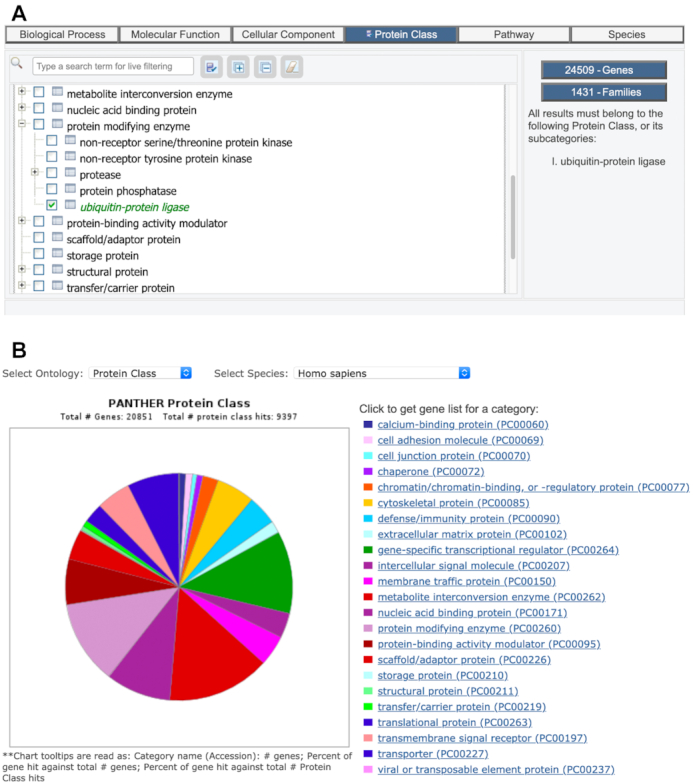
Using the Protein Class ontology. (A) Browsing the PANTHER data using Protein Class. Note that number of families also includes subfamilies. (B) Overview of entire set of protein-coding genes in a genome.
Figure 5.
Figure 5.
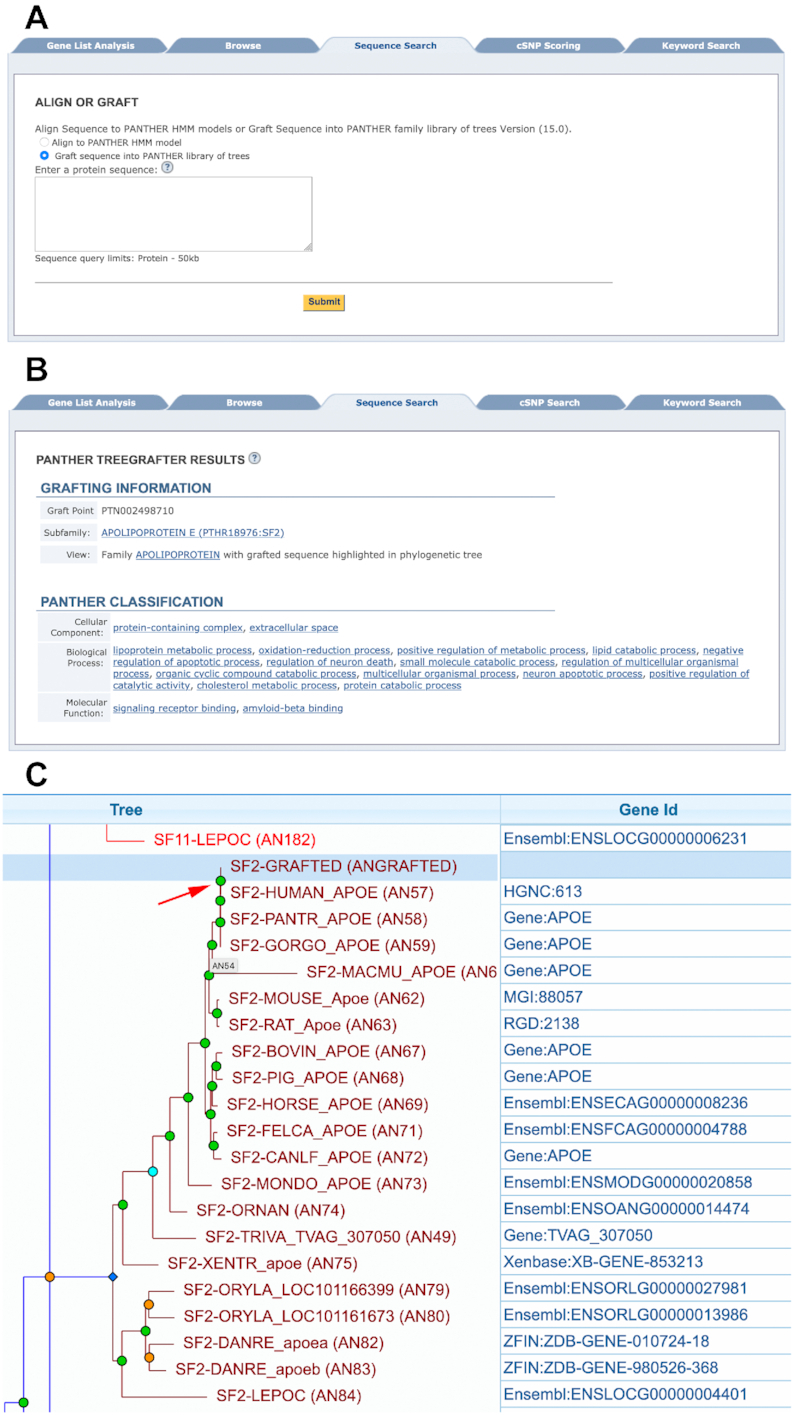
Using TreeGrafter to classify a new protein sequence. (A) Users can classify new sequences using HMMs, or TreeGrafter. (B) TreeGrafter results show subfamily assignment, and GO terms that depend on the graft point in the tree. (C) Users can view the grafted sequence in the context of the reference phylogenetic tree. The new sequence is an additional leaf in the tree (marked ‘ANGRAFTED’ and highlighted in blue), with the new internal node (pointed by a red arrow) induced by the grafting (marked ‘ANINDUCED’).
Figure 6.
Figure 6.
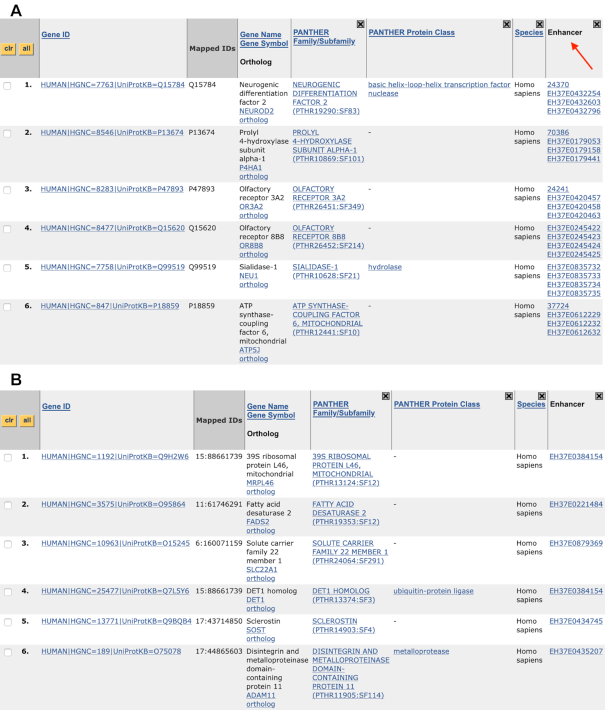
PANTHER now includes PEREGRINE enhancer-gene links data. (A) A screenshot of a gene list page after the user queries the PANTHER system with a list of genes (UniProt IDs in Mapped IDs column). The enhancers associated to each gene are listed in the Enhancer column (red arrow), which is not shown by default but can be added by clicking on a link above the list header (not shown). (B) A screenshot of the PANTHER gene list page when a user submits a VCF file. The coordinates of the variants are listed in the Mapped IDs column. PEREGRINE will map the variants to the enhancers (Enhancer column) as well as the gene(s) that is regulated by the enhancers (Gene ID column).

References

    1. Thomas P.D., Campbell M.J., Kejariwal A., Mi H., Karlak B., Daverman R., Diemer K., Muruganujan A., Narechania A.. PANTHER: a library of protein families and subfamilies indexed by function. Genome Res. 2003; 13:2129–2141. - PMC - PubMed
    1. Thomas P.D., Kejariwal A., Guo N., Mi H., Campbell M.J., Muruganujan A., Lazareva-Ulitsky B.. Applications for protein sequence-function evolution data: mRNA/protein expression analysis and coding SNP scoring tools. Nucleic Acids Res. 2006; 34:W645–W650. - PMC - PubMed
    1. Mi H., Muruganujan A., Huang X., Ebert D., Mills C., Guo X., Thomas P.D.. Protocol Update for large-scale genome and gene function analysis with the PANTHER classification system (v.14.0). Nat. Protoc. 2019; 14:703–721. - PMC - PubMed
    1. Ashburner M., Ball C.A., Blake J.A., Botstein D., Butler H., Cherry J.M., Davis A.P., Dolinski K., Dwight S.S., Eppig J.T. et al. .. Gene ontology: tool for the unification of biology. The Gene Ontology Consortium. Nat. Genet. 2000; 25:25–29. - PMC - PubMed
    1. The Gene Ontology Consortium The Gene Ontology Resource: 20 years and still GOing strong. Nucleic Acids Res. 2019; 47:D330–D338. - PMC - PubMed

Publication types