. 2020 Dec 9;287(1940):20202454.
doi: 10.1098/rspb.2020.2454. Epub 2020 Dec 9.

Infectious disease and sickness behaviour: tumour progression affects interaction patterns and social network structure in wild Tasmanian devils

Affiliations

Infectious disease and sickness behaviour: tumour progression affects interaction patterns and social network structure in wild Tasmanian devils

David G Hamilton et al. Proc Biol Sci. .

Abstract

Infectious diseases, including transmissible cancers, can have a broad range of impacts on host behaviour, particularly in the latter stages of disease progression. However, the difficulty of early diagnoses makes the study of behavioural influences of disease in wild animals a challenging task. Tasmanian devils (Sarcophilus harrisii) are affected by a transmissible cancer, devil facial tumour disease (DFTD), in which tumours are externally visible as they progress. Using telemetry and mark-recapture datasets, we quantify the impacts of cancer progression on the behaviour of wild devils by assessing how interaction patterns within the social network of a population change with increasing tumour load. The progression of DFTD negatively influences devils' likelihood of interaction within their network. Infected devils were more active within their network late in the mating season, a pattern with repercussions for DFTD transmission. Our study provides a rare opportunity to quantify and understand the behavioural feedbacks of disease in wildlife and how they may affect transmission and population dynamics in general.

Keywords: Tasmanian devil; devil facial tumour disease; disease transmission; sickness behaviour; transmissible cancer.


Conflict of interest statement

We declare we have no competing interests.

Figures
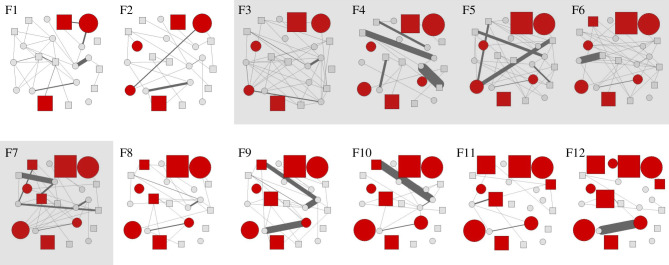
Figure 1.
Figure 1.
Fortnightly (F) contact networks based on the interactions between individual Tasmanian devils over the course of six months during the early stages of a DFTD outbreak; F1–12 represent 14-day time steps with the mating season highlighted in grey. Squares represent males, while circles represent females. Nodes coloured solid red represent those with clinical symptoms of DFTD, where size is scaled by tumour load category (1, 0.0001–50 cm3; 2, 50–100 cm3; 3, 100–200 cm3; 4, greater than 200 cm3; [37]). Edges between nodes represent interaction frequency within the dyad, the thicker the line, the more interactions between those individuals. Edges have been scaled (dyad interaction frequency/30) to allow depiction of high edge weights without occluding entire networks. (Online version in colour.)
Figure 2.
Figure 2.
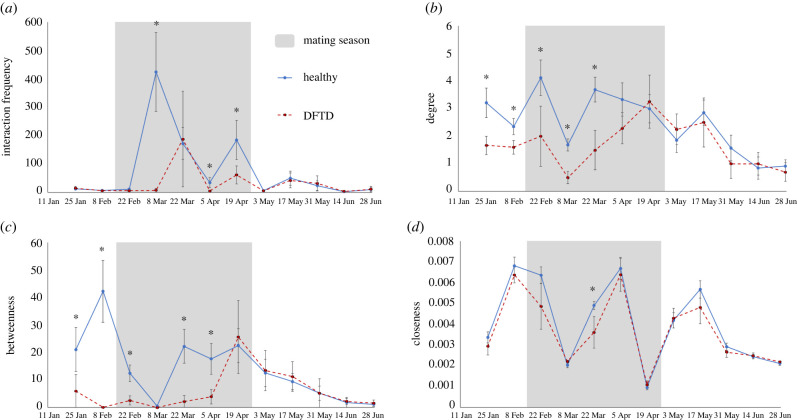
Mean network metrics of (a) interaction frequency, (b) degree, (c) betweenness, and (d) closeness through fortnightly contact networks for healthy devils (solid, blue) and those with clinical symptoms of DFTD (dashed, red). The Tasmanian devil mating season is shaded in grey. Error bars indicate 95% confidence intervals—periods with non-overlapping error bars represent a significant effect of infection status in node-permuted significance tests (indicated by an asterisk). (Online version in colour.)

References

    1. Telfer S, Lambin X, Birtles R, Beldomenico P, Burthe S, Paterson S, Begon M. 2010. Species interactions in a parasite community drive infection risk in a wildlife population. Science 330, 243–246. ( 10.1126/science.1190333) - DOI - PMC - PubMed
    1. Gallana M, Ryser-Degiorgis M-P, Wahli T, Segner H. 2013. Climate change and infectious diseases of wildlife: altered interactions between pathogens, vectors and hosts. Curr. Zool. 59, 427–437. ( 10.1093/czoolo/59.3.427) - DOI
    1. Lowry H, Lill A, Wong BB. 2013. Behavioural responses of wildlife to urban environments. Biol. Rev. 88, 537–549. ( 10.1111/brv.12012) - DOI - PubMed
    1. Kappeler PM, Cremer S, Nunn CL. 2015. Sociality and health: impacts of sociality on disease susceptibility and transmission in animal and human societies. Phil. Trans. R. Soc. B 370, 20140116 ( 10.1098/rstb.2014.0116) - DOI - PMC - PubMed
    1. Hart BL. 1988. Biological basis of the behavior of sick animals. Neurosci. Biobehav. Rev. 12, 123–137. ( 10.1016/S0149-7634(88)80004-6) - DOI - PubMed

Publication types