. 2020 Dec 6;9(12):1026.
doi: 10.3390/pathogens9121026.

Whole Genome Characterization and Evolutionary Analysis of G1P[8] Rotavirus A Strains during the Pre- and Post-Vaccine Periods in Mozambique (2012-2017)

Affiliations

Whole Genome Characterization and Evolutionary Analysis of G1P[8] Rotavirus A Strains during the Pre- and Post-Vaccine Periods in Mozambique (2012-2017)

Benilde Munlela et al. Pathogens. .

Abstract

Mozambique introduced the Rotarix® vaccine (GSK Biologicals, Rixensart, Belgium) into the National Immunization Program in September 2015. Although G1P[8] was one of the most prevalent genotypes between 2012 and 2017 in Mozambique, no complete genomes had been sequenced to date. Here we report whole genome sequence analysis for 36 G1P[8] strains using an Illumina MiSeq platform. All strains exhibited a Wa-like genetic backbone (G1-P[8]-I1-R1-C1-M1-A1-N1-T1-E1-H1). Phylogenetic analysis showed that most of the Mozambican strains clustered closely together in a conserved clade for the entire genome. No distinct clustering for pre- and post-vaccine strains were observed. These findings may suggest no selective pressure by the introduction of the Rotarix® vaccine in 2015. Two strains (HJM1646 and HGM0544) showed varied clustering for the entire genome, suggesting reassortment, whereas a further strain obtained from a rural area (MAN0033) clustered separately for all gene segments. Bayesian analysis for the VP7 and VP4 encoding gene segments supported the phylogenetic analysis and indicated a possible introduction from India around 2011.7 and 2013.0 for the main Mozambican clade. Continued monitoring of rotavirus strains in the post-vaccine period is required to fully understand the impact of vaccine introduction on the diversity and evolution of rotavirus strains.

Keywords: Bayesian analysis; G1P[8]; Mozambique; Rotarix®; rotavirus group A; whole genome sequencing.


Conflict of interest statement

CMD has served on an advisory board for GSK (2019), all payments were paid directly to an administrative fund held by Murdoch Children’s Research Institute. All other authors declare no conflicts of interest.

Figures
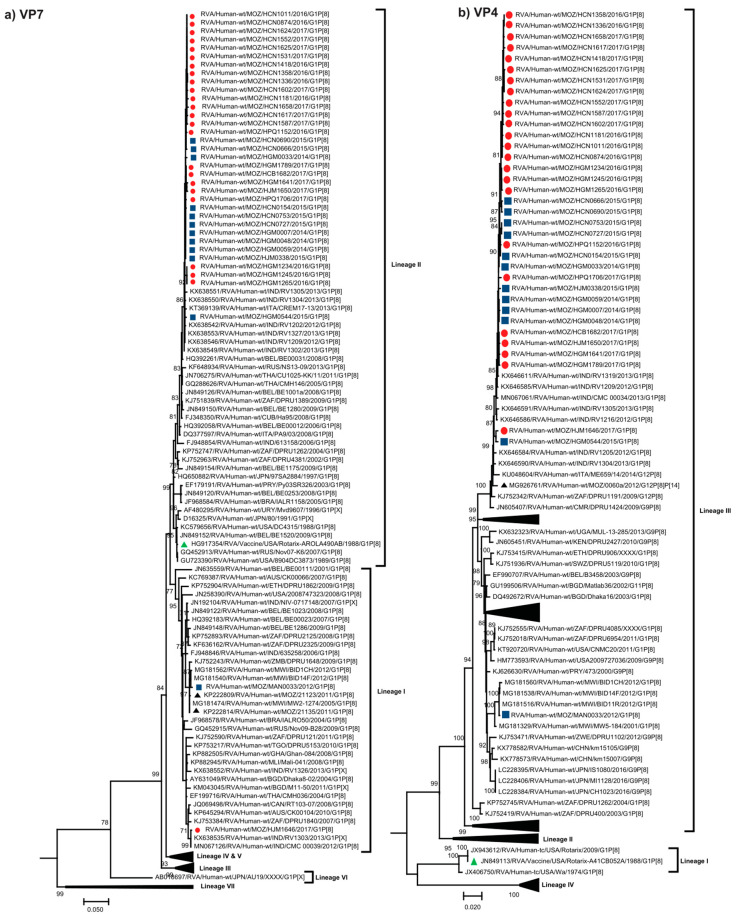
Figure 1
Figure 1
Phylogenetic trees based on the ORF (open reading frame) nucleotide sequence of the (a) VP7 and (b) VP4 genes of G1P[8] strains circulating in Mozambique and global strains obtained from GenBank. The trees were constructed based on the maximum likelihood method implemented in MEGA X [29], applying the best-fit nucleotide substitution model Tamura-3-parameter (T92+G+I) for VP7 and General Time Reversible (GTR-G) for VP4, determined by JModelTest [30]. Bootstrap values (1000 replicates) ≥70% are shown with DS-1 serving as an out-group (not shown in the final tree). Scale bar indicates genetic distance expressed as the number of nucleotide substitutions per site. Pre-vaccine Mozambican strains are indicated by blue squares, post-vaccine by red circles, the Rotarix® vaccine strain by a green triangle and Mozambican strains from previous studies [14,19] are indicated by black triangles. Lineages are defined from I-VIII for VP7 and I-IV for VP4 [21,22,23,25,26,27,28].
Figure 2
Figure 2
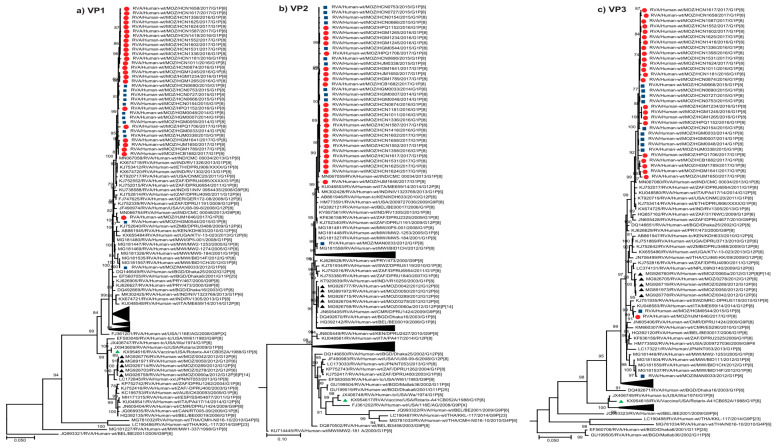
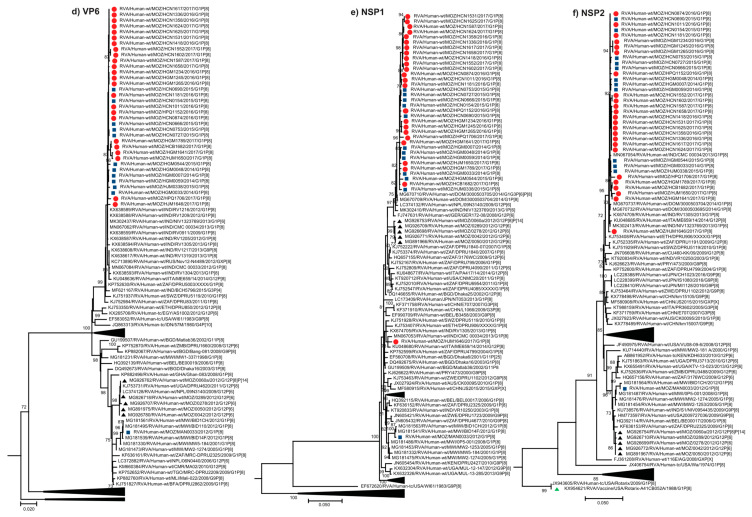
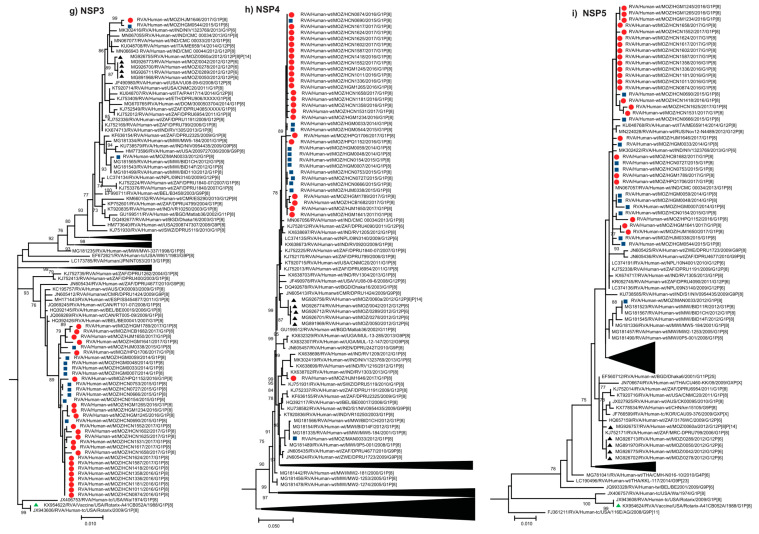
Phylogenetic trees based on the ORF nucleotide sequences of the (a) VP1, (b) VP2, (c) VP3, (d) VP6, (e) NSP1, (f) NSP2, (g) NSP3, (h) NSP4 and (i) NSP5 genes of G1P[8] strains circulating in Mozambique and global strains obtained from GenBank. The trees were constructed based on the maximum likelihood method implemented in MEGA X [29], using the best-fit nucleotide substitution model General Time Reversible (GTR+G+I) for VP3, GTR+G for VP2, NSP2 and NSP3, Hasegawa Kishino Yano (HKY+G+I) for VP6 and NSP1, HKY+G for VP1, NSP4 and NSP5/6, determined by JModelTest [30]. Bootstrap values (1000 replicates) ≥70% are shown with DS-1 serving as an out-group (not shown in the final tree). Scale bar indicates genetic distance expressed as the number of nucleotide substitutions per site. Pre-vaccine Mozambican strains are indicated by blue squares, post-vaccine by red circles, the Rotarix® vaccine strain by a green triangle and Mozambican strains from a previous study [19] are indicated by black triangles.
Figure 2
Figure 2
Phylogenetic trees based on the ORF nucleotide sequences of the (a) VP1, (b) VP2, (c) VP3, (d) VP6, (e) NSP1, (f) NSP2, (g) NSP3, (h) NSP4 and (i) NSP5 genes of G1P[8] strains circulating in Mozambique and global strains obtained from GenBank. The trees were constructed based on the maximum likelihood method implemented in MEGA X [29], using the best-fit nucleotide substitution model General Time Reversible (GTR+G+I) for VP3, GTR+G for VP2, NSP2 and NSP3, Hasegawa Kishino Yano (HKY+G+I) for VP6 and NSP1, HKY+G for VP1, NSP4 and NSP5/6, determined by JModelTest [30]. Bootstrap values (1000 replicates) ≥70% are shown with DS-1 serving as an out-group (not shown in the final tree). Scale bar indicates genetic distance expressed as the number of nucleotide substitutions per site. Pre-vaccine Mozambican strains are indicated by blue squares, post-vaccine by red circles, the Rotarix® vaccine strain by a green triangle and Mozambican strains from a previous study [19] are indicated by black triangles.
Figure 2
Figure 2
Phylogenetic trees based on the ORF nucleotide sequences of the (a) VP1, (b) VP2, (c) VP3, (d) VP6, (e) NSP1, (f) NSP2, (g) NSP3, (h) NSP4 and (i) NSP5 genes of G1P[8] strains circulating in Mozambique and global strains obtained from GenBank. The trees were constructed based on the maximum likelihood method implemented in MEGA X [29], using the best-fit nucleotide substitution model General Time Reversible (GTR+G+I) for VP3, GTR+G for VP2, NSP2 and NSP3, Hasegawa Kishino Yano (HKY+G+I) for VP6 and NSP1, HKY+G for VP1, NSP4 and NSP5/6, determined by JModelTest [30]. Bootstrap values (1000 replicates) ≥70% are shown with DS-1 serving as an out-group (not shown in the final tree). Scale bar indicates genetic distance expressed as the number of nucleotide substitutions per site. Pre-vaccine Mozambican strains are indicated by blue squares, post-vaccine by red circles, the Rotarix® vaccine strain by a green triangle and Mozambican strains from a previous study [19] are indicated by black triangles.
Figure 3
Figure 3
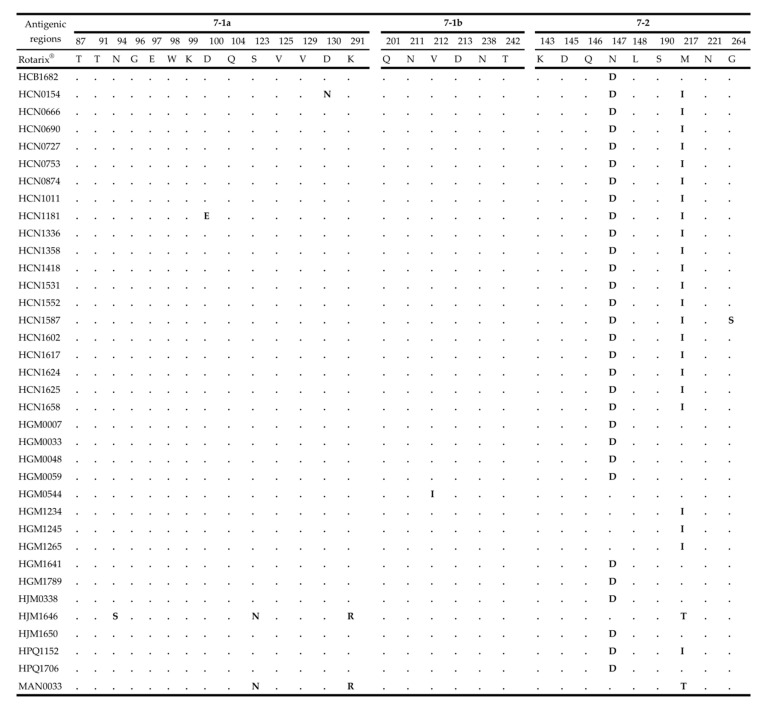
The alignment of amino acids corresponding to three VP7 antigenic epitopes (7-1a, 7-1b and 7-2). The amino acid sequence of Rotarix® is the reference strain and the conserved residues between the Rotarix® to Mozambican strains are indicated by dots (.) and residues that differ are in bold.
Figure 4
Figure 4
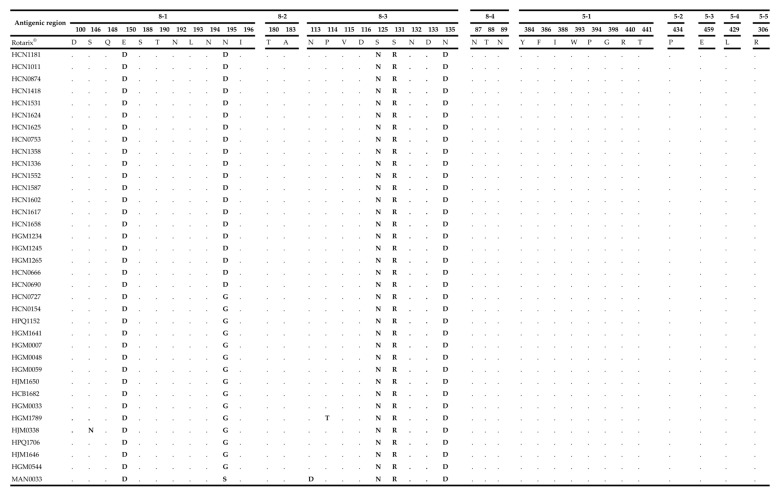
The alignment of the amino acids corresponding to the VP4 antigenic epitopes (8-1, 8-2, 8-3, 8-4 for VP8* and 5-1, 5-2, 5-3, 5-4, 5-5 for VP5). The amino acid sequence of Rotarix® is the reference strain and the conserved residues between the Rotarix® to Mozambican strains are indicated by dots (.) and residues that differ are in bold.

References

    1. Tate J.E., Burton A.H., Boschi-Pinto C., Parashar U.D. Global, Regional, and National Estimates of Rotavirus Mortality in Children <5 Years of Age, 2000–2013. Clin. Infect. Dis. 2016;62(Suppl. 2):S96–S105. doi: 10.1093/cid/civ1013. - DOI - PMC - PubMed
    1. Troeger C., Khalil I.A., Rao P.C., Cao S., Blacker B.F., Ahmed T., Armah G., Bines J.E., Brewer T.G., Colombara D.V., et al. Rotavirus Vaccination and the Global Burden of Rotavirus Diarrhea Among Children Younger Than 5 Years. JAMA Pediatr. 2018;172:958–965. doi: 10.1001/jamapediatrics.2018.1960. - DOI - PMC - PubMed
    1. Estes M.K., Cohen J. Rotavirus gene structure and function. Microbiol. Rev. 1989;53:410–449. doi: 10.1128/MR.53.4.410-449.1989. - DOI - PMC - PubMed
    1. Jayaram H., Estes M., Prasad B.V. Emerging themes in rotavirus cell entry, genome organization, transcription and replication. Virus Res. 2004;101:67–81. doi: 10.1016/j.virusres.2003.12.007. - DOI - PubMed
    1. Desselberger U. Rotaviruses. Virus Res. 2014;190:75–96. doi: 10.1016/j.virusres.2014.06.016. - DOI - PubMed

LinkOut - more resources