


Effects of Electronic Health Record Implementation and Barriers to Adoption and Use: A Scoping Review and Qualitative Analysis of the Content
- PMID: 33291615
- PMCID: PMC7761950
- DOI: 10.3390/life10120327
Effects of Electronic Health Record Implementation and Barriers to Adoption and Use: A Scoping Review and Qualitative Analysis of the Content
Abstract
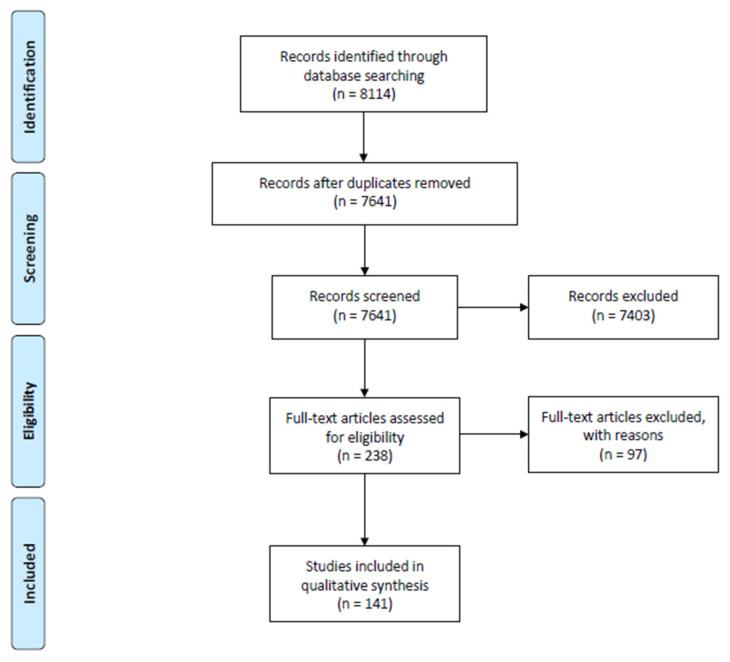
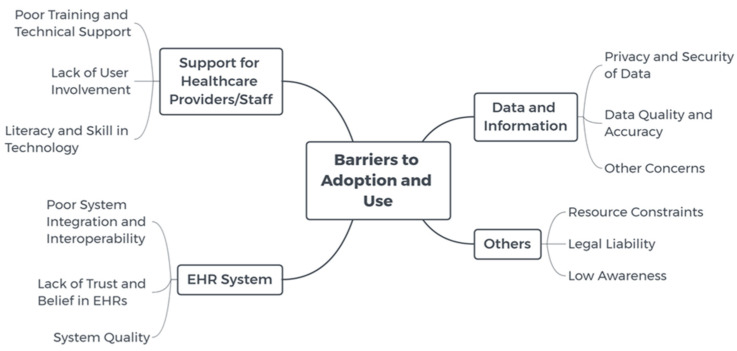
Despite the great advances in the field of electronic health records (EHRs) over the past 25 years, implementation and adoption challenges persist, and the benefits realized remain below expectations. This scoping review aimed to present current knowledge about the effects of EHR implementation and the barriers to EHR adoption and use. A literature search was conducted in PubMed, Web of Science, IEEE Xplore Digital Library and ACM Digital Library for studies published between January 2005 and May 2020. In total, 7641 studies were identified of which 142 met the criteria and attained the consensus of all researchers on inclusion. Most studies (n = 91) were published between 2017 and 2019 and 81 studies had the United States as the country of origin. Both positive and negative effects of EHR implementation were identified, relating to clinical work, data and information, patient care and economic impact. Resource constraints, poor/insufficient training and technical/educational support for users, as well as poor literacy and skills in technology were the identified barriers to adoption and use that occurred frequently. Although this review did not conduct a quality analysis of the included papers, the lack of uniformity in the use of EHR definitions and detailed contextual information concerning the study settings could be observed.
Keywords: adoption; electronic health record; implementation; personal health record; scoping review.
Conflict of interest statement
The authors declare no conflict of interest.
Figures

References
-
- Institute of Medicine—Committee on Improving the Patient Record . The Computer-Based Patient Record an Essential Technology for Health Care. National Academy Press; Washington, DC, USA: 1997. Revised Edition.
-
- Ornstein S.M., Oates R.B., Fox G.N. The computer-based medical record: Current status. J. Fam. Pract. 1992;35:556–565. - PubMed
-
- Hoerbst A., Ammenwerth E. Electronic health records. A systematic review on quality requirements. Methods Inf. Med. 2010;49:320–336. - PubMed
-
- International Organization for Standardization . Health Informatics—Capacity-Based eHealth Architecture Roadmap—Part 1: Overview of National eHealth Initiatives. Volume ISO/TR 14639-1:2012(en) ISO; Geneva, Switzerland: 2012.
Publication types
Grants and funding
LinkOut - more resources
Full Text Sources
Miscellaneous
