


The outcome at follow-up after inpatient eating disorder treatment: a naturalistic study
- PMID: 33292634
- PMCID: PMC7709321
- DOI: 10.1186/s40337-020-00349-6
The outcome at follow-up after inpatient eating disorder treatment: a naturalistic study
Abstract
Background: Patients with eating disorders may experience a severe and enduring course of illness. Treatment outcome for patients provided with inpatient treatment is reported as poor. Research to date has not provided consistent results for predictors of treatment outcome. The aims of the study were to investigate rates of remission at follow-up after inpatient treatment, symptom change from admission to follow-up, and predictors of treatment outcome.
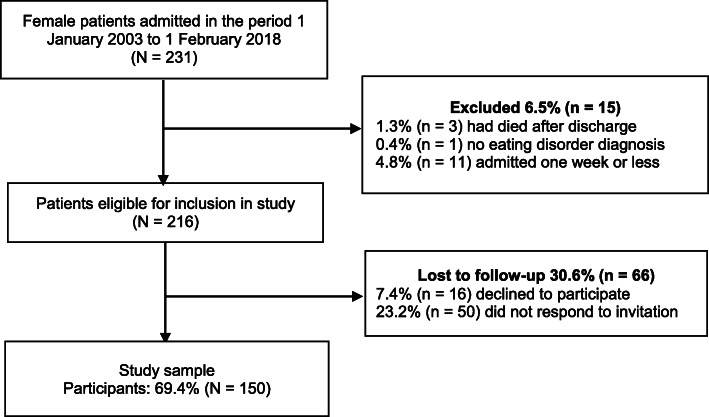
Methods: The follow-up sample consisted of 150 female adult former patients (69.4% of all eligible female patients) with eating disorders. Mean age at admission was 21.7 (SD = 4.9) years. Diagnostic distribution: 66% (n = 99) anorexia nervosa, 21.3% (n = 32) bulimia nervosa and 12.7% (n = 19) other specified feeding or eating disorder, including binge eating. Data were collected at admission, discharge and follow-up (mean 2.7 (SD = 1.9) years). Definition of remission was based on the EDE-Q Global score, body mass index and binge/purge behavior. Paired T-tests were performed to investigate change over time. Univariate and multivariate logistic regressions were estimated to investigate predictors of remission.
Results: At follow-up, 35.2% of the participants were classified as in remission. Significant symptom reduction (in all patients) (p < 0.001) and significant increase in body mass index (BMI) (in underweight participants at admission) (p < 0.001) was found. Increased BMI (p < 0.05), the level of core eating disorder symptoms at admission (p < 0.01) and reduced core eating disorder symptoms (p < 0.01) during inpatient treatment were found significant predictors of outcome in the multivariate model.
Conclusions: All participants had an eating disorder requiring inpatient treatment. Approximately one-third of all participants could be classified as in remission at follow-up. However, most participants experienced significant symptom improvement during inpatient treatment and the improvements were sustained at follow-up. Increased probability of remission at follow-up was indicated by lower core ED symptoms at admission for all patients, raised BMI during admission for patients with AN, and reduced core ED symptoms during inpatient treatment for all patients. This finding contributes important information and highlights the importance of targeting these core symptoms in transdiagnostic treatment programs.
Keywords: Adults; Eating disorders; Follow-up; Inpatient treatment; Outcome predictors; Remission; Treatment outcome.
Conflict of interest statement
The authors are responsible for the writing and content of this paper, and no conflicts of interest are reported.
References
-
- American Psychiatric Association (APA) Practice guideline for the treatment of patients with eating disorders NGC-4987. Am J Psychiatry. 2006;163:4–54. - PubMed
-
- National Collaborating Centre for Mental Health . Eating disorders: core interventions in the treatment and management of anorexia nervosa, bulimia nervosa and related eating disorders. Leicester: British Psychological Society; 2004. - PubMed
LinkOut - more resources
Full Text Sources
