


Ex vivo generation of platelet products from human iPS cells
- PMID: 33292717
- PMCID: PMC7708911
- DOI: 10.1186/s41232-020-00139-2
Ex vivo generation of platelet products from human iPS cells
Abstract
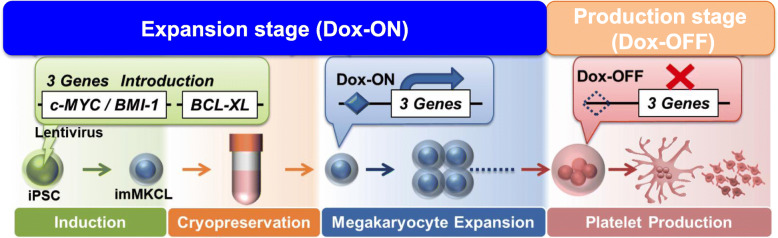
Platelet products are used in treatments for thrombocytopenia caused by hematopoietic diseases, chemotherapy, massive hemorrhages, extracorporeal circulation, and others. Their manufacturing depends on volunteers who donate blood. However, it is becoming increasingly necessary to reinforce this blood donation system with other blood sources due to the increase in demand and shortage of supply accompanying aging societies. In addition, blood-borne infections and alloimmune platelet transfusion refractoriness are not completely resolved. Since human induced pluripotent stem cell (iPSC)-platelet products can be supplied independently from the donor, it is expected to complement current platelet products. One big hurdle with iPSC-based systems is the production of 10 units, which is equivalent to 200 billion platelets. To overcome this issue, we established immortalized megakaryocyte cell lines (imMKCLs) by introducing three transgenes, c-MYC, BMI1, and BCL-XL, sequentially into hematopoietic and megakaryocytic progenitor stage cells derived from iPSCs. The three transgenes are regulated in a Tet-ON manner, enabling the addition and depletion of doxycycline to expand and maturate the imMKCLs, respectively. In addition, we succeeded in discovering drug combinations that enable feeder-free culture conditions in the imMKCL cultivation. Furthermore, we discovered the importance of turbulence in thrombopoiesis through live bone marrow imaging and developed a bioreactor based on the concept of turbulent flow. Eventually, through the identification of two key fluid physic parameters, turbulent energy and shear stress, we succeeded in scaling up the bioreactor to qualitatively and quantitatively achieve clinically applicable levels. Interestingly, three soluble factors released from imMKCLs in the turbulent flow condition, macrophage migration inhibitory factor (MIF), insulin growth factor binding protein 2 (IGFBP2), and nardilysin (NRDC), enhanced platelet production. Based on these developments, we initiated the first-in-human clinical trial of iPSC-derived platelets to a patient with alloimmune platelet transfusion refractoriness (allo-PTR) using an autologous product. In this review, we detail current research in this field and our study about the ex vivo production of iPSC-derived platelets.
Keywords: Bioreactor; Megakaryocyte; Platelet; Turbulence; iPS cell.
Conflict of interest statement
K.E. and S.N. has submitted patents related to some references [5, 9, 10, 15, 24, 28]. K.E. is a cofounder of Megakaryon Corporation and a member of its scientific advisory board without salary. K.E. receives grants from Megakaryon, Otsuka Pharmaceutical Co., Ltd., and Kyoto Seisakusho Co., Ltd. The interests of K.E. were reviewed and are managed by Kyoto University in accordance with its conflict of interest policies. S.N. and N.S. declare no conflict of interest.
Figures

References
Publication types
LinkOut - more resources
Full Text Sources
Research Materials
Miscellaneous
