. 2020 Dec 9:148:e298.
doi: 10.1017/S0950268820002988.

Quarantine and the risk of COVID-19 importation

Affiliations

Quarantine and the risk of COVID-19 importation

J Arino et al. Epidemiol Infect. .

Abstract

Using a stochastic model, we assess the risk of importation-induced local transmission chains in locations seeing few or no local transmissions and evaluate the role of quarantine in the mitigation of this risk. We find that the rate of importations plays a critical role in determining the risk that case importations lead to local transmission chains, more so than local transmission characteristics, i.e. strength of social distancing measures (NPI). The latter influences the severity of the outbreaks when they do take place. Quarantine after arrival in a location is an efficacious way to reduce the rate of importations. Locations that see no or low-level local transmission should ensure that the rate of importations remains low. A high level of compliance with post-arrival quarantine followed by testing achieves this objective with less of an impact than travel restrictions or bans.

Keywords: COVID-19; importation risk; mathematical modelling; quarantine.


Conflict of interest statement

We declare no competing interests.

Figures
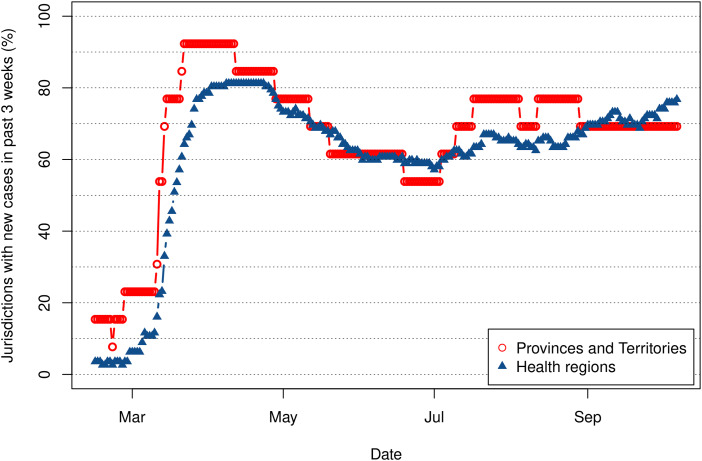
Fig. 1.
Fig. 1.
Percentage of provinces, territories and health regions in Canada having declared new confirmed cases of COVID-19 in 2020 during a three-week period prior to dates shown. Time runs from three weeks after the first case in Canada on 25 January 2020 to 30 November 2020.
Fig. 2.
Fig. 2.
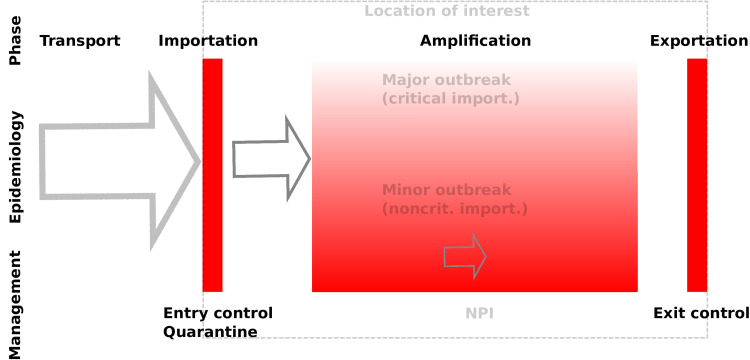
Spatialisation process: transport of cases from other locations; importation into the location of interest; local amplification; exportation to other locations. Red indicates control methods. See ES.1.1 for details.
Fig. 3.
Fig. 3.
Input−output setting: imports arrive through transport, are potentially funnelled through quarantine, then enter one of the infected compartments. The three types of outcomes considered are shown on the right. In the epidemic model, compartment S represents susceptible individuals, L1 and L2 are latent individuals, I1 and I2 are detected infectious individuals, A1 and A2 are undetected infectious individuals, D are deaths from detected infections or posthumously tied to the infection; finally RI and RA are recovered from detected and undetected infections, respectively.
Fig. 4.
Fig. 4.
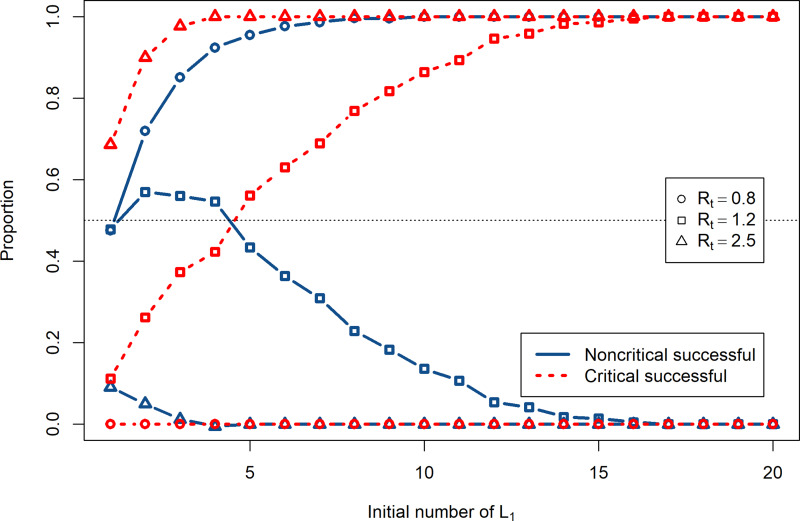
Proportions of critical (dotted red) and non-critical successful (solid blue) importations as a function of the initial number of imported L1 cases. Circles:formula image, squares: 1.2 and triangles: 2.5.
Fig. 5.
Fig. 5.
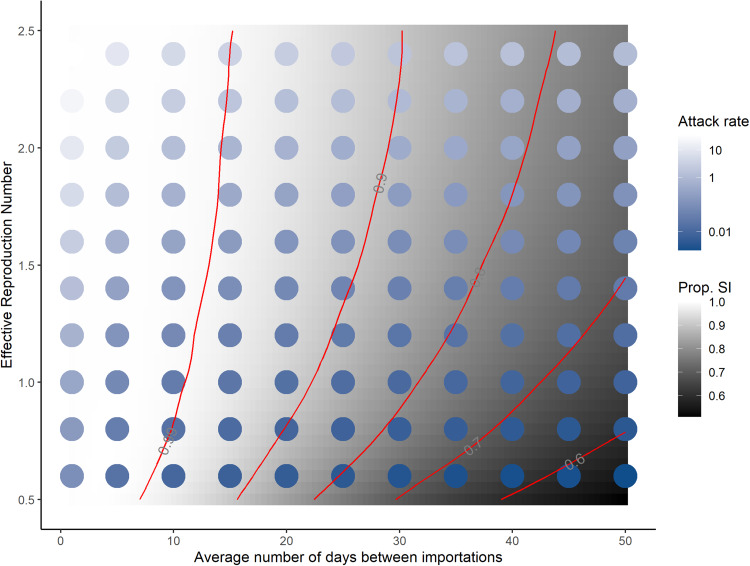
Proportion of successful importations (SI, grey scale) and attack rates (blue scale) in a three-month period for different values of the average number of days 1/λ between two importations and formula image, an indicator of NPI efficacy.
Fig. 6.
Fig. 6.
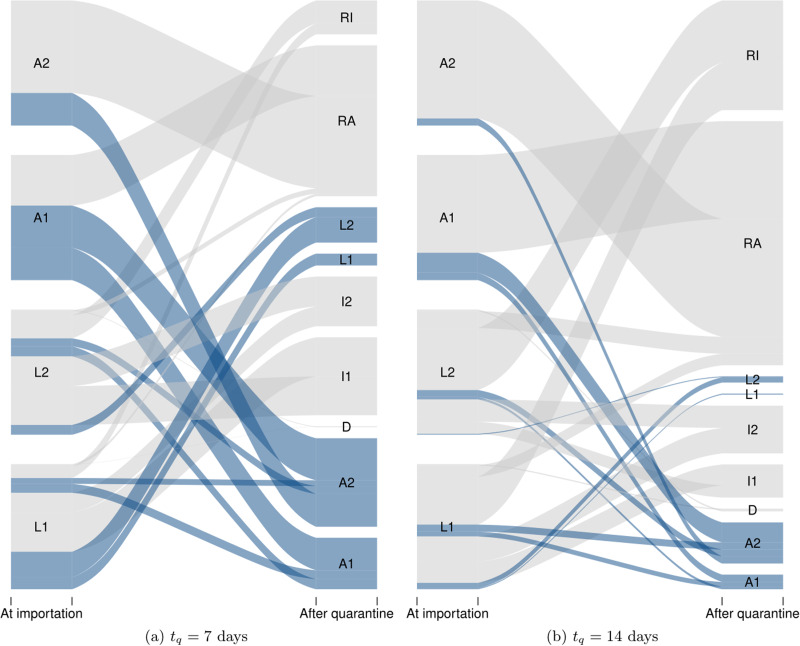
Evolution of the status of import cases during a (left) one- or (right) two-week quarantine period imposed upon arrival. Dark grey flows are individuals who are still a risk to the jurisdiction at the end of the quarantine period. Here, simulations were run for 2500 individuals of each type of unobservable cases L1, L2, A1 and A2 entering quarantine.
Fig. 7.
Fig. 7.
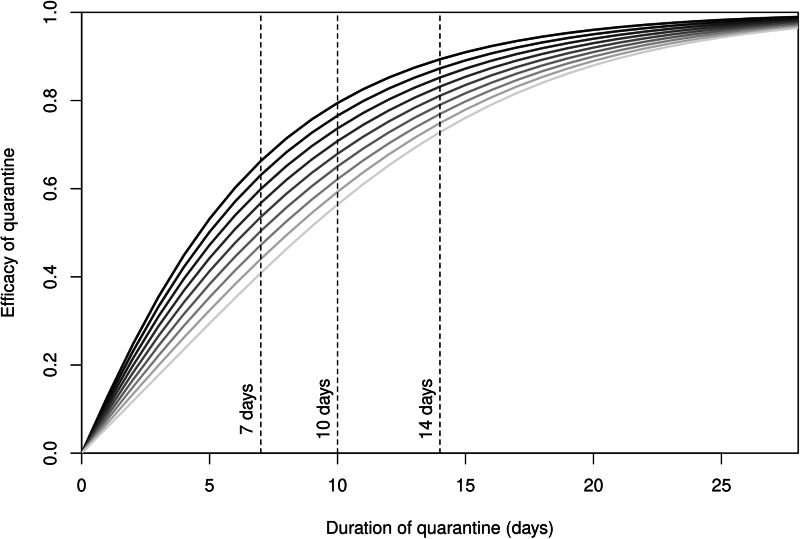
Probability c that the quarantine is successful as a function of its duration tq. From dark to light grey: fraction π of undetected cases varying from 0.1 to 0.9 by steps of 0.1. Vertical bars show the most commonly used quarantine durations.

References

    1. Adegboye OA, Adekunle AI and Gayawan E (2020) Early transmission dynamics of novel coronavirus (COVID-19) in Nigeria. International Journal of Environmental Research and Public Health 17, 4. - PMC - PubMed
    1. Jesus JGD et al. (2020) Importation and early local transmission of COVID-19 in Brazil, 2020. Revista do Instituto de Medicina Tropical de Sao Paulo 62, e30. - PMC - PubMed
    1. Korea Centers for Disease Control and Prevention (2020) Early trend of imported COVID-19 cases in South Korea. Osong Public Health and Research Perspectives 11, 140–145. - PMC - PubMed
    1. Lin C-Y et al. (2020) Importation of SARS-CoV-2 infection leads to major COVID-19 epidemic in Taiwan. International Journal of Infectious Diseases 97, 240–244. - PMC - PubMed
    1. Berry I et al. (2020) Open access epidemiologic data and an interactive dashboard to monitor the COVID-19 outbreak in Canada. Canadian Medical Association Journal 192, E420–E420. - PMC - PubMed

Publication types