. 2021 Jan 4;193(1):E10-E18.
doi: 10.1503/cmaj.201686. Epub 2020 Dec 7.

Diagnosis-wide analysis of COVID-19 complications: an exposure-crossover study

Affiliations

Diagnosis-wide analysis of COVID-19 complications: an exposure-crossover study

William Murk et al. CMAJ. .

Abstract

Background: Many studies reporting coronavirus disease 2019 (COVID-19) complications have involved case series or small cohorts that could not establish a causal association with COVID-19 or provide risk estimates in different care settings. We sought to study all possible complications of COVID-19 to confirm previously reported complications and to identify potential complications not yet known.

Methods: Using United States health claims data, we compared the frequency of all International Classification of Diseases, 10th Revision, Clinical Modification (ICD-10-CM) diagnosis codes occurring before and after the onset of the COVID-19 pandemic in an exposure-crossover design. We included patients who received a diagnosis of COVID-19 between Mar. 1, 2020, and Apr. 30, 2020, and computed risk estimates and odds ratios (ORs) of association with COVID-19 for every ICD-10-CM diagnosis code.

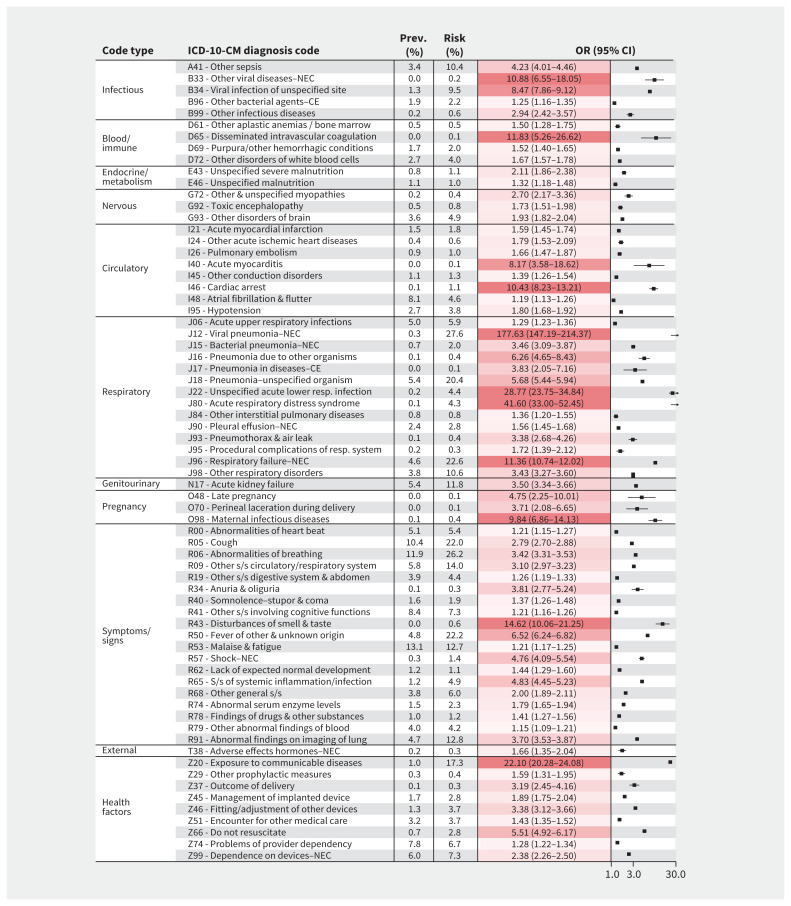
Results: Among 70 288 patients with COVID-19, 69 of 1724 analyzed ICD-10-CM diagnosis codes were significantly associated with COVID-19. Disorders showing both strong association with COVID-19 and high absolute risk included viral pneumonia (OR 177.63, 95% confidence interval [CI] 147.19-214.37, absolute risk 27.6%), respiratory failure (OR 11.36, 95% CI 10.74-12.02, absolute risk 22.6%), acute kidney failure (OR 3.50, 95% CI 3.34-3.68, absolute risk 11.8%) and sepsis (OR 4.23, 95% CI 4.01-4.46, absolute risk 10.4%). Disorders showing strong associations with COVID-19 but low absolute risk included myocarditis (OR 8.17, 95% CI 3.58-18.62, absolute risk 0.1%), disseminated intravascular coagulation (OR 11.83, 95% CI 5.26-26.62, absolute risk 0.1%) and pneumothorax (OR 3.38, 95% CI 2.68-4.26, absolute risk 0.4%).

Interpretation: We confirmed and provided risk estimates for numerous complications of COVID-19. These results may guide prognosis, treatment decisions and patient counselling.


Conflict of interest statement

Competing interests: William Murk is a consultant to and holds stocks in Aetion, Inc. Monica Gierada, Andrew Weckstein and Jeremy Rassen are employees of and hold stock options or stocks in Aetion, Inc. Reyna Klesh is an employee of HealthVerity, Inc., which provided the data for this study. No other competing interests were declared.

Figures
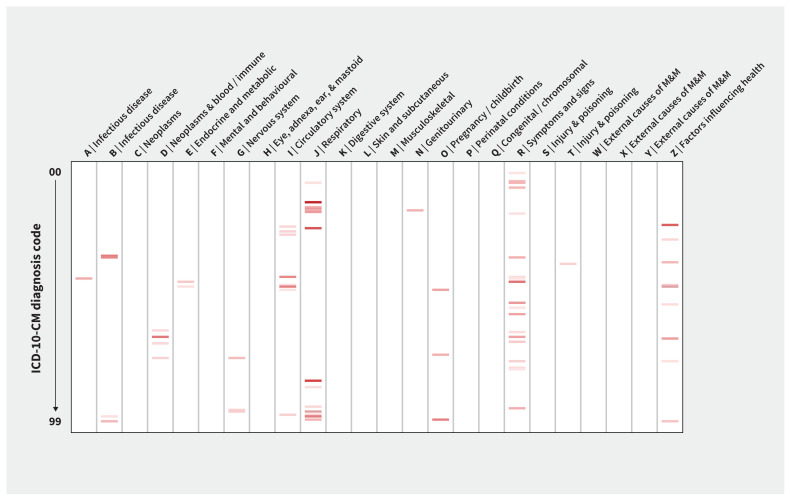
Figure 1:
Figure 1:
Heat map of candidate coronavirus disease 2019 (COVID-19) complications, by International Classification of Diseases, 10th Revision, Clinical Modification (ICD-10-CM) chapter. Odds ratios for association with COVID-19 are shown. Bands show ICD-10-CM diagnosis codes (aggregated at the code header) that were significantly associated with COVID-19 at a Bonferroni-corrected level of significance and for which the odds ratio was > 1. Darker colours show higher odds ratios. Codes highlighted here are described in Figure 2. Note: M&M = morbidity and mortality.
Figure 2:
Figure 2:
Diagnosis codes identified as candidate complications related to coronavirus disease 2019 (COVID-19) for all patients. Baseline prevalences (“Prev.”), overall risks (“Risk”), and odds ratios (ORs) with 95% confidence intervals (CIs) of association with COVID-19 are shown for International Classification of Diseases, 10th Revision, Clinical Modification (ICD-10-CM) diagnosis codes, aggregated at the code header level. Baseline prevalence is the proportion of patients with the condition in the baseline period, among all patients. Overall risk is the proportion of patients with the condition after acquiring COVID-19, among patients who did not previously have the condition. Only significantly associated codes with OR > 1 are listed. The significance threshold for this analysis was 0.05/(total number of codes analyzed) = 0.05/1724 = 2.90E-05. Complete data are provided in Appendix 1, eTable 2 (available at www.cmaj.ca/lookup/doi/10.1503/cmaj.201686/tab-related-content). Calculations are described in Appendix 1, eFigure 3. The X-axis shows ORs represented on a log scale. Darker shading shows higher values. Note: CE = as the cause of diseases classified elsewhere, NEC = not elsewhere classified, s/s = symptoms/signs.
Figure 3:
Figure 3:
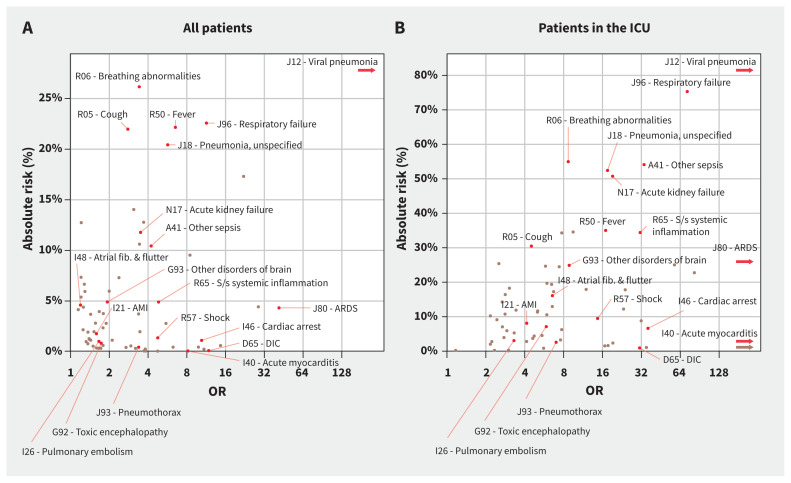
Risks and odds ratios (ORs) of identified complications of coronavirus disease 2019 (COVID-19). Candidate COVID-19 complications identified in the primary analysis are plotted here. The X-axis shows ORs on a log scale, representing the strength of association between COVID-19 and the indicated complication. The Y-axis shows overall risk for the complication (i.e., how common the condition is after acquiring COVID-19, among patients who previously did not have the condition). Odds ratios and risk estimates were calculated in the respective populations (either [A] all patients or [B] patients in the intensive care unit [ICU]). Arrowheads show International Classification of Diseases, 10th Revision, Clinical Modification (ICD-10-CM) diagnosis codes with ORs that are higher than the scale limit. Because of space constraints, only a selection of complications representing different ranges of ORs and risks are highlighted; full data are provided in Figure 2. Note: AMI = acute myocardial infarction, ARDS = acute respiratory distress syndrome, DIC = disseminated intravascular coagulation, fib = fibrillation, NEC = not elsewhere classified, s/s = signs and symptoms.
Figure 4:
Figure 4:
Risk estimates of the most common complications of coronavirus disease 2019 (COVID-19), by age and hospital admission status. Some of these conditions are composites of more than 1 International Classification of Diseases, 10th Revision, Clinical Modification (ICD-10-CM) header code. Pneumonia: defined as J12 (viral pneumonia, not elsewhere classified) or J18 (pneumonia, unspecified organism). Respiratory failure or acute respiratory distress syndrome (ARDS): defined as J96 (respiratory failure, not elsewhere classified) or J80 (acute respiratory distress syndrome). Acute kidney failure: defined as N17 (acute kidney failure). Systemic inflammatory response syndrome (SIRS), sepsis or septic shock: defined as A41 (other sepsis) or R65 (symptoms and signs specifically associated with systemic inflammation and infection). Complete data for these findings are provided in Appendix 1, eTable 6 (available at www.cmaj.ca/lookup/doi/10.1503/cmaj.201686/tab-related-content).

References

    1. WHO coronavirus disease (COVID-19) dashboard. Geneva: World Health Organization; 2020. Available: https://covid19.who.int/ (accessed 2020 Nov. 20).
    1. Huang C, Wang Y, Xingwang L, et al. Clinical features of patients infected with 2019 novel coronavirus in Wuhan, China. Lancet 2020;395:497–506. - PMC - PubMed
    1. Interim clinical guidance for management of patients with confirmed coronavirus disease (COVID-19). Atlanta: Centers for Disease Control and Prevention; 2020. Available: www.cdc.gov/coronavirus/2019-ncov/hcp/clinical-guidance-management-patie... (accessed 2020 July 1).
    1. Varga Z, Flammer AJ, Steiger P, et al. Endothelial cell infection and endotheliitis in COVID-19. Lancet 2020;395:1417–8. - PMC - PubMed
    1. Klok FA, Kruip MJHA, van der Meer NJM, et al. Incidence of thrombotic complications in critically ill ICU patients with COVID-19. Thromb Res 2020;191:145–7. - PMC - PubMed

Publication types