. 2020 Dec 8;10(1):21453.
doi: 10.1038/s41598-020-78222-4.

Exploration of a novel virtual environment improves memory consolidation in ADHD

Affiliations

Exploration of a novel virtual environment improves memory consolidation in ADHD

Valentin Baumann et al. Sci Rep. .

Abstract

Experimental evidence in rodents and humans suggests that long-term memory consolidation can be enhanced by the exploration of a novel environment presented during a vulnerable early phase of consolidation. This memory enhancing effect (behavioral tagging) is caused by dopaminergic and noradrenergic neuromodulation of hippocampal plasticity processes. In translation from animal to human research, we investigated whether behavioral tagging with novelty can be used to tackle memory problems observed in children and adolescents with attention-deficit/hyperactivity disorder (ADHD). 34 patients with ADHD and 34 typically developing participants (age 9-15 years) explored either a previously familiarized or a novel virtual environment 45 min after they had learned a list of 20 words. Participants took a free recall test both immediately after learning the word list and after 24 h. Patients who explored a familiar environment showed significantly impaired memory consolidation compared to typically developing peers. Exploration of a novel environment led to significantly better memory consolidation in children and adolescents with ADHD. However, we did not observe a beneficial effect of novel environment exploration in typically developing participants. Our data rather suggested that increased exploration of a novel environment as well as higher feelings of virtual immersion compromised memory performance in typically developing children and adolescents, which was not the case for patients with ADHD. We propose that behavioral tagging with novel virtual environments is a promising candidate to overcome ADHD related memory problems. Moreover, the discrepancy between children and adolescents with and without ADHD suggests that behavioral tagging might only be able to improve memory consolidation for weakly encoded information.


Conflict of interest statement

The authors declare no competing interests.

Figures
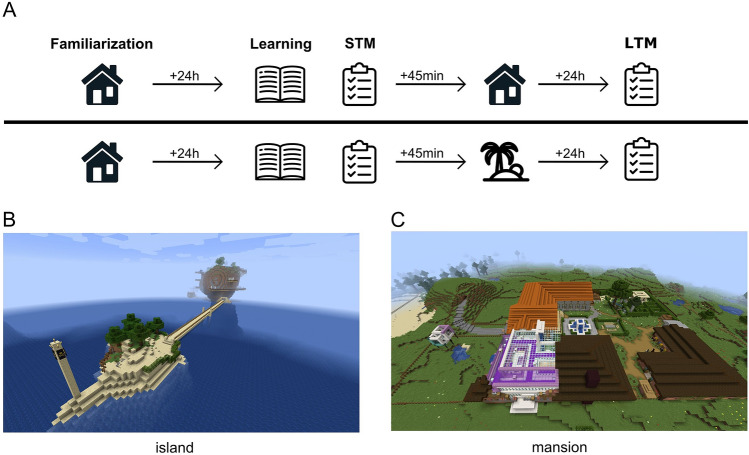
Figure 1
Figure 1
Overview over the experimental design (A) and the virtual environments presented in the experiment (B and C). On day 1, participants were familiarized with one of the two environments (familiarization). On day 2, participants at first learned a list of 20 words (learning) and had to immediately recall the words (STM). 45 min later, they explored either the already familiar environment (upper row) or a novel environment (lower row). On day 3, free recall was tested again (LTM). Note that in the design example above the “mansion” environment was familiarized, while we counterbalanced the order in which environments where presented in the experiment. The Minecraft save game data to recreate the environments is available at https://github.com/valentinbaumann/minecraft_adhd. STM = short term memory, LTM = long term memory.
Figure 2
Figure 2
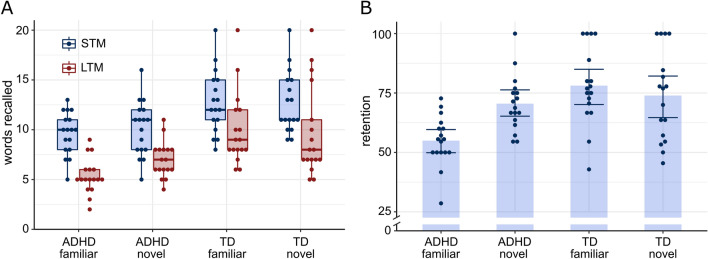
STM and LTM free recall scores with boxplots (A) and retention scores with means and 95% confidence intervals (B). Retention represents the percentage of words retained from STM to LTM (retention = LTM/STM * 100). Across a delay of 24 h, children and adolescents with ADHD retained a higher percentage of words if they explored a novel compared to a familiar environment (indicating improved memory consolidation). This effect was not observed for typically developing children and adolescents. Dots represent single participants, STM = short term memory, LTM = long term memory, TD = typically developing.
Figure 3
Figure 3
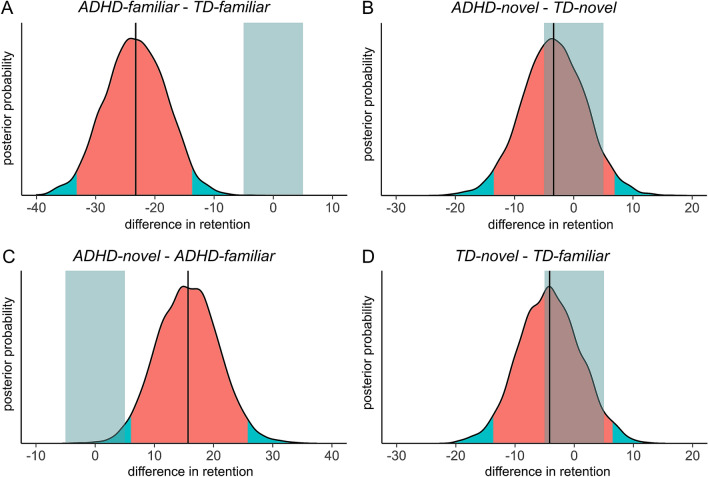
Posterior distributions of the differences in retention score between groups. The red area shows the 95% highest density interval (HDI), the light blue stripe represents the region of practical interest (ROPE) of [− 5, 5] and the black line indicates the mean of the posterior distribution. An effect can be considered to be significantly different from zero if more than 95% of the posterior distribution lie outside the HDI. Patients with ADHD initially showed a significant disadvantage in memory consolidation compared to typically developing children (A), but exploration of a novel environment alleviated this disadvantage (B). Direct comparison of the two patient groups indicated that patients who explored a novel environment retained a significantly higher percentage of words than patients who explored a familiar environment (C). We could not observe a significant memory benefit of novel environment exploration for typically developing children and adolescents. (D). Retention represents the percentage of words retained from STM to LTM (retention = LTM/STM * 100). TD = typically developing, STM = short-term memory, LTM = long-term memory.
Figure 4
Figure 4
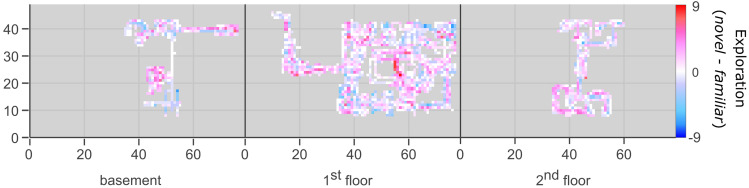
On day 2, participants explored more space in novel than in familiar environments (collapsed across diagnosis). The scale represents the difference in number of participants who visited a tile, with red tiles visited more often in the novel condition and blue tiles in the familiar condition. The first floor also included the starting area (left hand side) as well as a garden and stables (right hand side). Note that since the visualization only shows the “mansion” environment, it is based on only one half of the sample.
Figure 5
Figure 5
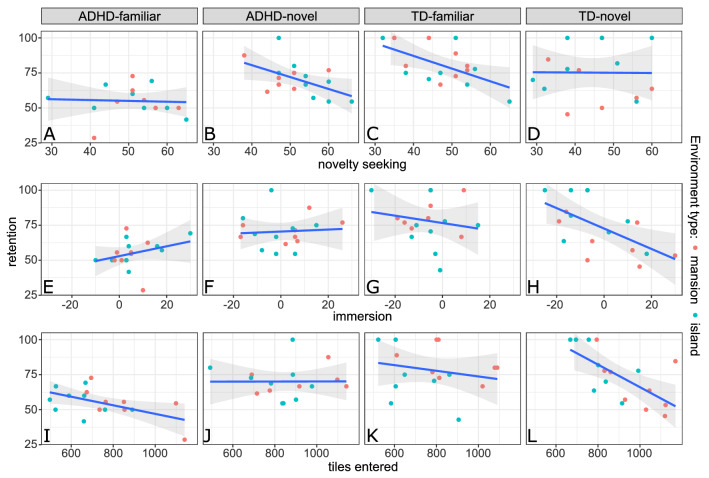
(AD) Influence of novelty seeking on memory retention (exploratory excitability ratings, T-values), (EH) influence of immersion (immersion ratings, raw scores) and (IL) influence of exploration (number of tiles entered). In the TD-novel group, higher levels of exploration and immersion were associated with worse memory retention (D, H). Additionally, our data strongly suggested that this association was not present in the ADHD-novel group (F, J), indicating that the influence of exploration and immersion on memory retention might be different between children with and without ADHD. Note that here exploration, immersion and novelty seeking are shown on their original scales, while we z-transformed all three variables for the analyses reported in the text. Grey shaded areas indicate 95% confidence intervals, dots represent single participants. TD = typically developing, retention = LTM/STM * 100.

References

    1. Sayal K, Prasad V, Daley D, Ford T, Coghill D. ADHD in children and young people: prevalence, care pathways, and service provision. Lancet Psychiatry. 2018;5:175–186. doi: 10.1016/S2215-0366(17)30167-0. - DOI - PubMed
    1. American Psychiatric Association. Diagnostic and Statistical Manual of Mental Disorders 5th ed (2013).
    1. Martinussen R, Hayden J, Hogg-Johnson S, Tannock R. A meta-analysis of working memory impairments in children with attention-deficit/hyperactivity disorder. J. Am. Acad. Child Adolesc. Psychiatry. 2005;44:377–384. doi: 10.1097/01.chi.0000153228.72591.73. - DOI - PubMed
    1. Crocker N, Vaurio L, Riley EP, Mattson SN. Comparison of verbal learning and memory in children with heavy prenatal alcohol exposure or attention-deficit/hyperactivity disorder. Alcohol. Clin. Exp. Res. 2011;35:1114–1121. doi: 10.1111/j.1530-0277.2011.01444.x. - DOI - PMC - PubMed
    1. Udal AH, Øygarden B, Egeland J, Malt UF, Groholt B. Memory in early onset bipolar disorder and attention-deficit/hyperactivity disorder: similarities and differences. J. Abnorm. Child Psychol. 2012;40:1179–1192. doi: 10.1007/s10802-012-9631-x. - DOI - PubMed

Publication types