


GliMR: Cross-Border Collaborations to Promote Advanced MRI Biomarkers for Glioma
- PMID: 33293909
- PMCID: PMC7712600
- DOI: 10.1007/s40846-020-00582-z
GliMR: Cross-Border Collaborations to Promote Advanced MRI Biomarkers for Glioma
Abstract
Purpose: There is an annual incidence of 50,000 glioma cases in Europe. The optimal treatment strategy is highly personalised, depending on tumour type, grade, spatial localization, and the degree of tissue infiltration. In research settings, advanced magnetic resonance imaging (MRI) has shown great promise as a tool to inform personalised treatment decisions. However, the use of advanced MRI in clinical practice remains scarce due to the downstream effects of siloed glioma imaging research with limited representation of MRI specialists in established consortia; and the associated lack of available tools and expertise in clinical settings. These shortcomings delay the translation of scientific breakthroughs into novel treatment strategy. As a response we have developed the network "Glioma MR Imaging 2.0" (GliMR) which we present in this article.
Methods: GliMR aims to build a pan-European and multidisciplinary network of experts and accelerate the use of advanced MRI in glioma beyond the current "state-of-the-art" in glioma imaging. The Action Glioma MR Imaging 2.0 (GliMR) was granted funding by the European Cooperation in Science and Technology (COST) in June 2019.
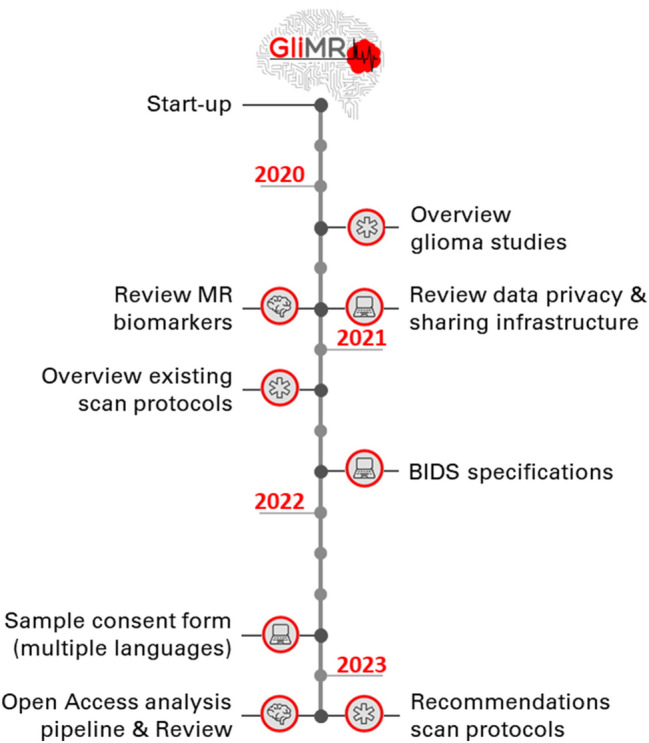
Results: GliMR's first grant period ran from September 2019 to April 2020, during which several meetings were held and projects were initiated, such as reviewing the current knowledge on advanced MRI; developing a General Data Protection Regulation (GDPR) compliant consent form; and setting up the website.
Conclusion: The Action overcomes the pre-existing limitations of glioma research and is funded until September 2023. New members will be accepted during its entire duration.
Keywords: Advanced MRI; COST action; Glioma; Multi-disciplinary; Networking; Translational research.
© The Author(s) 2020.
Conflict of interest statement
Conflict of interestMarion Smits is ‘speaker honoraria’ from GE Healthcare, for which honoraria are paid to the author’s institution. Vera C. Keil is an invited paid lecturer for Philips healthcare in Germany and Switzerland.
Figures
References
-
- ECIS—European Cancer Information System. (2018). Estimates of cancer incidence and mortality in 2018. Retrieved June 19, 2020, from https://ecis.jrc.ec.europa.eu/explorer.php?$0-0$1-All$2-All$4-1,2$3-44$6....
-
- Olar A, Wani KM, Alfaro-Munoz KD, Heathcock LE, van Thuijl HF, Gilbert MR, Armstrong TS, Sulman EP, Cahill DP, Vera-Bolanos E, Yuan Y, Reijneveld JC, Ylstra B, Wesseling P, Aldape KD. IDH mutation status and role of WHO grade and mitotic index in overall survival in grade II-III diffuse gliomas. Acta Neuropathologica. 2015;129(4):585–596. - PMC - PubMed
-
- Pashayan N, Pharoah PDP. The challenge of early detection in cancer. Science. 2020;368(6491):589–590. - PubMed
-
- Louis DN, Perry A, Reifenberger G, von Deimling A, Figarella-Branger D, Cavenee WK, Ohgaki H, Wiestler OD, Kleihues P, Ellison DW. The 2016 World Health Organization classification of tumors of the Central Nervous System: A summary. Acta Neuropathologica. 2016;131(6):803–820. - PubMed
-
- Eurostat—Statistics. (2019). Use of imaging equipment—number of magnetic resonance imaging (MRI) scans, 2017. Retrieved June 19, 2020, from https://ec.europa.eu/eurostat/statistics-explained/index.php?title=Healt....
Publication types
LinkOut - more resources
Full Text Sources
Research Materials
Miscellaneous