


Endoscopic radiofrequency facet joint treatment in patients with low back pain: technique and long-term results. A prospective cohort study
- PMID: 33294037
- PMCID: PMC7708704
- DOI: 10.1177/1759720X20958979
Endoscopic radiofrequency facet joint treatment in patients with low back pain: technique and long-term results. A prospective cohort study
Abstract
Aims: The aim of the study was to evaluate the efficacy of endoscopic rhizotomy (ER) for denervation of lumbar facet joints in patients with chronic low back pain (LBP) due to facet joint syndrome (FJS).
Methods: A total of 50 consecutive patients suffering from chronic LBP due to facet joints were screened to be treated with ER. The patients participating in the study had a 2-year follow up. Numeric Rating Scale (NRS) and Oswestry Disability Index (ODI) were assessed in the preoperative and postoperative period. To evaluate secondary endpoints, patients were divided into groups. One group included the patients previously treated with percutaneous radiofrequency (RF). The other group comprised patients at their first interventional treatment. We also compared patients dividing them by age and by number of joints treated, trying to elucidate if these parameters could be predictive of effectiveness of the procedure.
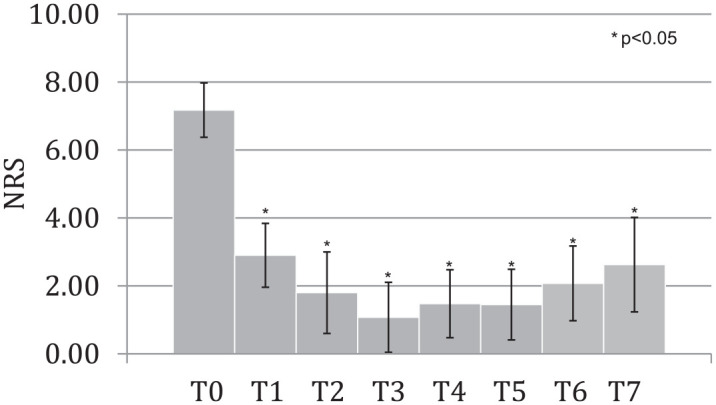
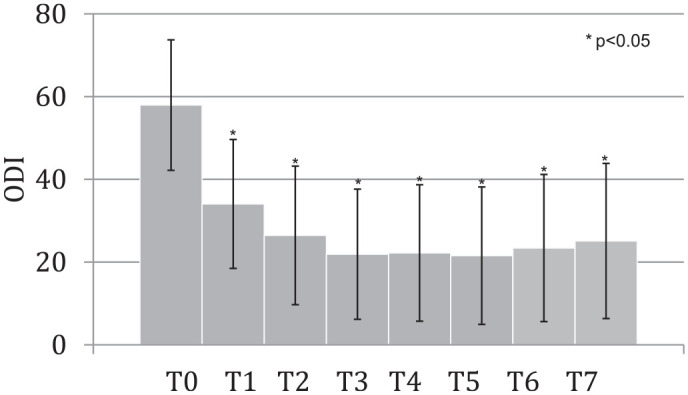
Results: All patients had a reduction in NRS and an improvement in ODI. NRS was reduced significantly after 1 month and remained the same until the end of the study. ODI was significantly improved from T1 (1 month after surgery) up to T7 (end of the study). The improvements did not differ whether already treated with percutaneous rhizotomy or not. Patients less than 60 years or with 1-2 joints treated had better improvement compared with the others.
Conclusion: The results obtained demonstrate that ER for denervation of the facet joint is an effective treatment in patients with chronic LBP, with consistent and stable results at 2-year follow up. The technique has a rapid learning curve and no major complications occurred. Moreover, the previous percutaneous RF treatment had no influence on the results obtained with endoscopic technique. There is evidence that best results are obtained in younger patients and/or in patients with 1-2 joints treated.
Lay summary: Low-back pain has facet joints inflammation or degeneration as pain generator in 20-40% of cases. Nervous lesion of the dorsal ramus innervating the facet joints has been shown as an efficacious treatment to obtain good analgesia. Percutaneous techniques have provided short term results for several reasons. This research aimed to see whether endoscopic denervation, which guarantees a more precise approach to anatomical structure, would result in more durable results. The study conducted on 40 patients has made it clear that this approach gives significant analgesia for at least 2 years, which was the time of patient follow up.
Keywords: endoscopic radiofrequency; facet joint syndrome; low back pain; medial branch radiofrequency; radiofrequency neurolesion.
© The Author(s), 2020.
Conflict of interest statement
Conflict of interest statement: GV is member of the Editorial Board of this journal. The other authors declare that they do not have any conflict of interest.
Figures
References
-
- Juniper M, Le TK, Mladsi D. The epidemiology, economic burden, and pharmacological treatment of chronic low back pain in France, Germany, Italy, Spain and the UK: a literature-based review. Expert Opin Pharmacother 2009; 10: 2581–2592. - PubMed
-
- Langley P, Müller-Schwefe G, Nicolaou A, et al. The societal impact of pain in the European Union: health-related quality of life and healthcare resource utilization. J Med Econ 2010; 13: 571–581. - PubMed
-
- Langley P, Müller-Schwefe G, Nicolaou A, et al. The impact of pain on labor force participation, absenteeism and presenteeism in the European Union. J Med Econ 2010; 13: 662–672. - PubMed
-
- Fusco M, Skaper SD, Coaccioli S, et al. Degenerative joint diseases and neuroinflammation. Pain Pract 2017; 17: 522–532. - PubMed
LinkOut - more resources
Full Text Sources
Miscellaneous
