


Conventional disease-modifying antirheumatic drugs therapy may not slow spinal radiographic progression in ankylosing spondylitis: results from an 18-year longitudinal dataset
- PMID: 33294039
- PMCID: PMC7705797
- DOI: 10.1177/1759720X20975912
Conventional disease-modifying antirheumatic drugs therapy may not slow spinal radiographic progression in ankylosing spondylitis: results from an 18-year longitudinal dataset
Abstract
Objectives: The clinical benefit of conventional disease-modifying antirheumatic drugs (cDMARDs) for treating ankylosing spondylitis (AS) is generally limited to improvements in peripheral arthritis. However, cDMARDs could be conditionally considered as alternatives to established drugs for improving axial manifestations in exceptional circumstances. However, there are few studies of the impact of cDMARDs on radiographic progression outcomes. Therefore, we investigated the effectiveness of cDMARDs on radiographic progression in AS.
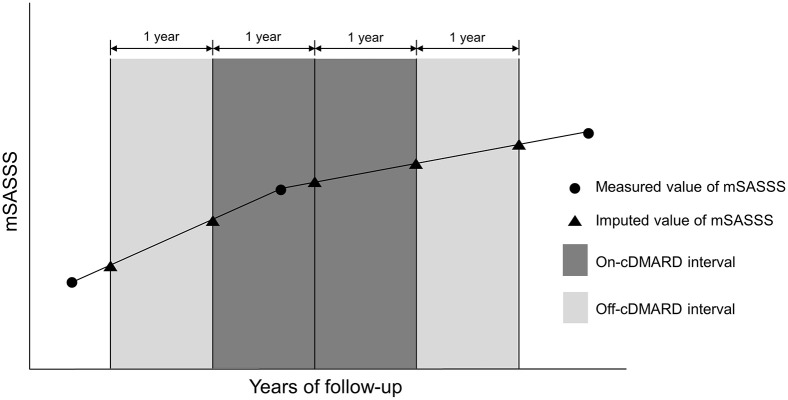
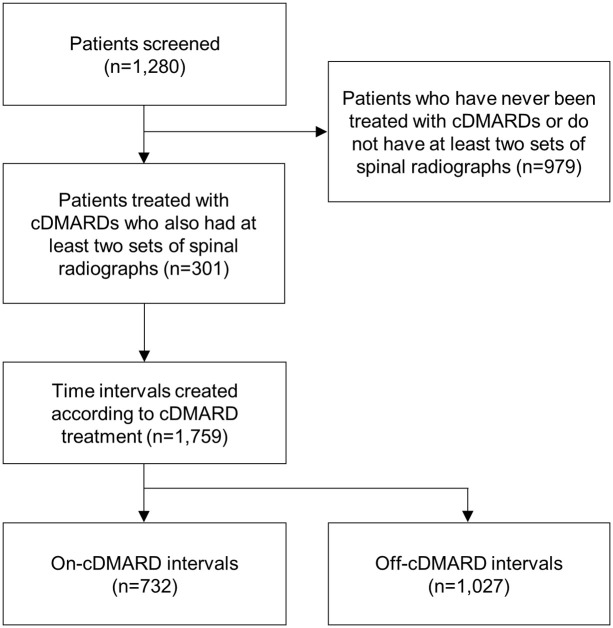
Methods: Among 1280 AS patients at a single hospital from 2000 to 2018, 301 who had been treated with sulfasalazine (SSZ) or methotrexate (MTX) were enrolled. For each patient, the entire follow-up period was split into 1-year intervals. Each interval was classified as either an "on-cDMARD" interval, which was a period of treatment with SSZ alone, MTX alone, or a combination of SSZ and MTX, or an "off-cDMARD" interval, which was a period without cDMARD treatment. Radiographic progression was scored using the modified Stoke Ankylosing Spondylitis Spinal Score (mSASSS). The relationship between cDMARD use and radiographic progression within the intervals, defined as the rate of mSASSS progression, was investigated using linear models with adjustment for potential confounding covariates and for clustering among observations from the same patient.
Results: The 732 on-cDMARD intervals and 1027 off-cDMARD intervals were obtained from enrolled patients. In multivariable regression analysis, there was no significant association between cDMARDs and the rate of mSASSS progression (β = -0.081, p = 0.418). The mean adjusted mSASSS change per year was 0.610 from on-cDMARD intervals and 0.691 from off-cDMARD intervals.
Conclusion: Treatment with cDMARDs may not reduce radiographic progression in AS patients.
Keywords: ankylosing spondylitis; disease-modifying antirheumatic drugs; methotrexate; radiographic progression; sulfasalazine.
© The Author(s), 2020.
Conflict of interest statement
Conflict of interest statement: The authors declare that there is no conflict of interest.
Figures
References
-
- van der Heijde D, Ramiro S, Landewé R, et al. 2016 update of the ASAS-EULAR management recommendations for axial spondyloarthritis. Ann Rheum Dis 2017; 76: 978–991. - PubMed
-
- Ward MM, Deodhar A, Gensler LS, et al. 2019 update of the American College of Rheumatology/Spondylitis Association of America/Spondyloarthritis Research and Treatment Network recommendations for the treatment of ankylosing spondylitis and nonradiographic axial spondyloarthritis. Arthritis Rheumatol 2019; 71: 1599–1613. - PMC - PubMed
-
- Tam LS, Wei JC, Aggarwal A, et al. 2018. APLAR axial spondyloarthritis treatment recommendations. Int J Rheum Dis 2019; 22: 340–356. - PubMed
-
- Nissilä M, Lehtinen K, Leirisalo-Repo M, et al. Sulfasalazine in the treatment of ankylosing spondylitis: a twenty-six–week, placebo-controlled clinical trial. Arthritis Rheum 1988; 31: 1111–1116. - PubMed
LinkOut - more resources
Full Text Sources
Research Materials
