


Atypical presentation of Arts syndrome due to a novel hemizygous loss-of-function variant in the PRPS1 gene
- PMID: 33294372
- PMCID: PMC7689168
- DOI: 10.1016/j.ymgmr.2020.100677
Atypical presentation of Arts syndrome due to a novel hemizygous loss-of-function variant in the PRPS1 gene
Abstract
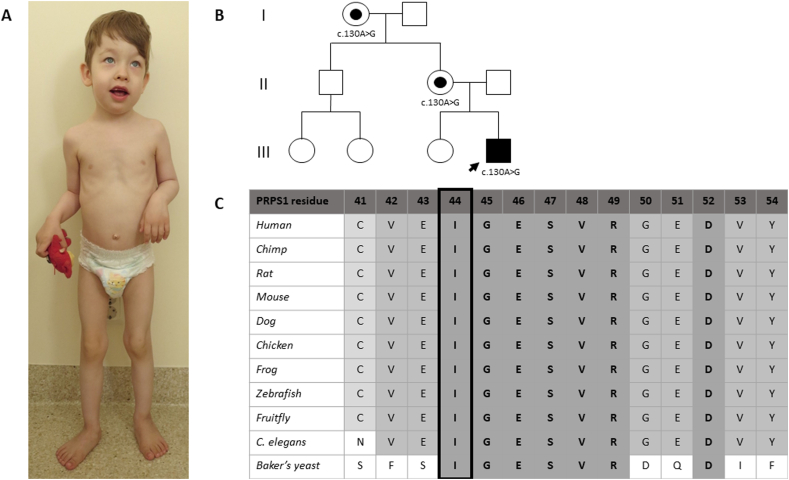
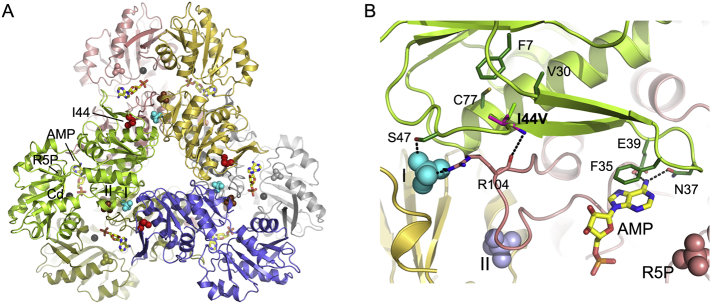
The PRPS1 gene, located on Xq22.3, encodes phosphoribosyl-pyrophosphate synthetase (PRPS), a key enzyme in de novo purine synthesis. Three clinical phenotypes are associated with loss-of-function PRPS1 variants and decreased PRPS activity: Arts syndrome (OMIM: 301835), Charcot-Marie-Tooth disease type 5 (CMTX5, OMIM: 311070), and nonsyndromic X-linked deafness (DFN2, OMIM: 304500). Hearing loss is present in all cases. CMTX5 patients also show peripheral neuropathy and optic atrophy. Arts syndrome includes developmental delay, intellectual disability, ataxia, and susceptibility to infections, in addition to the above three features. Gain-of-function PRPS1 variants result in PRPS superactivity (OMIM: 300661) with hyperuricemia and gout. We report a 6-year-old boy who presented with marked generalized muscular hypotonia, global developmental delay, lack of speech, trunk instability, exercise intolerance, hypomimic face with open mouth, oropharyngeal dysphagia, dysarthria, and frequent upper respiratory tract infections. However, his nerve conduction velocity, audiologic, and funduscopic investigations were normal. A novel hemizygous variant, c.130A > G p.(Ile44Val), was found in the PRPS1 gene by panel sequencing. PRPS activity in erythrocytes was markedly reduced, confirming the pathogenicity of the variant. Serum uric acid and urinary purine and pyrimidine metabolite levels were normal. In conclusion, we present a novel PRPS1 loss-of-function variant in a patient with some clinical features of Arts syndrome, but lacking a major attribute, hearing loss, which is congenital/early-onset in all other reported Arts syndrome patients. In addition, it is important to acknowledge that normal levels of serum and urinary purine and pyrimidine metabolites do not exclude PRPS1-related disorders.
Keywords: Arts syndrome; Autophagy; PRPS1; Purines.
© 2020 The Authors.
Conflict of interest statement
The authors declare that they have no conflict of interest.
Figures
References
-
- Becker M.A., Heidler S.A., Bell G.I., Seino S., Le Beau M.M., Westbrook C.A., Neuman W., Shapiro L.J., Mohandas T.K., Roessler B.J. Cloning of cDNAs for human phosphoribosylpyrophosphate synthetases 1 and 2 and X chromosome localization of PRPS1 and PRPS2 genes. Genomics. 1990;8:555–561. - PubMed
-
- Balasubramaniam S., Duley J.A., Christodoulou J. Inborn errors of purine metabolism: clinical update and therapies. J. Inherit. Metab. Dis. 2014;37:669–686. - PubMed
-
- Balasubramaniam S., Duley J.A., Christodoulou J. Inborn errors of pyrimidine metabolism: clinical update and therapy. J. Inherit. Metab. Dis. 2014;37:687–698. - PubMed
-
- Roche Diagnostics Cobas Uric Acid Ver.2 2017-07, V 11.0 English. 2020.
-
- Hartmann S., Okun J.G., Schmidt C., Langhans C.D., Garbade S.F., Burgard P., Haas D., Sass J.O., Nyhan W.L., Hoffmann G.F. Comprehensive detection of disorders of purine and pyrimidine metabolism by HPLC with electrospray ionization tandem mass spectrometry. Clin. Chem. 2006;52:1127–1137. - PubMed
Publication types
LinkOut - more resources
Full Text Sources
