. 2020 Nov 17:2020:4193541.
doi: 10.1155/2020/4193541. eCollection 2020.

Full-Length TrkB Variant in NSCLC Is Associated with Brain Metastasis

Affiliations

Full-Length TrkB Variant in NSCLC Is Associated with Brain Metastasis

Mariangela Lombardi et al. Biomed Res Int. .

Abstract

Despite remarkable therapeutic advances have been made in the last few decades, non-small cell lung cancer (NSCLC) is still one of the leading causes of death worldwide. Brain metastases are a common complication of a wide range of human malignancies and in particular NSCLC. Brain-derived neurotrophic factor (BDNF), binding its high-affinity tyrosine kinase B receptor, has been shown to promote cancer progression and metastasis. We hereby investigated the expression of the BDNF and its TrkB receptor in its full-length and truncated isoform T1, in samples from primary adenocarcinomas (ADKs) of the lung and in their metastasis to evaluate if their expression was related to preferential tumor entry into the central nervous system (CNS). By immunohistochemistry, 80% of the ADKs that metastasize to central nervous system expressed TrkB receptor compared to 33% expressing of ADKs without CNS metastasis. Moreover, ADKs with CNS metastasis showed an elevated expression of the full-length TrkB receptor. The TrkB receptor FL/T1 ratio was statistically higher in primary ADKs with brain metastasis compared to ADKs without brain metastasis. Our data indicate that TrkB full-length isoform expression in primary ADK cells may be associated with higher risk to develop brain metastasis. Therefore, TrkB receptor may possess prognostic and therapeutic implications in lung ADK.


Conflict of interest statement

The author declares that there is no conflict of interest that could be perceived as prejudicing the impartiality of the research reported.

Figures
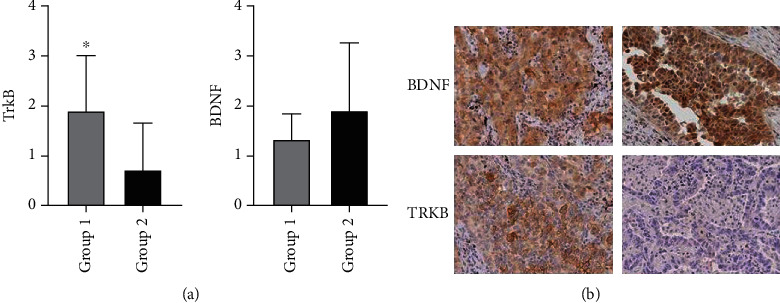
Figure 1
Figure 1
Immunohistochemical detection of TrkB and BDNF protein expression in sections of primitive ADKs of the lung with (Group 1) or without (Group 2) brain metastasis. The histograms summarize the results obtained. A statistically significant increase of TrkB protein expression was observed in samples from primitive ADK in Group 1 compared with Group 2. The BDNF protein expression was higher in Group 2 in comparison with Group 1. Notice the anatomical localization of BDNF and TrkB protein expression in ADK cell. BDNF antibodies generated a prevalent nuclear dark brown immunoreaction. The TrkB antibody generated a cytoplasmic and cell membrane immunoreaction. A clear and specific TrkB and BDNF immunostaining was documented in ADKs cells in both primitive and brain metastasis in Group 1. Contrarily, in Group 2, a strong and specific BDNF immunostaining was documented in brain metastasis, but not for TrkB. The data are the mean + SD of different experiments performed in triplicate. ×20 ∗p < 0.0177.
Figure 2
Figure 2
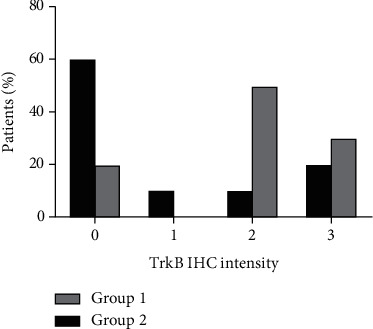
Distribution among the groups of TrkB intensity immunostaining (0: expression < 5%; 1: low intensity; 2: moderate intensity; and 3: high intensity) detected in sections of primitive ADKs of the lung with (Group 1) and without (Group 2) brain metastasis. The results are the mean of three independent expert pathologist evaluation. ×20.
Figure 3
Figure 3
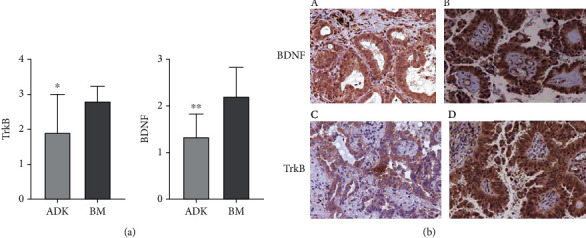
Immunohistochemical detection of TrkB and BDNF protein expression in section samples obtained by Group 1 (ADK with brain metastasis). (a) The histograms summarize the results obtained. A statistical significant increase of TrkB and BDNF protein expression was observed in samples from metastasis compared with relative primitive ADKs. (b) Notice the anatomical localization of BDNF and TrkB protein expression in ADK cells. A strong specific immunostaining was clearly documented in both primitive ADKs and brain metastasis (a–d). The data are the mean ± SD of different experiments performed in triplicate. ADK, primitive ADKs; BM, corresponding brain metastasis. ∗p < 0.02; ∗∗p < 0.004.
Figure 4
Figure 4
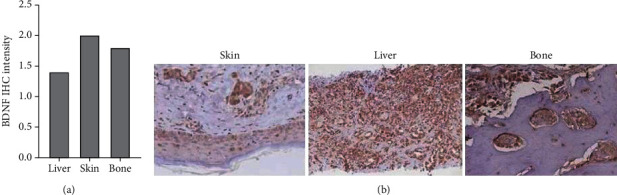
Immunohistochemical detection of BDNF protein expression in section of metastasis from the skin, liver, and bone. The BDNF immunostaining was strongly expressed in the different metastatic sites studied (a, b). Note the specific clear immunostaining within cancer cells in metastatic cancer cells. ×20.
Figure 5
Figure 5
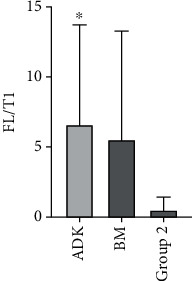
qRT-PCR. The histogram emphasizes the elevated TrkB FL/T1 ratio in primary ADKs of the lung with brain metastasis. The data are the mean ± SD of different experiments performed in triplicate. ADK, primitive ADKs; BM, corresponding brain metastasis. ∗p < 0.01.
Figure 6
Figure 6
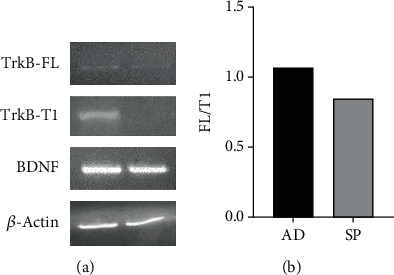
RT-PCR (a) and qRT-PCR (a) to clarify the FL TrkB and TrkB-T1 isoform expression in lung adenocarcinoma cell lines (NCI-H460) grown in adherence (AD) or in spheroid conditions (SP). The total amount of cDNA present in each reaction was normalized by β-actin gene amplification. (a) The RT-PCR display and increased expression of the FL/T1 ratio in spheroid cancer cell. This data was confirmed by qRT-PCR (b). AD, adherent cell lines; SP, spheroid cell lines.

References

    1. Torre L. A., Siegel R. L., Ward E. M., Jemal A. Global cancer incidence and mortality rates and trends--an update. Cancer Epidemiology, Biomarkers & Prevention. 2016;25(1):16–27. doi: 10.1158/1055-9965.EPI-15-0578. - DOI - PubMed
    1. The Cancer Genome Atlas Research Network. Comprehensive molecular profiling of lung adenocarcinoma. Nature. 2014;511(7511):543–550. doi: 10.1038/nature13385. - DOI - PMC - PubMed
    1. Schrank Z., Chhabra G., Lin L., et al. Current molecular-targeted therapies in NSCLC and their mechanism of resistance. Cancers. 2018;10(7) doi: 10.3390/cancers10070224. - DOI - PMC - PubMed
    1. Maione P., Sacco P. C., Casaluce F., et al. Overcoming resistance to EGFR inhibitors in NSCLC. Reviews on Recent Clinical Trials. 2016;11(2):99–105. doi: 10.2174/1574887111666160330120431. - DOI - PubMed
    1. Huang E. J., Reichardt L. F. Neurotrophins: roles in neuronal development and function. Annual Review of Neuroscience. 2001;24(1):677–736. doi: 10.1146/annurev.neuro.24.1.677. - DOI - PMC - PubMed

Substances