


The Challenges of Treating Female Soccer Players With ACL Injuries: Hamstring Versus Bone-Patellar Tendon-Bone Autograft
- PMID: 33294473
- PMCID: PMC7708716
- DOI: 10.1177/2325967120964884
The Challenges of Treating Female Soccer Players With ACL Injuries: Hamstring Versus Bone-Patellar Tendon-Bone Autograft
Abstract
Background: Although anterior cruciate ligament (ACL) injuries are common in female soccer players, the optimal graft option for ACL reconstruction is currently unclear.
Purpose/hypothesis: To compare the outcomes of female soccer players after ACL reconstruction using either hamstring tendon autograft or bone-patellar tendon-bone (BTB) autograft. We hypothesized that there would be no difference in clinical outcome scores, return to sport, or retear rates between BTB and hamstring grafts in our study cohort.
Study design: Case series; Level of evidence, 4.
Methods: We performed a retrospective review of all skeletally mature adolescent female soccer players who underwent primary ACL reconstruction using either hamstring tendon or BTB autograft between 2013 and 2016. Demographic, injury, and surgical variables were documented. Outcome measures included the Lysholm score, Single Assessment Numeric Evaluation, Tegner activity score, and visual analog scales for pain and for satisfaction, as well as ability to return to sport.
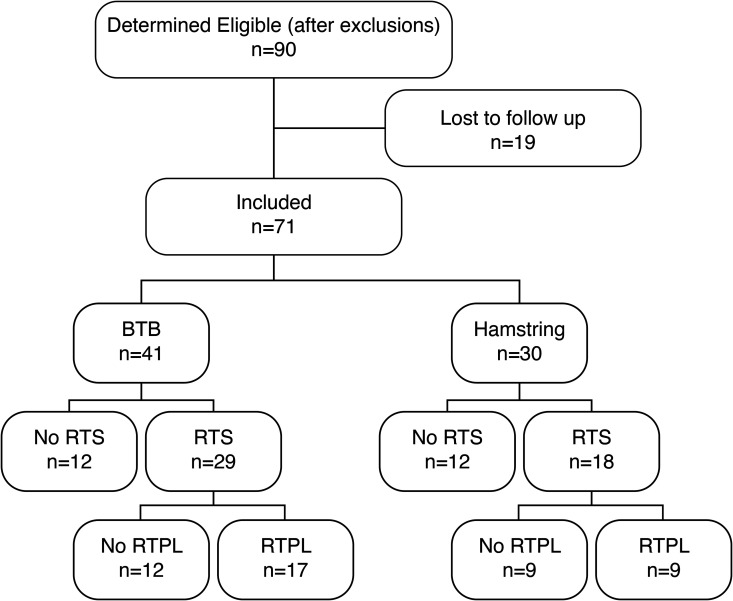
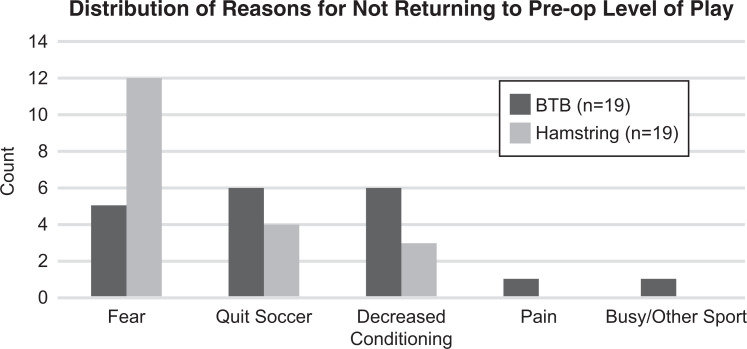
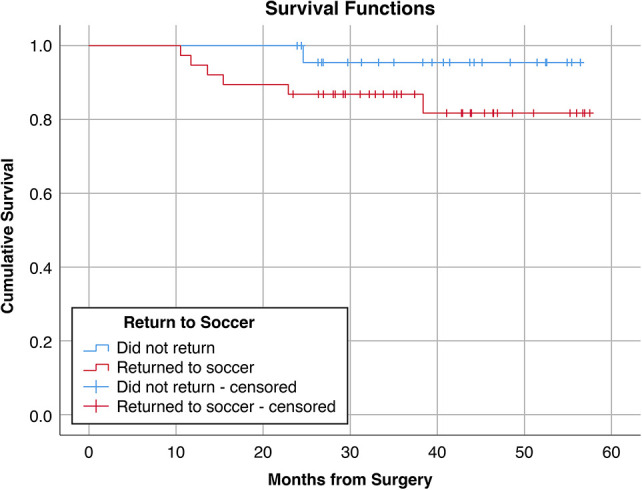
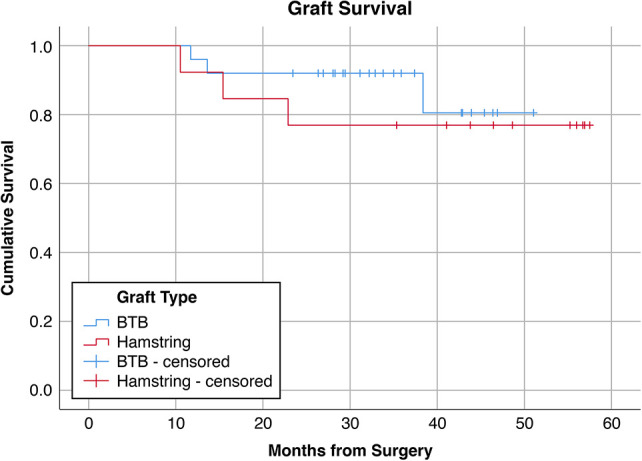
Results: Overall, 90 female soccer players met the inclusion criteria, of whom 79% (41 BTB and 30 hamstring) were available for a minimum 2-year follow-up or had a graft failure before the follow-up. The BTB group had a lower body mass index (mean ± SD, 23 ± 3 vs 25 ± 4; P = .02) and shorter postoperative follow-up time in months (mean ± SD, 37.4 vs 46.1; P ≤ .001); otherwise, no differences in demographic, injury, or surgical variables between groups were noted. Regarding outcome measures, the BTB group achieved a higher Tegner score (6.0 vs 4.2; P = .004), and there was no other difference between groups. Of the patients who did not return to soccer, 44.7% reported fear as the reason. Of the patients who did return to soccer, 31.9% sustained another ACL injury (retear or contralateral tear), with no differences in reinjury rates based on graft selection.
Conclusion: Adolescent female soccer players undergoing ACL reconstruction had relatively high satisfaction and outcome scores independent of autograft choice. Notwithstanding, patients and families need to be counseled that less than half of patients will return to their preinjury level of sport and, if an athlete attempts to return, there is a high risk of further ACL injury.
Keywords: ACL reconstruction; BTB autograft; adolescent; anterior cruciate ligament; female soccer player; hamstring autograft; retear; return to sport.
© The Author(s) 2020.
Conflict of interest statement
One or more of the authors has declared the following potential conflict of interest or source of funding: E.B. has received educational support from SportsTek. E.E. has received research support from DePuy and speaking fees from Arthrex and Ossur. H.C. has received research support from Allergan and consulting fees from OrthoPediatrics and Roche Molecular Systems. A.P. has received educational support from Arthrex and SportsTek, consulting fees from OrthoPediatrics, and speaking fees from Smith & Nephew. AOSSM checks author disclosures against the Open Payments Database (OPD). AOSSM has not conducted an independent investigation on the OPD and disclaims any liability or responsibility relating thereto.
Figures
References
-
- Alguacil JL, Arroyo-Morales M, Martin-Gomez JL, et al. Strength recovery after anterior cruciate ligament reconstruction with quadriceps tendon versus hamstring tendon autografts in soccer players: a randomized controlled trial. Knee. 2018;25(4):704–714. - PubMed
-
- Allen MM, Pareek A, Krych AJ, et al. Are female soccer players at an increased risk of second anterior cruciate ligament injury compared with their athletic peers? Am J Sports Med. 2016;44(10):2492–2498. - PubMed
-
- Ardern CL, Taylor NF, Feller JA, Webster KE. Fifty-five per cent return to competitive sport following anterior cruciate ligament reconstruction surgery: an updated systematic review and meta-analysis including aspects of physical functioning and contextual factors. Br J Sports Med. 2014;48(21):1543–1552. - PubMed
-
- Barrett GR, Luber K, Replogle WH, Manley JL. Allograft anterior cruciate ligament reconstruction in the young, active patient: Tegner activity level and failure rate. Arthroscopy. 2010;26:1593–1601. - PubMed
-
- Borchers JR, Pedroza A, Kaeding C. Activity level and graft type as risk factors for anterior cruciate ligament graft failure: a case-control study. Am J Sports Med. 2009;37:2362–2367. - PubMed
LinkOut - more resources
Full Text Sources
Miscellaneous
